For many children with autism, cerebral palsy, Down syndrome, aphasia, or other speech-related disabilities, communication itself becomes a daily barrier.
A child may understand language internally but still struggle to express needs, emotions, or thoughts verbally. In many cases, this leads to frustration, isolation, behavioural challenges, and difficulty participating in classrooms or social settings.
Avaz was created to address that problem through assistive communication technology.
Originally developed in Chennai and now operating globally through California-headquartered Avaz Inc., the company builds Augmentative and Alternative Communication (AAC) tools for people who cannot rely fully on speech. Its flagship product, Avaz AAC, is a tablet- and smartphone-based communication app that helps users construct sentences using pictures, symbols, text, and speech output.
The company traces its origins to work done between 2005 and 2009 by a small group of inventors associated with the Indian Institute of Technology Madras. According to Avaz’s official history, the team initially experimented with different assistive communication systems while working with special-needs schools in India.
The key founder behind the project was Ajit Narayanan, an inventor and engineer known for his work in visual communication systems and assistive technologies. Narayanan later became widely recognized for both Avaz and another communication framework called FreeSpeech.
Before Avaz became a mobile application, the team first built a dedicated hardware communication device. According to the company, the original tablet-based system was among the first AAC devices developed specifically for the Indian market. The product was named “Avaz,” meaning “voice” in Hindi and Persian-derived usage.
The core idea behind the platform is relatively simple.
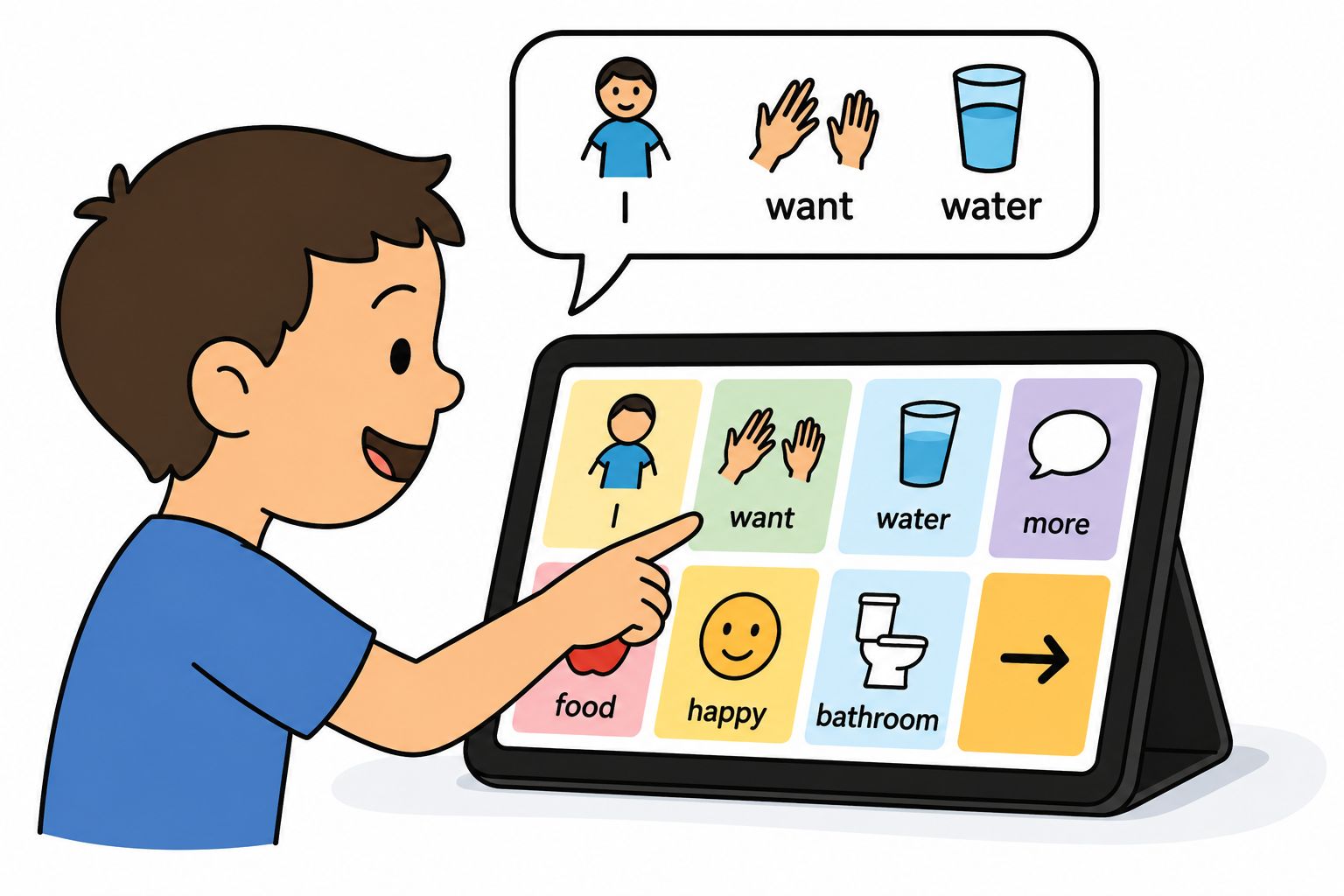
Many non-verbal or minimally verbal individuals can understand images more easily than text or spoken language. Avaz allows users to tap symbols, pictures, or words on a screen to form sentences. The software then converts those selections into spoken output through a speech engine.
For example, a child might tap icons representing “I,” “want,” and “water,” and the app will speak the sentence aloud. Over time, users can build longer sentences, learn grammar structures, and expand vocabulary.
The platform operates as both a communication tool and a language-learning system.
According to company descriptions, Avaz includes graded vocabulary sets with thousands of words organized into categories. These vocabularies are designed using AAC and speech-therapy principles intended to help users gradually progress from simple requests toward fuller conversational language.
The company says the app supports multiple communication levels, ranging from very early-stage communicators to more advanced users. One important aspect of the system is localization.
AAC tools historically evolved mainly in Western countries and often focused heavily on English-language environments. Avaz expanded aggressively into multilingual support. According to company material, the platform supports numerous languages, including Indian and regional languages.
This matters because communication tools become significantly harder to use if children cannot communicate in the language spoken at home or school.
The company has also focused on making AAC more affordable and accessible through mainstream devices instead of specialized hardware.
Traditional AAC devices internationally can cost several thousand dollars. Avaz instead shifted toward app-based deployment on iPads, Android tablets, and smartphones.
The platform is now used in homes, therapy centers, special schools, and inclusive classrooms.
The company’s products are used across countries including India, the United States, Australia, Denmark, and Italy. The company has also increasingly expanded beyond communication alone into broader assistive learning systems.
Its product portfolio now includes Avaz Reader for reading assistance, Communication Adventures for communication-partner training, teletherapy programs, and AAC certification services for educators and speech-language professionals.
One of the company’s more experimental projects has been FreeSpeech. FreeSpeech is a visual language system invented by Ajit Narayanan that attempts to represent not just words, but grammar and sentence structures visually. Narayanan described it as a way of representing complete sentence meaning graphically rather than only replacing words with icons.
The broader market Avaz operates in is known as Augmentative and Alternative Communication.
Globally, AAC includes communication boards, speech-generating devices, eye-tracking systems, symbol-based software, and text-to-speech tools designed for people with speech and communication disabilities.
International players in this space include companies such as Tobii Dynavox and PRC-Saltillo, which develop AAC hardware and software systems for schools, hospitals, and rehabilitation settings.
What differentiates Avaz is its emphasis on multilingual communication, lower-cost mobile deployment, and emerging-market accessibility.
The company also focused early on parents, therapists, and teachers as active communication partners rather than treating AAC only as a standalone device problem.
For now, Avaz remains one of India’s most recognized assistive-technology products in the communication-disability space.
- Our correspondent