Modern aerospace engines, rocket systems, industrial furnaces, and defence equipment operate under extreme conditions.
Materials inside these systems may face temperatures above 1000°C, chemical corrosion, thermal shock, oxidation, and mechanical stress for long periods. Conventional metals and polymers often fail in such environments.
CeraTattva InnoTech, a Chennai-based advanced materials startup, is developing specialized ceramic materials designed for these high-temperature and harsh operating conditions.
The company works on non-oxide ceramics, preceramic polymers, ceramic coatings, ceramic composites, and advanced ceramic manufacturing technologies intended for sectors such as aerospace, defence, energy, and advanced manufacturing.
The startup positions itself as India’s first company focused specifically on “polymer-derived ceramics” or PDC technology.
CeraTattva was founded by Dr. Ganesh Babu T, who earned his PhD from Vikram Sarabhai Space Centre (VSSC), ISRO, where he worked on ceramic materials for high-temperature applications. He later conducted postdoctoral research at IIT Madras and has more than 10 years of experience in advanced ceramic materials.
The company’s co-founders and technical advisors include Dr. Abha Bharti and Dr. Ravi Kumar.
Dr. Abha Bharti specializes in hydrogen fuel cells and electrochemical energy systems. She completed her PhD at VSSC, ISRO and later worked with Capstone Energy in the UK and Capstone Projects in Kenya. Dr. Ravi Kumar is a professor and Head of the Department of Metallurgical and Materials Engineering at IIT Madras. His research focuses on advanced inorganic and non-metallic materials, thermal management systems, and energy-related materials science.
CeraTattva itself emerged from the IIT Madras ecosystem and is incubated at IIT Madras Incubation Cell.
The company’s core technology revolves around polymer-derived ceramics.
Traditional ceramics are usually produced from powders that are molded and heated at very high temperatures. Polymer-derived ceramics work differently. In this process, specially engineered polymers are first created and then converted into ceramic materials through controlled heat treatment.
This approach allows more control over the final ceramic structure and can make it easier to produce coatings, fibers, composites, adhesives, or complex geometries that would be difficult using conventional ceramic manufacturing methods.
CeraTattva develops what it calls “preceramic precursors.” These are specially engineered polymers that transform into ceramics when heated under controlled conditions.
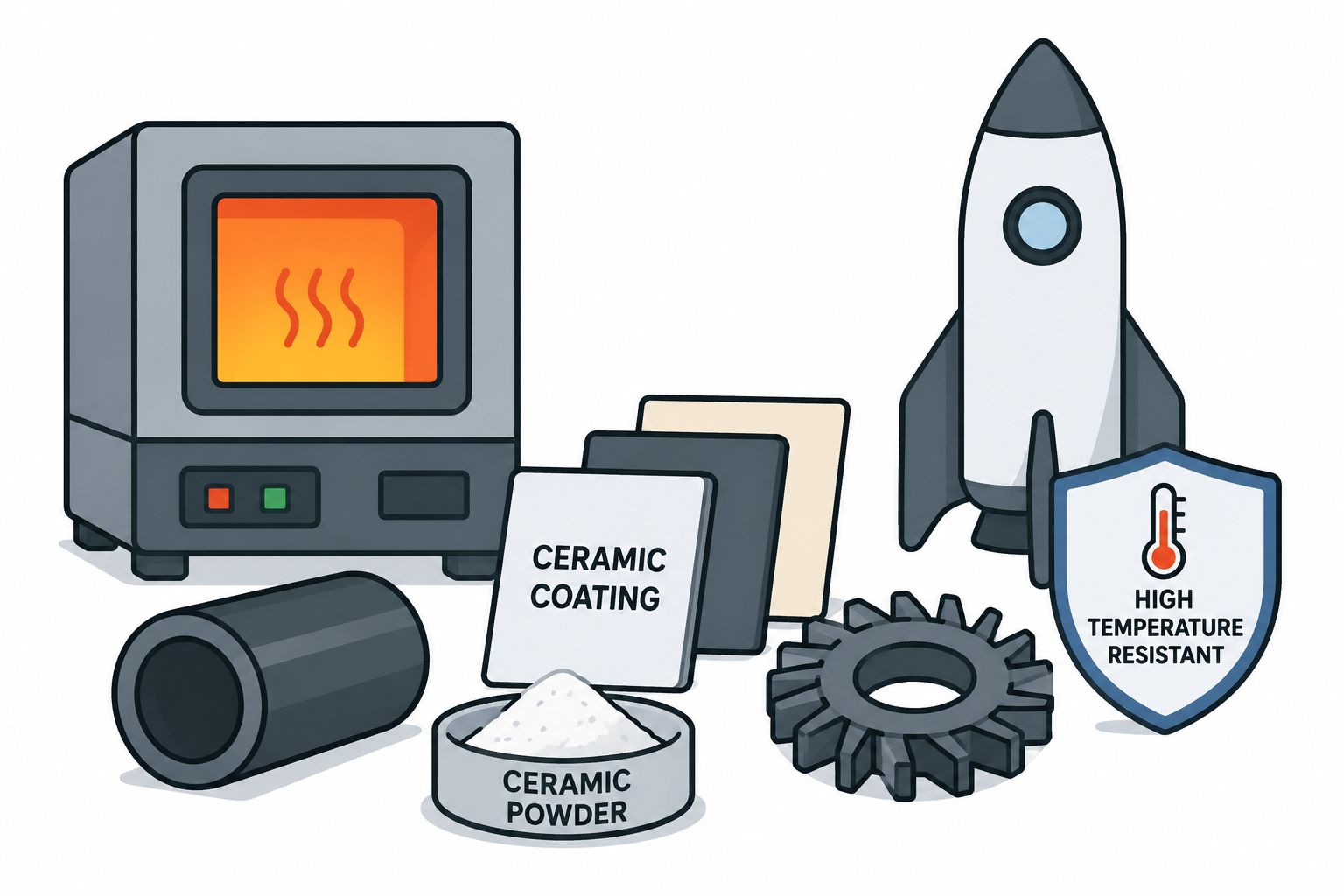
The company says its materials are designed to withstand temperatures from 500°C to 2800°C depending on the application. That temperature range matters because industries such as aerospace and defence require materials that maintain structural integrity under extreme heat. For example, rocket nozzles, thermal protection systems, high-temperature insulation layers, and turbine systems all require advanced materials capable of surviving thermal stress without degrading rapidly.
The company develops several categories of products.
One major area is ceramic coatings. Another area is ceramic adhesives. Unlike conventional industrial adhesives that degrade under heat, ceramic adhesives are intended for bonding systems operating under extreme thermal conditions.
The startup also develops ceramic composites and micro/nano fiber manufacturing systems. These materials can potentially be used in aerospace insulation, thermal barriers, lightweight structural systems, and energy applications.
The company also offers materials modeling services using DFT and CALPHAD methodologies. These are computational material science techniques used to simulate and optimize material properties before physical manufacturing. In practical terms, these modeling systems help researchers predict how materials may behave under different temperature, stress, and chemical conditions.
CeraTattva’s technology is targeted toward sectors where materials are often the limiting factor in system performance.
Its official customer and collaboration list includes organizations such as ISRO, DRDO, IIT Madras, Saint-Gobain, Carborundum Universal (CUMI), and several academic institutions.
In July 2024, CeraTattva announced that it had raised ₹1.31 crore in funding led by Campus Angels Network and Forge Innovation & Ventures.
CeraTattva has additionally won several deep-tech and manufacturing awards. The company lists recognition from Boeing Build 2.0, TANSEED 4.0, IIT Madras KRIA’Tive Awards, and FORT Industrial Innovation and Scaleup Grant. [Company website]
Investor and ecosystem feedback around the company has focused mainly on the strategic importance of advanced materials manufacturing in India.
Globally, advanced ceramics represent an important but highly specialized materials category.
Companies in the US, Japan, Germany, and China have spent decades developing ceramic technologies for aerospace, semiconductors, defence systems, medical devices, and industrial manufacturing. International companies operating in related sectors include CoorsTek, Kyocera, CeramTec, Saint-Gobain Ceramics, and Morgan Advanced Materials. These companies manufacture advanced ceramics for applications ranging from semiconductor manufacturing to defence and energy infrastructure.
Polymer-derived ceramics themselves remain a relatively niche category within advanced materials science because the manufacturing processes are complex and require deep expertise in chemistry, thermal engineering, and materials processing.
India has historically depended heavily on imported advanced ceramic systems for many high-performance industrial and defence applications. This is one reason why deep-tech material startups are now attracting strategic attention from government agencies and industrial investors.
CeraTattva’s positioning is notable because it focuses not on consumer products or generic industrial materials but on highly specialized ceramic systems designed for extreme operating conditions. That also makes commercialization more difficult.
Advanced materials companies often face long product qualification cycles because aerospace, defence, and industrial customers require extensive testing before deploying new materials into mission-critical systems. A material failure inside a turbine, propulsion system, or thermal barrier can create catastrophic operational risks.
As a result, companies in this sector usually scale more slowly than software startups. Much of the work involves testing, validation, pilot production, and certification rather than rapid mass-market rollout.
CeraTattva is still at an early stage, but it reflects a broader shift happening inside India’s deep-tech ecosystem where startups are beginning to work on foundational industrial technologies such as advanced materials, semiconductors, industrial robotics, and energy systems rather than only software applications.
- Our correspondent