Autonomous vehicles are usually associated with robotaxis, self-driving cars, and futuristic urban transportation systems.
But some of the earliest large-scale deployments of autonomous mobility are happening in far more controlled environments: factories, industrial campuses, logistics parks, airports, ports, and private mobility networks.
Coimbatore-based Flo Mobility is building technology for that category. The company develops autonomous driving systems, electric vehicles, and mobility platforms designed for controlled environments where transportation routes are predictable and operational efficiency matters more than public-road driving.
Flo Mobility was founded in 2019 by Prasanth Jaganathan, Shanmugam Subramanian, and Karthikeyan Rajendran. The founders came from engineering, robotics, automotive systems, and autonomous-technology backgrounds before launching the venture.
The company emerged from a practical observation about autonomous vehicles. Building fully self-driving systems for public roads is technically difficult because vehicles must handle unpredictable traffic, pedestrians, weather conditions, road variations, and regulatory requirements.
Industrial campuses present a different problem. Routes are usually fixed. Vehicle movement can be monitored. Operating environments are more structured. Speed requirements are lower. Infrastructure can be adapted to support automation.
Flo Mobility decided to focus on those conditions rather than competing directly in consumer self-driving transportation.
Its core technology stack combines autonomous navigation software, sensor systems, vehicle-control electronics, fleet-management platforms, and electric mobility hardware. The company develops both autonomous vehicles and the software systems required to operate them.
According to Flo Mobility, its autonomous platforms use combinations of cameras, LiDAR sensors, GPS systems, onboard computing, and artificial-intelligence models to navigate predefined environments. The system continuously processes environmental information, identifies obstacles, determines movement paths, and controls vehicle operation without requiring constant human intervention.
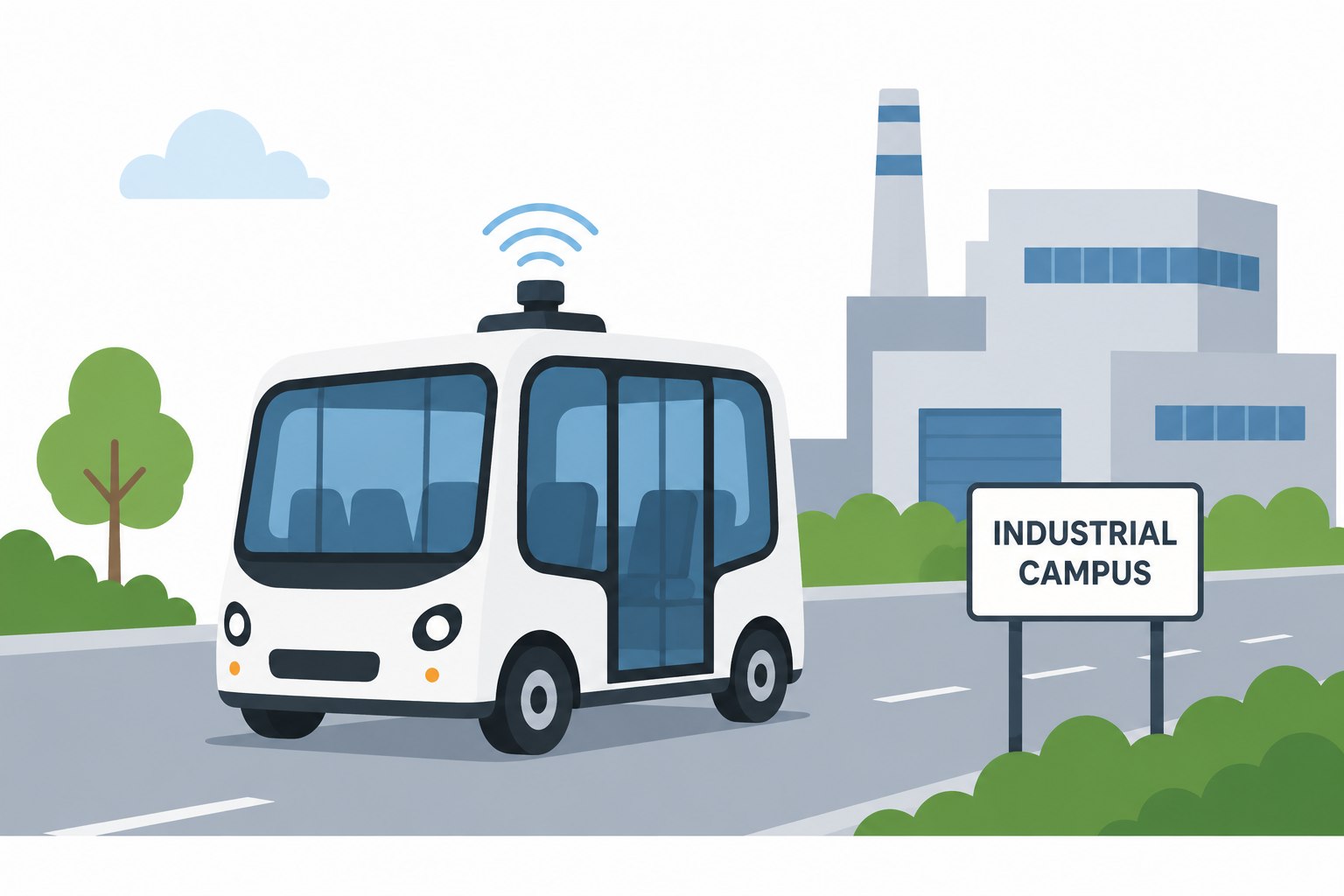
One of the company’s key product categories is autonomous electric shuttles designed for campus transportation. These vehicles are intended for environments such as industrial facilities, technology parks, universities, airports, and large private campuses where people frequently travel along repeated internal routes.
Instead of relying on conventional drivers, the shuttle uses onboard navigation systems to move between designated locations. The company also develops autonomous material-movement vehicles for industrial operations.
In factories and logistics facilities, large amounts of time are spent moving components, tools, inventory, and materials between production areas. Flo Mobility’s autonomous systems are designed to automate portions of that movement process using electric vehicles that follow planned routes and respond to operational instructions through fleet-management software.
The broader objective is not simply automation for its own sake. Industrial operators often face workforce shortages, transportation inefficiencies, rising logistics costs, and pressure to improve operational productivity.
Autonomous transport systems can potentially reduce repetitive driving tasks while improving consistency and utilization rates. Flo Mobility additionally develops fleet-management software that allows operators to monitor vehicles, assign routes, manage charging schedules, and oversee transportation operations from centralized dashboards.
One notable aspect of the company’s strategy is that it combines vehicle development with autonomous-driving software.
Many autonomous-vehicle companies focus exclusively on software and integrate their systems into third-party vehicles. Others manufacture vehicles but depend on external autonomy providers.
Flo Mobility attempts to control both layers simultaneously. According to the company, this allows tighter integration between sensors, vehicle controls, software systems, and operational requirements.
Flo Mobility raised approximately $2 million in seed funding in 2023. The round was led by Exfinity Venture Partners, with participation from existing investors including renowned entrepreneur and inventor Dr. A. Velumani and other angel investors.
The broader market for autonomous mobility has changed significantly over the past decade.
Early industry attention focused heavily on self-driving passenger cars. However, many companies discovered that public-road autonomy requires solving extremely complex edge cases involving unpredictable real-world conditions. As a result, several autonomous-vehicle companies shifted toward controlled-environment deployments where commercial adoption can happen earlier.
Globally, companies such as EasyMile, Navya, May Mobility, Oxa, and Baidu Apollo have developed autonomous shuttles and closed-campus mobility systems. In industrial logistics, firms including Seegrid, OTTO Motors, and Geek+ have focused on warehouse and facility automation.
These environments offer a more manageable path to deployment because routes, infrastructure, and operational conditions can be controlled. India has also seen growing interest in industrial autonomy.
Manufacturing expansion, warehouse growth, logistics modernization, and large industrial parks have created demand for automation technologies that improve efficiency without requiring full public-road deployment.
Companies working in adjacent areas include Ati Motors, Addverb, GreyOrange, and several industrial-automation firms focused on autonomous movement systems. However, product categories differ considerably, ranging from warehouse robots to industrial transport vehicles and autonomous logistics platforms.
Flo Mobility’s positioning sits between autonomous transportation and industrial automation.
Rather than building warehouse robots that operate entirely indoors, the company focuses on larger mobility systems capable of moving people and materials across broader operational environments.
The company has also emphasized electric mobility alongside autonomy. Most of its vehicle platforms are designed around electric powertrains rather than internal-combustion engines. This reflects a broader trend across industrial mobility, where electrification and automation are increasingly being deployed together.
Market feedback around autonomous systems remains mixed globally. Operators are interested in productivity gains and reduced operational costs, but adoption often depends on reliability, safety validation, infrastructure readiness, and regulatory approvals. In controlled environments, however, those barriers are generally lower than on public roads.
- Our Correspondent