Factories generate enormous amounts of data. Motors, pumps, turbines, compressors, boilers and production lines continuously produce signals about temperature, vibration, pressure, flow rates and operating conditions.
Most of this information is already available inside industrial plants through sensors and control systems. The challenge is that companies often struggle to interpret the data early enough to prevent failures.
Hyderabad-based XYMA Analytics is building software designed to address that problem.
The company develops industrial analytics systems that monitor equipment behavior and identify signs of abnormal performance before major breakdowns occur. Instead of selling physical machinery, XYMA focuses on using artificial intelligence and industrial data analysis to help factories improve reliability, reduce downtime and optimize operations.
The company was founded in 2017 by Venkata Vamsi Krishna and Srinivas Manda. Both founders have backgrounds in industrial systems, engineering and technology development. Their work has focused on applying machine learning and advanced analytics to manufacturing and process industries.
XYMA emerged from a practical industrial problem. Many manufacturing facilities already have large investments in sensors, industrial automation systems and data-collection infrastructure.
However, most plants still rely heavily on manual monitoring, periodic inspections and reactive maintenance. Equipment is often repaired only after performance begins to degrade or a failure occurs.
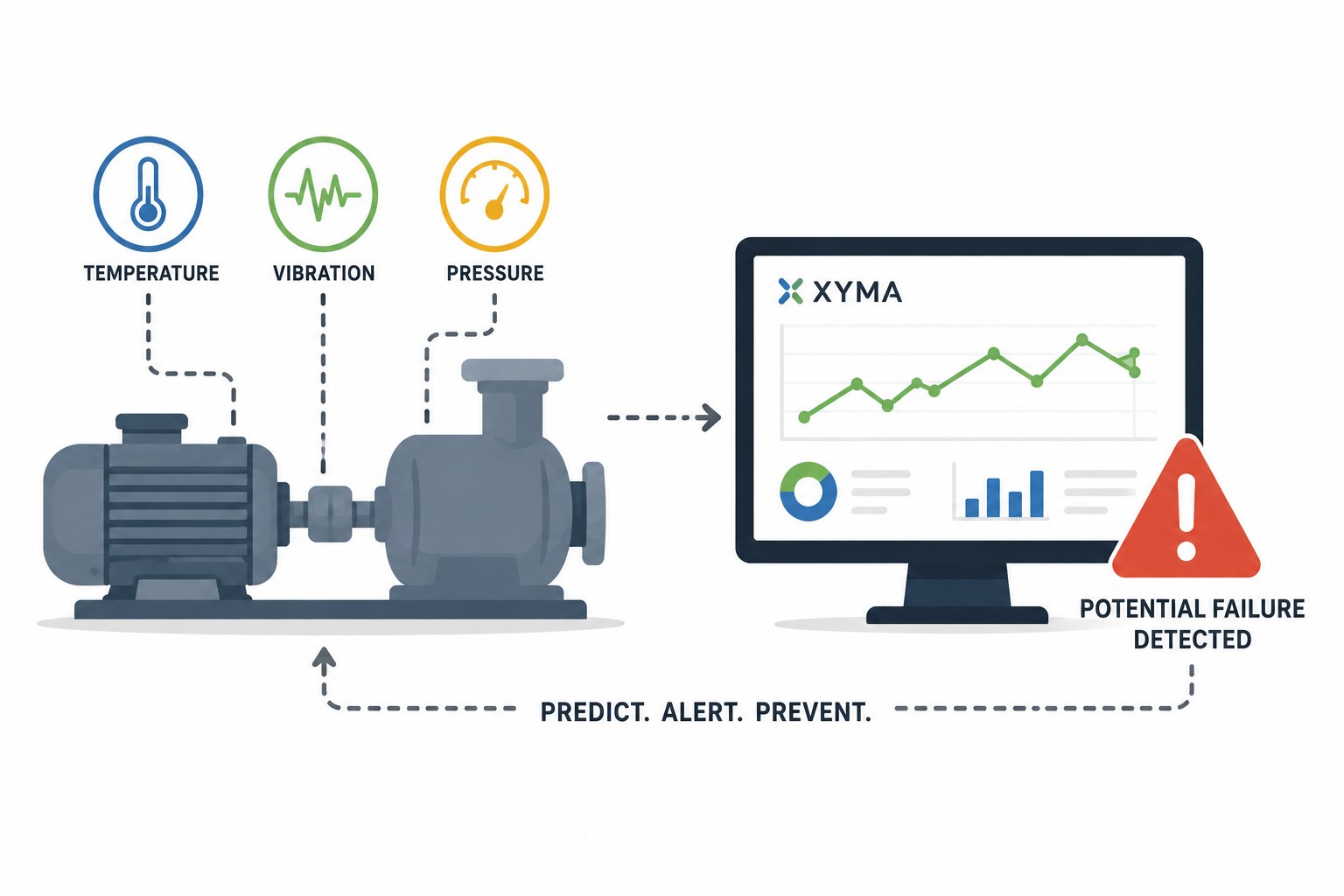
The company’s software is designed to work on top of existing industrial systems. According to XYMA, its platform connects with plant data sources and continuously analyzes equipment behavior. Rather than waiting for a machine to fail, the system attempts to detect patterns that indicate developing problems.
The technology falls into a category often called predictive maintenance. The idea is relatively straightforward. Industrial equipment usually shows subtle warning signs before breakdowns occur. A pump may begin vibrating differently. A turbine may show temperature variations. A compressor may consume more energy than normal. These changes may be difficult for operators to detect manually, especially across large facilities with hundreds of assets.
XYMA’s platform uses machine-learning models and anomaly-detection systems to identify unusual behavior in industrial equipment. According to the company, the software establishes baseline operating patterns and then flags deviations that could indicate faults, inefficiencies or performance deterioration.
One of the company’s key products is its Industrial AI platform for asset monitoring and diagnostics. The system is intended to provide maintenance teams with alerts, performance insights and recommendations based on equipment behavior. Instead of generating raw sensor data alone, the software attempts to translate operating signals into actionable maintenance information.
The company says its platform can be used across sectors including power generation, oil and gas, manufacturing, metals, cement, chemicals and process industries. These industries often operate expensive equipment where unexpected shutdowns can result in substantial production losses.
A notable aspect of XYMA’s approach is that it focuses on brownfield industrial environments. In other words, the company is not targeting only newly built smart factories. Its systems are designed to integrate with existing industrial assets and operational technology infrastructure already deployed in factories and plants.
The company states that its analytics engine can identify root causes of abnormal equipment behavior and generate maintenance recommendations. However, the exact performance depends on asset type, operating conditions and available historical data.
In 2022, XYMA announced a funding round led by Rockstart Energy Fund. According to public reports, the company planned to use the investment to expand industrial AI deployments and scale its technology platform.
The market XYMA operates in has grown rapidly over the last decade. Industrial companies increasingly view operational data as a strategic asset rather than simply a byproduct of automation systems. As sensor deployment expands and cloud computing costs decline, manufacturers are investing more heavily in predictive maintenance and industrial analytics platforms.
Globally, major companies such as Siemens, GE Digital, Honeywell, Schneider Electric and ABB have developed industrial analytics and asset-performance-management systems. These platforms often combine machine learning, industrial automation and maintenance optimization tools.
Alongside these large industrial firms, a growing ecosystem of specialised startups has emerged. Companies such as Augury, C3 AI, SparkCognition and Uptake have developed predictive-maintenance technologies focused on industrial assets. Their approaches vary, but the common goal is using operational data to detect problems earlier and improve equipment reliability.
The broader category is often described as Industrial AI or Industry 4.0 software. These systems combine machine learning, industrial automation, cloud infrastructure and operational analytics. Instead of simply automating machines, the goal is to make industrial systems more self-monitoring and data-driven.
India has become an increasingly active market for such technologies because of the large installed base of industrial infrastructure. Power plants, refineries, manufacturing facilities and process industries generate significant operational data but often operate under pressure to improve efficiency and reduce maintenance costs. Predictive-maintenance systems are viewed as one way to achieve those goals without major capital expenditure on new equipment.
Unlike consumer-facing artificial intelligence products, industrial analytics systems must operate inside complex engineering environments. Accuracy matters because incorrect recommendations can affect production schedules, maintenance planning and operational safety. As a result, industrial customers typically evaluate such systems based on measurable outcomes rather than software features alone.
- Our correspondent