Factories have used industrial robots for decades, but most of those systems are built for repetitive, fixed movements.
A traditional robotic arm on an assembly line usually performs the same motion thousands of times in a controlled environment. If the production process changes significantly, the robot often needs expensive reprogramming, new tooling, or even a redesigned production line.
Perceptyne, a Hyderabad-based robotics startup, is trying to build a different kind of industrial automation system.
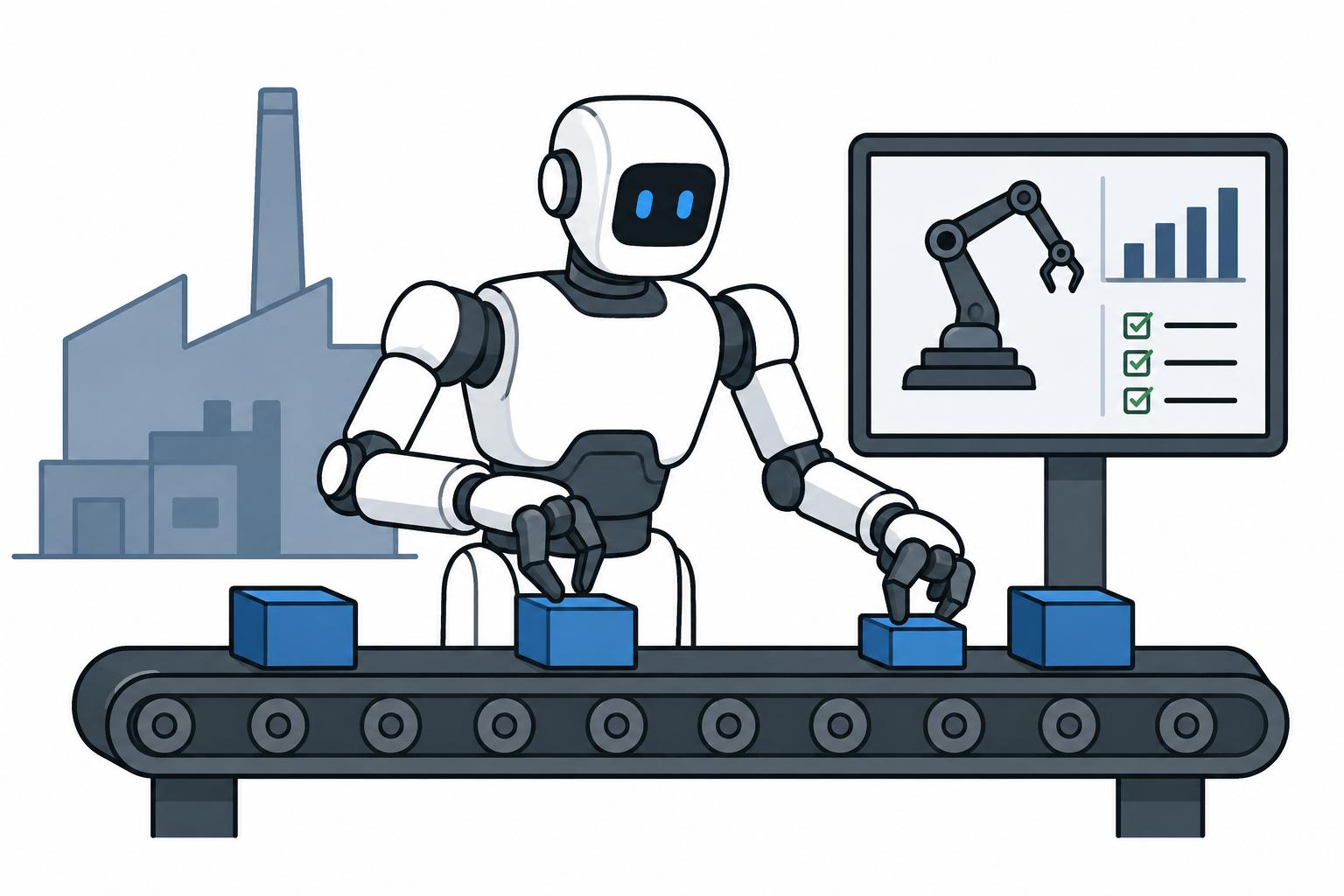
The company develops AI-driven robots designed to perform tasks that require more flexibility, perception, and human-like dexterity. Instead of focusing only on rigid industrial automation, Perceptyne is building what it describes as “AI-first” semi-humanoid robots for manufacturing environments.
The startup was founded in 2021 by Raviteja Chivukula, Jagga Raju Nadimpalli, and Mrutyunjaya Nadiminti. The founders come from engineering, robotics, and industrial technology backgrounds. Raviteja Chivukula studied at IIT Madras and previously worked on engineering systems and robotics-related projects. Mrutyunjaya Nadiminti is a BITS Pilani graduate with prior experience in enterprise technology and industrial systems.
The company operates from Hyderabad and was incubated through the Telangana startup ecosystem, including support from T-Hub.
Perceptyne’s core focus is industrial robotics for manufacturing operations such as product assembly, packaging, and material handling. These are tasks that are difficult for traditional industrial robots because they often involve variable object positions, changing workflows, delicate movements, or environments designed originally for human workers.
The company’s robots are built around what Perceptyne calls a “physical AI” stack. In practical terms, this means the robots combine multiple technologies together rather than functioning as simple mechanical machines. The systems use computer vision, AI-based planning, sensors, force control, and robotic motion systems to interact with factory environments dynamically.
The company’s best-known systems are the PR-34D and PR-9D robots.
The PR-34D is a dual-arm industrial robot designed for manufacturing and assembly tasks that normally require coordinated human movement. The robot includes dual seven-degree-of-freedom robotic arms, advanced grippers, integrated computer vision systems, tactile sensing, and force-control systems.
The goal is not to imitate humans visually in the way consumer humanoid robots are often marketed. Instead, the company is trying to build robots capable of operating inside existing industrial setups without requiring entire production lines to be rebuilt.
This is an important distinction in manufacturing robotics.
Many factories, especially in electronics and automotive sectors, already have infrastructure optimized for human workers. Replacing those systems entirely with conventional industrial robotics can be expensive and disruptive. Perceptyne’s approach is to develop robots that can adapt more easily to existing workflows.
The robots use multimodal sensing and AI-driven task planning to perform operations such as assembly and packaging. The company also says its systems support low-code integration and teleoperation-based training.
Teleoperation training means human operators can guide robot actions remotely, allowing the AI system to learn new tasks from demonstrations instead of relying entirely on traditional programming methods.
This category of robotics is sometimes referred to globally as “physical AI” or “embodied AI.” Unlike software AI systems that only process digital information, embodied AI systems interact physically with the environment through sensors, motors, cameras, and movement systems.
In early 2024, Perceptyne raised a pre-seed funding round led by Venture Catalysts. Investors included founders and executives from Indian deep-tech companies such as Ather Energy and Skyroot Aerospace, along with T-Hub and Z21 Ventures.
The startup later raised $3 million in seed funding in October 2024. The round was co-led by Endiya Partners and Yali Capital, with participation from Whiteboard Capital and several angel investors.
Market feedback around the company has largely focused on the broader rise of AI-driven industrial robotics.
Investors backing Perceptyne argue that manufacturing industries increasingly want flexible automation systems rather than fixed robotic setups. Traditional industrial robots work well for repetitive processes but struggle when workflows change frequently or involve delicate manipulation tasks.
Perceptyne’s systems are designed specifically for such environments.
The company’s approach also reflects a broader shift happening globally in robotics.
Large technology companies and startups are investing heavily into humanoid and semi-humanoid industrial robotics. Companies such as Figure AI, Apptronik, Sanctuary AI, Agility Robotics, and Tesla are all working on robots capable of performing more generalized physical work rather than narrow repetitive tasks.
China has also become a major center for humanoid robotics manufacturing, with startups such as Unitree Robotics and Fourier Intelligence scaling rapidly.
In India, the industrial robotics ecosystem is still relatively early but expanding quickly.
Companies such as Addverb, GreyOrange, Genrobotics, Sastra Robotics, and General Autonomy are building automation systems for logistics, industrial operations, or AI-enabled robotics. Perceptyne differs from warehouse-focused robotics companies because its systems are designed for dexterous industrial assembly work rather than movement automation alone.
The technical challenge in this category is significant.
A robot working in a real factory must deal with changing lighting conditions, inconsistent object placement, vibration, production variability, and complex hand-eye coordination tasks. Humans perform many such operations naturally, but programming machines to handle these situations reliably remains difficult.
This is one reason why industrial humanoid robotics has progressed more slowly than software AI despite major advances in machine learning.
What makes the company notable within India’s deep-tech ecosystem is that it is attempting to build both the hardware and software stack locally rather than functioning only as an AI software layer on imported robotics systems.
- Our correspondent