Many products used in home care, cosmetics, agriculture, pharmaceuticals, and packaged consumer goods still depend heavily on petrochemical-derived ingredients. These include synthetic stabilizers, thickeners, coatings, binders, and additives that help products maintain texture, shelf life, or performance.
The problem is that many of these ingredients are difficult to biodegrade and can contribute to microplastic pollution or chemical waste.
BacAlt Biosciences, a Bengaluru-based biotech startup, is developing bio-based alternatives using agricultural waste and microbial fermentation.
The company focuses on producing sustainable biopolymers and specialty ingredients designed to replace petrochemical and synthetic inputs across multiple industrial sectors.
BacAlt Biosciences was founded by Shruti Kutmutia and Dr. Pranav Nair in 2023.
The founding team built BacAlt around the idea of creating scalable biomaterials using circular feedstocks and fermentation-based manufacturing systems.
Dr. Pranav Nair, the company’s co-founder, comes from a biotechnology and industrial microbiology background. Both the founders are part of the Bengaluru biotechnology startup ecosystem. The startup operates in the growing field of industrial biomanufacturing.
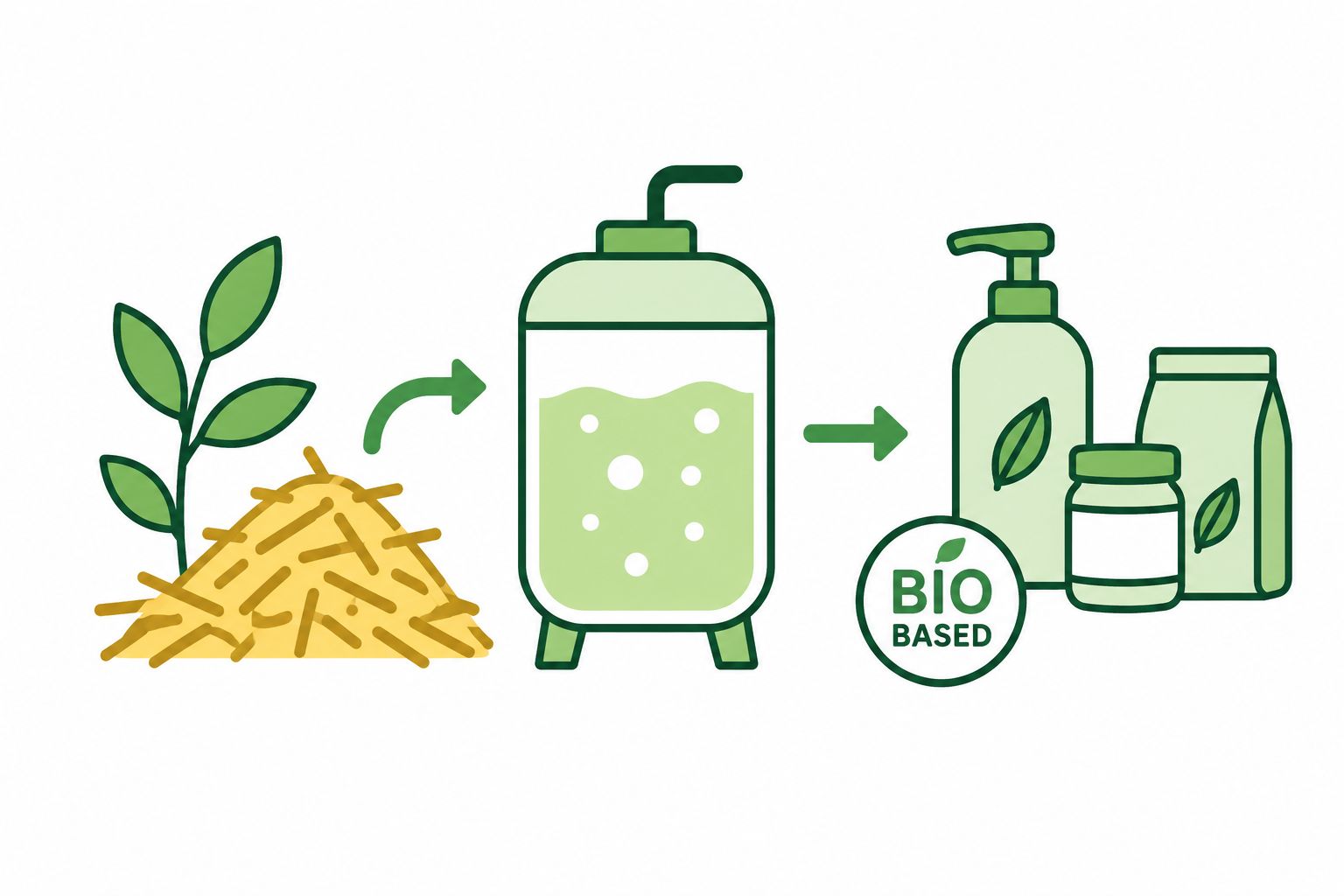
Its core process involves taking post-harvest agricultural residues and converting them into useful industrial materials using microbial fermentation. Instead of treating agricultural waste as disposal material, the company uses it as feedstock for biological production systems.
The company develops bio-based polymers such as bacterial cellulose and poly gamma glutamic acid, also known as γ-PGA.
Bacterial cellulose is a naturally produced material generated by specific microbes during fermentation. Unlike conventional petroleum-derived polymers, it is biodegradable and can be engineered for different industrial applications. Poly gamma glutamic acid is another biologically produced polymer used in areas such as agriculture, cosmetics, water retention systems, and specialty formulations.
BacAlt says its products are designed for applications in home care, personal care, agrochemicals, nutraceuticals, pharmaceuticals, and industrial formulations.
In practical terms, these ingredients can function as stabilizers, texture modifiers, water retention agents, or specialty formulation materials inside consumer and industrial products.
One important part of BacAlt’s positioning is that the company is not simply selling “eco-friendly” materials at premium pricing. The founders repeatedly emphasize cost competitiveness and scalability.
According to company reports, BacAlt uses lean, high-throughput, and energy-efficient fermentation systems combined with “non-sterile fermentation” processes.
Traditional industrial fermentation systems often require tightly controlled sterile environments, which increase operational costs significantly. BacAlt claims its approach can lower production costs while maintaining industrial-scale manufacturing potential.
In practice, this means agricultural byproducts that would otherwise be discarded or burned are converted into industrial raw materials. India generates enormous quantities of agricultural residue every year, and much of it has historically had limited commercial use.
The company says its goal is to reduce dependence on imported specialty ingredients and position India as a global bio-manufacturing hub.
Unlike some biotech startups focused mainly on pharmaceutical research, BacAlt is targeting industrial-scale ingredients markets. That means the challenge is not only scientific performance but also manufacturing economics.
For industrial customers, performance alone is not enough. Materials must also be affordable, scalable, stable during transport and storage, and compatible with existing manufacturing systems. This is one reason the company repeatedly emphasizes “mass-market viable cost points” in investor and media statements.
In September 2025, BacAlt Biosciences raised ₹18 crore, approximately $2 million, in a pre-seed funding round led by Avaana Capital. Lubrizol InnoVentures, the venture arm of specialty chemicals company Lubrizol, also participated in the round.
Many bio-based material startups succeed in laboratory environments but struggle to scale production economically. Moving from lab fermentation to industrial-scale production is often one of the most difficult phases in biomanufacturing.
Globally, BacAlt operates within the rapidly expanding sustainable biomaterials and industrial biotechnology sector.
Governments and industrial companies worldwide are investing heavily into alternatives to petrochemical-based materials due to environmental regulations, consumer pressure, and climate concerns.
Several international companies work in related categories. US-based Newlight Technologies develops biomaterials produced from greenhouse gas conversion systems. Origin Materials develops carbon-negative industrial materials using biomass.
Large chemical companies such as BASF, DSM-Firmenich, Novonesis, and DuPont are also investing heavily in industrial biotechnology and fermentation-based manufacturing systems. The broader market itself is growing quickly because industries are searching for replacements for plastics, synthetic additives, and petroleum-derived specialty chemicals.
At the same time, this remains a technically difficult category.
Biomaterials companies must solve several problems simultaneously: biological production efficiency, feedstock supply chains, industrial scalability, formulation stability, regulatory approval, and price competitiveness against petrochemical incumbents that benefit from decades of industrial optimization.
This is one reason why relatively few bio-based material startups successfully scale into large industrial manufacturers.
For BacAlt, the critical next stage will likely be demonstrating that its fermentation systems can consistently produce industrial-grade materials at commercial scale and economically viable pricing.
The company reflects a larger shift inside India’s deep-tech ecosystem toward industrial biotechnology and sustainable manufacturing infrastructure rather than only software-based startups.
- Our correspondent