
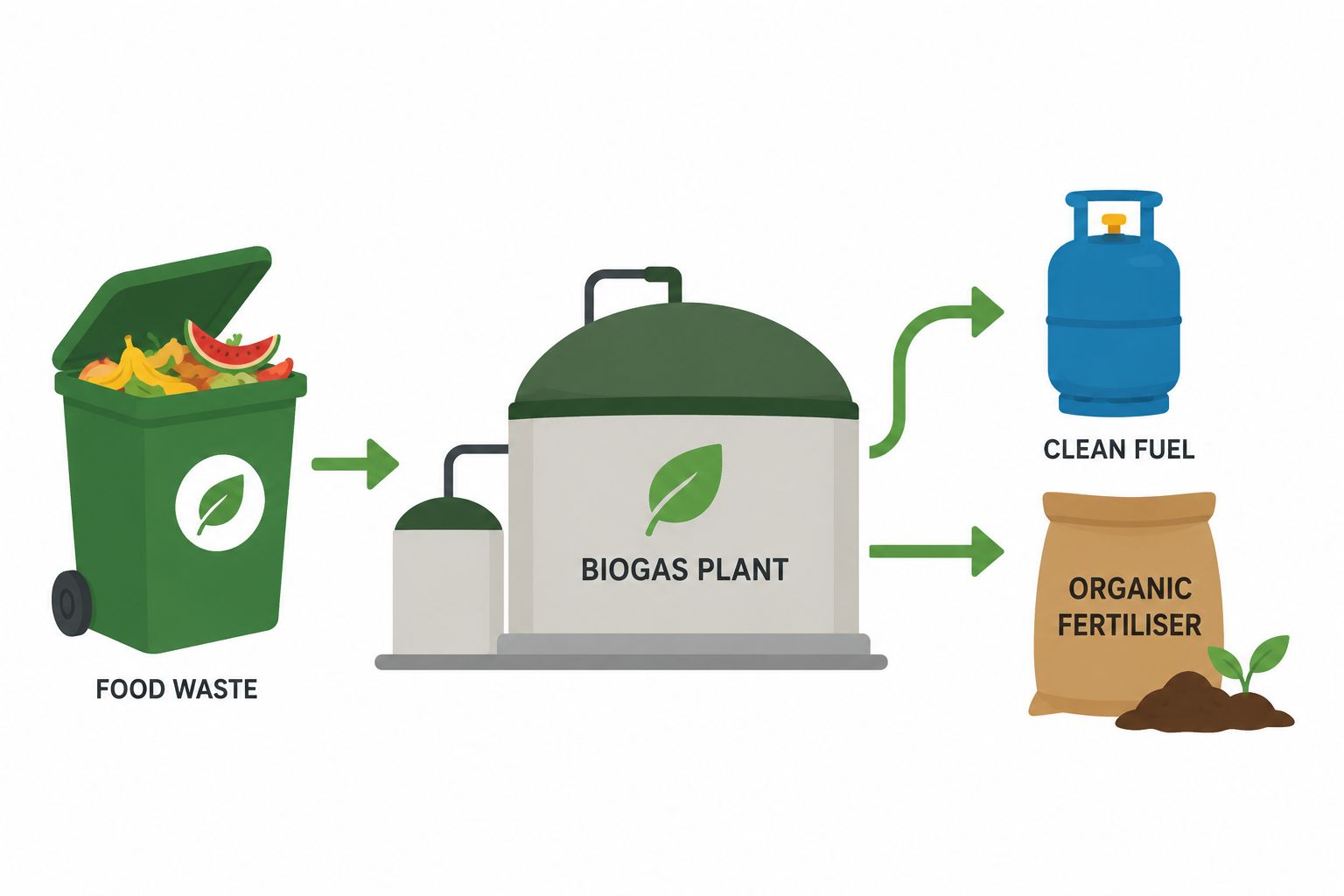
Every day, Indian cities generate thousands of tonnes of wet waste from homes, restaurants, hotels, vegetable markets, and food-processing facilities. Much of that waste ends up in landfills, where it decomposes and releases methane, a greenhouse gas significantly more potent than carbon dioxide over shorter time periods.
Bengaluru-based Carbonlites is building its business around a different outcome. Instead of sending food and agricultural waste to landfill sites, the company processes it through biogas systems that produce compressed biogas (CBG) and organic fertilisers.
Carbonlites is the product brand of Carbon Masters India, a climate-tech company founded by Kevin Houston and Som Narayan. Carbon Masters was established in the UK in 2009 and expanded into India in 2012. The founders built the company around the idea that waste streams could be converted into commercially usable products while reducing emissions from landfill disposal and fossil-fuel consumption.
Kevin Houston, listed as Co-Founder on the company website, previously worked on low-carbon energy and sustainability initiatives before launching Carbon Masters. Som Narayan co-founded the company and helped lead its India operations and technology deployment efforts.
The company’s central product line operates under the Carbonlites brand. Its system collects wet organic waste and processes it through anaerobic digestion, a biological process in which microorganisms break down organic material in oxygen-free environments. The output of this process is biogas. Carbonlites then upgrades that biogas into compressed biogas, or CBG, which can be used as a replacement for LPG, diesel, or conventional natural gas in certain applications.
The company says its Carbonlites CBG contains roughly 94 percent methane and can be used for commercial cooking, industrial heating, and transport applications. The gas is supplied in bottled form using specialized storage and pressure systems developed for commercial users. Alongside fuel production, the digestion process also generates nutrient-rich digestate. Instead of treating this as waste, Carbonlites converts it into organic fertilisers sold under its Carbonlites Bio-Enriched Organic Fertiliser and Liquid Organic Fertiliser product lines.
This means the company is effectively producing two commercial outputs from the same waste stream: fuel and agricultural inputs.
The model is based on circular-economy principles. Organic waste enters the system, biogas is extracted and upgraded into fuel, and the remaining material is processed into fertiliser rather than being discarded.
One of its largest public projects is located in Harohalli, Karnataka. According to Carbonlites, the facility was established through a joint venture called Sustainable Impacts, created with waste-management organization Hasiru Dala Innovations.
One of the more unusual projects in its portfolio is called “Carbonlites in a Box.” Located in Koramangala, Bengaluru, the system places a functioning biogas plant inside a refurbished shipping container.
The project was developed through a public-private partnership involving BBMP, local resident groups, and Carbon Masters. According to the company, the initiative was designed to demonstrate how decentralized waste-processing infrastructure could operate within dense urban environments.
Carbonlites has also experimented with distribution and adoption models beyond waste processing itself.
Carbon Masters raised its first institutional funding round in 2017. The round was led by Indian Angel Network (IAN) and Sangam Ventures. The company stated that the capital would be used for product development, engineering recruitment, and project expansion.
The company has also received industry recognition. Carbon Masters won the WWF India Climate Solver Award in 2017 for innovations aimed at reducing emissions and improving clean-energy access. It was also selected among finalists in the Shell Make the Future Accelerator programme focused on energy-efficiency and carbon-reduction technologies.
The broader category in which Carbonlites operates is often called waste-to-energy or renewable natural gas.
Globally, companies are increasingly converting food waste, agricultural residues, sewage sludge, and organic industrial waste into biogas and compressed renewable fuels. Countries including Germany, Sweden, Denmark, the United Kingdom, and the United States have developed large anaerobic-digestion sectors linked to energy generation and waste-management systems.
In India, the market has expanded due to government support for compressed biogas through initiatives such as SATAT (Sustainable Alternative Towards Affordable Transportation). These programmes encourage production of renewable gas that can substitute conventional fossil fuels.
Companies working in related areas include GPS Renewables, Sistema.bio, CEID Consultants, Greenjoules, and several municipal waste-to-biogas operators. However, business models vary considerably. Some focus on equipment manufacturing, some on project development, and others on fuel distribution or waste processing.
What differentiates Carbonlites is its attempt to commercialise both sides of the output stream. Rather than producing only fuel, it also builds a fertiliser business around the residual material generated during digestion.
Whether that model scales nationally will depend on municipal waste collection systems, feedstock quality, economics of compressed biogas distribution, and continued demand for organic fertilisers. But Carbonlites has already demonstrated that food waste can move through a chain that ends not in a landfill, but in fuel cylinders and farm inputs.
- Our correspondent
Leave a Comment