India has thousands of ponds, lakes, reservoirs, aquaculture tanks, and irrigation water bodies that support farming, fisheries, and local livelihoods.
Many of them face a common problem: declining water quality. Oxygen levels drop, pollutants accumulate, algae spreads, and water circulation weakens. In aquaculture, poor water conditions can directly reduce fish growth and increase disease outbreaks. In urban lakes, stagnant water can become heavily polluted.
Odisha-based Bariflo Labs is building technology systems aimed at monitoring and managing these water bodies using sensors, aeration systems, robotics, and data analytics.
Founded in 2018, the company is focused on water body management systems for aquaculture and environmental applications.
The startup works at the intersection of aquaculture, environmental engineering, and water monitoring. Its systems combine fluid dynamics, IoT sensors, automation, AI-based analysis, and mechanical aeration devices to improve water conditions in ponds, lakes, and fish farming systems.
Bariflo Labs was founded by Mrityunjay Sahu and Anudhyan Mishra. The company operates from Bhubaneswar, Odisha, and has worked through incubators and support programs including Startup Odisha and KIIT Technology Business Incubator.
The core problem Bariflo Labs is trying to solve is not simply water scarcity, but water quality degradation in static or slow-moving water bodies. In many fish farms, oxygen levels in ponds fall because water circulation is poor. Organic waste accumulates at the bottom and begins decomposing, which reduces dissolved oxygen and affects fish survival. Traditional aeration systems often consume large amounts of electricity and may not distribute oxygen evenly.
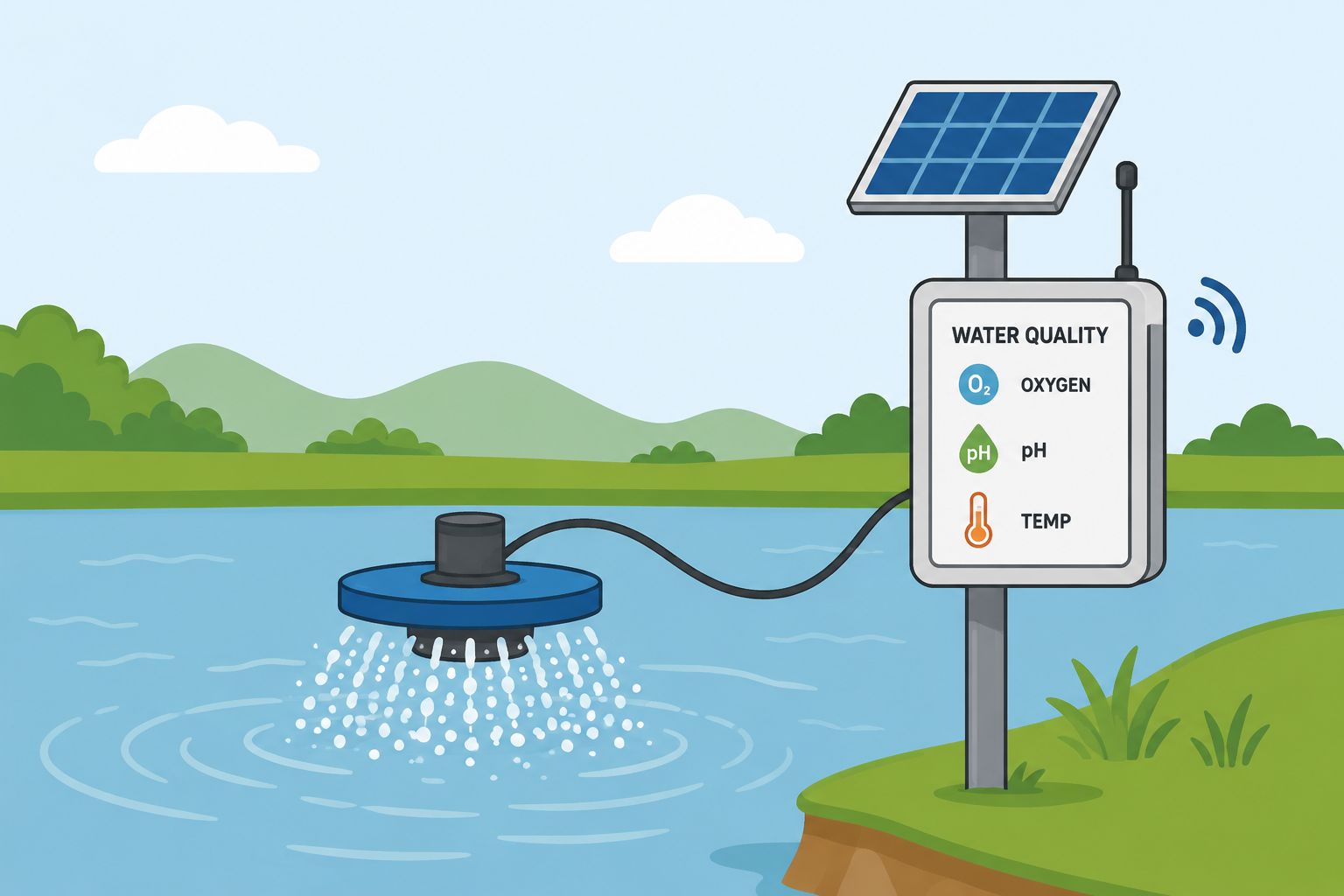
Bariflo Labs says its flagship system is based on environmental hydraulics and diffused aeration technology. Instead of only pumping oxygen near the surface, the company’s system reportedly diffuses air toward deeper sediment layers inside water bodies. The idea is to improve oxygen circulation more efficiently across the pond or lake.
The company claims this approach can reduce energy use by as much as 75% compared to conventional pumping systems.
The system also includes IoT-enabled sensors that continuously monitor water conditions. According to company descriptions, these sensors collect data on parameters such as dissolved oxygen, water chemistry, and overall water health.
The information is then displayed through dashboards that help aquafarmers or water managers understand changing conditions inside ponds and reservoirs. Instead of relying only on manual observation, farmers can receive ongoing data about water quality trends.
In aquaculture, this matters because even small changes in oxygen levels or water chemistry can affect fish growth, mortality, and feed efficiency. Fish farming losses often occur because farmers notice water deterioration too late.
Bariflo Labs says its technology is designed to help farmers increase fish production while reducing operating costs. The startup’s systems are intended for multiple environments including aquaculture ponds, irrigation tanks, lakes, reservoirs, and urban water bodies.
One of the practical challenges in India’s aquaculture sector is that many farmers operate on relatively small margins. Expensive imported monitoring systems are often unaffordable for small or medium-scale fish farmers. Bariflo Labs appears to be positioning itself as a domestic technology provider that can offer modular systems adapted for Indian conditions.
The company repeatedly describes its systems as “plug and play,” meaning they are designed for installation without requiring large infrastructure changes.
Bariflo Labs also positions itself within the broader “blue economy” sector — industries connected to water resources, fisheries, and aquatic ecosystems.
Support from government and ecosystem programs has been important to the company’s development. The startup says it has received support from Startup Odisha. Additional mentions include associations with the Indian Council of Agricultural Research (ICAR), the Ministry of Science and Technology, and Telangana AI Mission.
In 2024, Bariflo Labs joined the FinLab Greentech Accelerator run by Singapore-based United Overseas Bank (UOB).
The market for smart aquaculture systems has grown globally over the past decade. Fish farming operations increasingly use sensors, feeding automation, oxygen management systems, and AI-driven monitoring tools to improve yields and reduce losses.
Globally, companies such as eFishery in Indonesia, Innovasea in the United States, and several Chinese aquaculture technology firms are developing connected aquaculture infrastructure. These systems often combine water quality monitoring, feeding optimization, fish health analytics, and automation.
India’s aquaculture sector is also expanding rapidly, particularly in shrimp farming and inland fisheries. But technology adoption remains uneven. Many smaller farmers still rely heavily on manual methods and visual inspection. This creates room for startups offering lower-cost monitoring and automation systems.
At the same time, water monitoring technology faces operational challenges. Sensors deployed in outdoor ponds can degrade quickly. Maintenance is difficult in humid and muddy environments. Farmers may hesitate to adopt systems unless the economic benefits are very clear.
Another challenge is proving performance through long-term field data. Water systems vary significantly depending on climate, stocking density, pond design, and local farming practices. Technology that works well in one region may behave differently elsewhere.
Bariflo Labs appears to be trying to solve this by combining engineering systems with field-level deployment rather than operating purely as a software company. Its emphasis on fluid dynamics and aeration suggests the company is focusing on the physical movement and oxygenation of water, not just data collection.
As aquaculture production expands and urban water stress intensifies, demand for continuous monitoring and management systems is expected to increase. Companies like Bariflo Labs are attempting to build local technology infrastructure around those problems using a mix of environmental engineering, automation, and sensor-based monitoring.
- Our correspondent