For many visually impaired people in India, navigating roads, classrooms, buses, and public spaces remains physically difficult and often unsafe.
Traditional white canes help users detect obstacles near the ground, but they cannot identify objects above waist level, describe surroundings, read printed text, or recognize people and currency.
Ahmedabad-based Torchit is building assistive devices designed to address some of these gaps using sensors, audio feedback, AI-based object recognition, and wearable technology.
The company focuses on affordable assistive technology for visually impaired users and people with disabilities. Its products include smart mobility devices, AI-powered glasses, accessible learning tools, and educational kits.
Torchit was founded by Hunny Bhagchandani, who began working on assistive technology while still an engineering student. The idea emerged during an internship at a blind school, where he observed visually impaired students colliding with obstacles while moving around campus.
Bhagchandani said he was inspired by obstacle-avoiding robotics systems and began exploring whether similar technology could be adapted into a navigation aid for visually impaired users. He reportedly went through 16 prototypes before arriving at the first working version of the company’s flagship product.
That first product became Saarthi, a handheld assistive mobility device designed to work alongside a white cane. Instead of replacing the cane entirely, Saarthi adds electronic obstacle detection. The device uses sensors to identify nearby objects and alerts the user through vibration feedback. The goal is to help users detect obstacles that conventional canes may miss, especially objects above knee level.
According to YourStory, Saarthi was initially priced around Rs 2,500, significantly lower than many imported assistive devices.
The affordability angle is central to Torchit’s positioning. Many advanced assistive technologies available globally — especially wearable AI systems for visually impaired users — are expensive and often inaccessible to low-income users in developing countries.
For example, devices such as Israel-based OrCam’s wearrble visual assistant can cost several thousand dollars internationally. Torchit appears to be targeting lower-cost alternatives designed for Indian users and nonprofit deployment programs.
Over time, the company expanded beyond obstacle detection into AI-powered visual assistance systems.
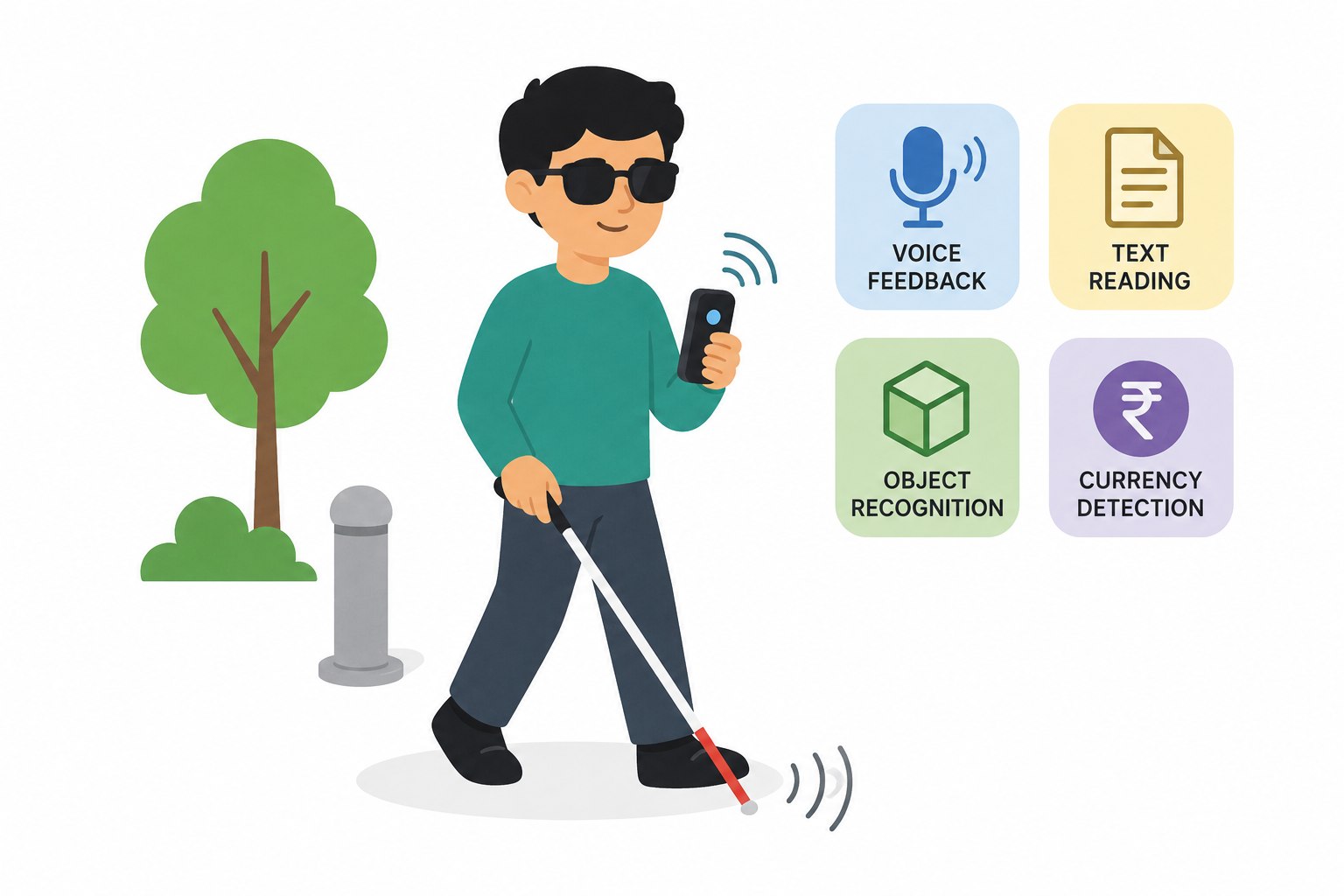
One of its newer products is Jyoti AI, a pair of AI-assisted smart glasses for visually impaired users. According to the company website, the glasses can identify objects, recognize text, detect currency, describe scenes, and provide spoken feedback to users.
The product evolved partly from user feedback. According to Torchit’s own account, Saarthi users appreciated obstacle alerts but wanted more detailed information about their surroundings — not just that something was ahead, but what exactly it was.
The company then added additional AI-driven functions such as multilingual text reading, scene description, object recognition, and currency identification. These functions are intended to help users navigate daily activities more independently, including reading printed material and recognizing environmental details.
The startup additionally operates a nonprofit arm called Torchit Foundation, which focuses on accessibility training, disability inclusion, and assistive technology access programs.
One unusual aspect of the company’s approach is that it also employs persons with disabilities within its workforce. According to the foundation website, over 20 employees are persons with disabilities and a significant share of leadership roles are held by PwD team members.
Globally, assistive technology for visually impaired users has become an active area of AI and wearable-device development.
Companies such as OrCam in Israel, Be My Eyes in Denmark, and several university research groups are building systems that combine cameras, speech synthesis, computer vision, and AI-based scene understanding.
Some systems focus mainly on navigation. Others help users read text, identify products, recognize faces, or interpret visual environments through audio descriptions.
India presents a different challenge from wealthier markets because affordability matters heavily. Imported assistive devices are often too expensive for most users. Public infrastructure is also more uneven, making navigation harder in crowded streets, poorly marked sidewalks, and dense urban environments.
That has created space for Indian startups working on lower-cost assistive systems adapted to local conditions.
The sector still faces major technical and operational challenges. AI recognition systems can fail in low light or noisy environments. Wearable devices must remain lightweight and durable. Battery life matters because users may rely on devices for long periods outside home environments. Multilingual voice support is also important in India’s linguistically diverse settings.
There are also broader accessibility questions that technology alone cannot solve. Safe sidewalks, accessible public transport, tactile infrastructure, and inclusive urban design remain limited in many Indian cities.
- Our correspondent