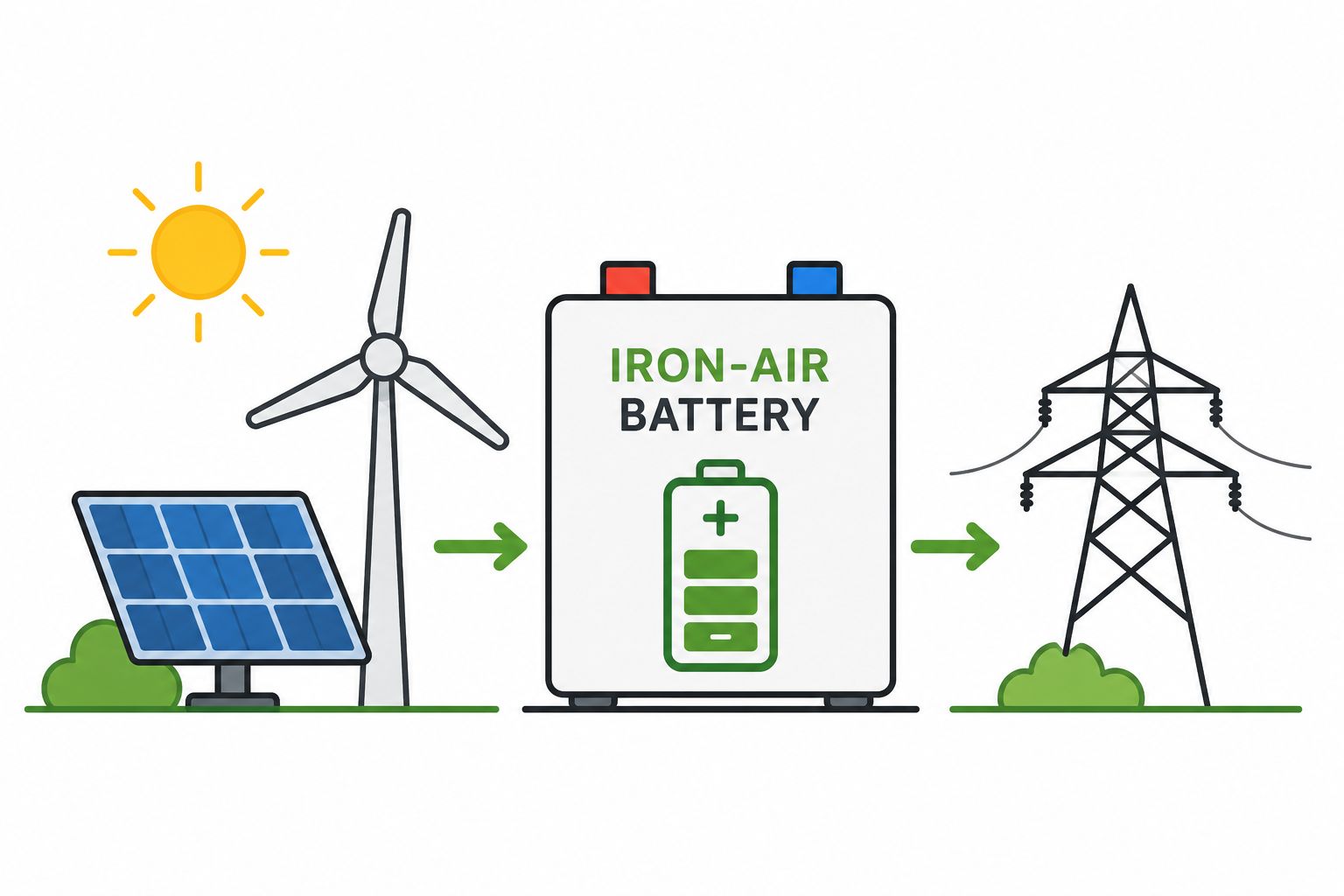
As solar and wind power become a larger part of electricity systems, a new challenge emerges: what happens when the sun does not shine and the wind does not blow for several days?
Most battery systems deployed today use lithium-ion technology. These batteries work well for storing electricity over a few hours but become expensive when utilities need storage lasting multiple days. Karetic Energy is one of a growing number of startups trying to solve that problem through long-duration energy storage.
Founded in 2025, Karetic Energy is developing an iron-air battery platform designed to provide electricity storage for 100 to 145 hours continuously. The company’s goal is to create a storage technology that is safer, cheaper, and better suited for multi-day renewable energy storage than conventional lithium-ion systems.
Origins of the Company
Karetic Energy was founded by Dr. Suryanarayana Vikrant Karra, an Assistant Professor at the Indian Institute of Technology Delhi (IIT Delhi). Dr. Karra holds a PhD from Purdue University and a BTech from Indian Institute of Technology Kanpur.
The company’s Chief Technology Officer is Prabhakar Kumar, a PhD research scholar at IIT Delhi. Together, the founders are building a battery technology platform focused on grid-scale energy storage rather than consumer electronics or electric vehicles.
What Karetic Energy Is Building
The company’s core product is an iron-air battery system.
Unlike lithium-ion batteries, which store energy through lithium-based electrochemical reactions, iron-air batteries use iron, oxygen from the atmosphere, and water-based electrolytes.
The concept is attractive because iron is abundant, inexpensive, and widely available. This can significantly reduce storage costs compared with lithium-based systems.
The technology aims to provide storage at roughly one-fifth the capital cost of comparable lithium-ion solutions for long-duration applications.
How the Technology Works
The most distinctive feature of Karetic’s approach is its proprietary iron-particulate-bed architecture.
Traditional metal-air batteries face challenges such as hydrogen evolution and surface passivation. In simple terms, unwanted chemical reactions can reduce efficiency and battery life.
Karetic says its particulate-bed electrochemical design addresses these issues by improving the behavior of iron particles during charging and discharging cycles. The company claims this architecture helps maintain performance during long-duration operation.
The battery uses a water-based electrolyte rather than the flammable organic electrolytes commonly used in lithium-ion batteries. This can improve safety, especially for utility-scale installations.
The intended application is not fast-charging electric vehicles. Instead, the technology is designed for storing renewable electricity over periods lasting several days.
Competing Technologies and Companies
Karetic operates in the long-duration energy storage sector, one of the fastest-growing areas within climate technology.
Several companies worldwide are pursuing alternatives to lithium-ion batteries for storing renewable energy over extended periods.
Among the best-known players is Form Energy, which is developing iron-air batteries for multi-day grid storage. Other companies include ESS Inc. in iron-flow batteries and a growing number of startups working on zinc-air, metal-air, gravity-storage, and thermal-storage systems.
In India, companies such as Sthyr Energy are developing alternative long-duration storage systems based on zinc-air technology.
Global Context
Long-duration energy storage has become a major focus area as countries expand renewable power generation.
Solar and wind power can produce electricity at very low cost, but generation often does not match demand. Grid operators increasingly need storage systems capable of supplying electricity overnight, through periods of low wind, or during multi-day weather events.
Many researchers and investors believe lithium-ion batteries alone will not solve these longer-duration storage needs economically. As a result, billions of dollars are being invested globally into technologies such as iron-air batteries, zinc-air batteries, flow batteries, compressed-air storage, and thermal storage systems.
Karetic Energy’s technology fits directly into this emerging category. Its focus on low-cost iron-based materials, non-flammable chemistry, and multi-day storage reflects broader industry efforts to build storage systems specifically designed for renewable-energy grids rather than consumer electronics.
- Our correspondent