Most conversations around solar energy focus on electricity. Solar panels on rooftops, utility-scale solar farms and battery systems dominate public attention.
But a large share of industrial energy consumption is not electricity at all. Factories, food-processing units, textile plants, chemical manufacturers and pharmaceutical facilities often need heat rather than power. Much of that heat is still generated using coal, furnace oil, diesel or natural gas.
Hyderabad-based QuantSolar is working on this problem.
The company develops solar thermal systems designed to generate industrial process heat using concentrated solar energy. Instead of producing electricity through photovoltaic panels, QuantSolar’s technology captures sunlight and converts it directly into usable heat for industrial operations.
The company was founded in 2015 by Chaitanya Bhanu and Srinivas Cherukuri. According to company information and startup ecosystem profiles, both founders come from engineering and technology backgrounds and have focused on solar thermal energy systems rather than conventional solar power generation.
Chaitanya Bhanu serves as CEO and has been one of the public faces of the company. His work has centered on solar thermal engineering and industrial decarbonization technologies.
The core problem QuantSolar addresses is straightforward. Industrial heat is one of the hardest parts of the energy transition. Many factories require temperatures ranging from 80°C to over 250°C for activities such as drying, washing, sterilization, chemical processing and steam generation. Solar photovoltaic systems can provide electricity, but producing industrial-grade heat often requires additional equipment and energy conversion steps.
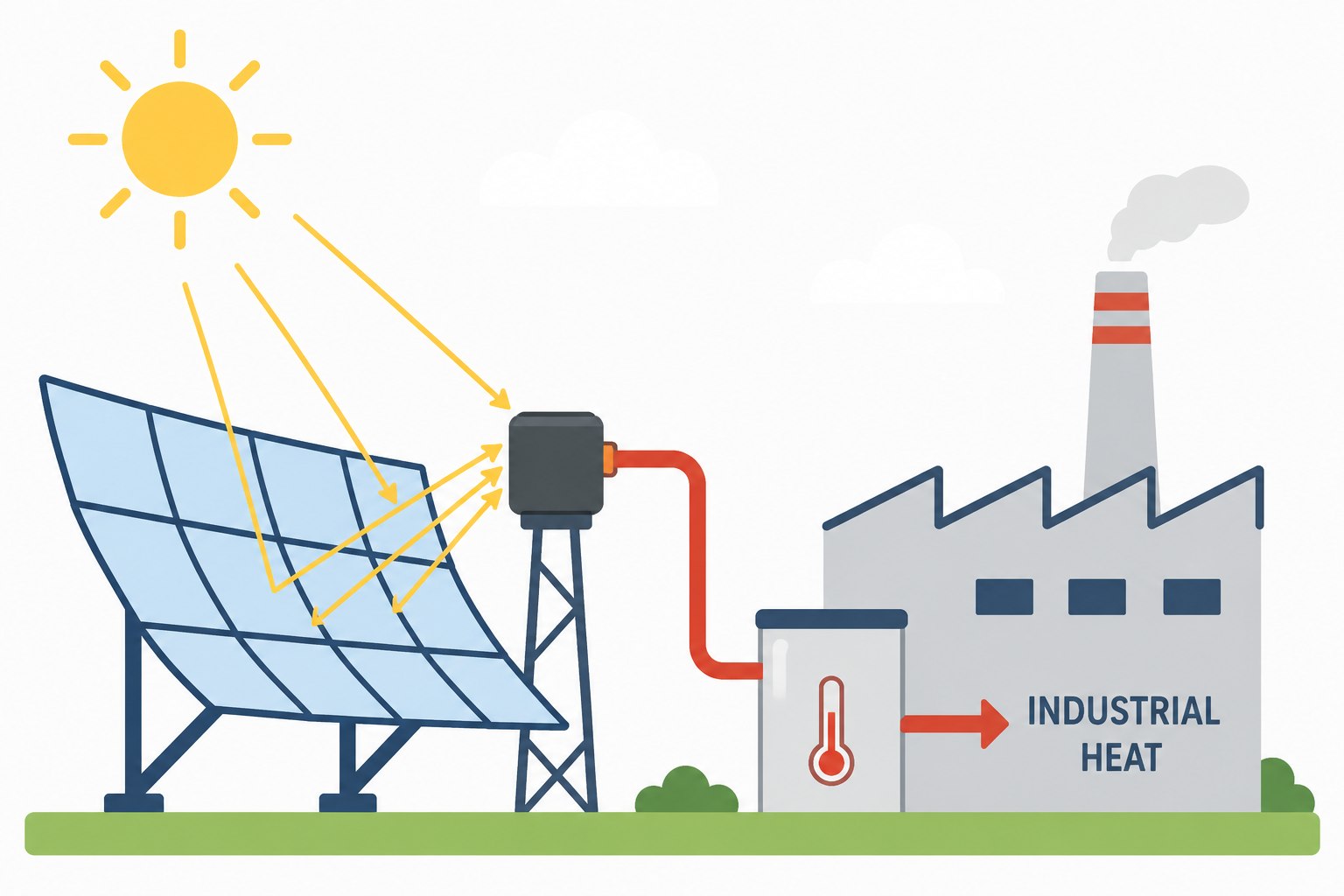
QuantSolar’s approach is based on concentrated solar thermal technology. The company uses reflective mirrors that track the movement of the sun and focus sunlight onto a receiver. The concentrated energy heats a transfer fluid or generates steam, which can then be used directly within industrial processes.
Unlike flat solar thermal collectors commonly seen in water-heating applications, concentrated solar systems are designed to achieve higher temperatures. According to QuantSolar, its systems can deliver temperatures suitable for industrial process heat and steam applications. The company says its technology is intended for industries including food processing, textiles, pharmaceuticals, chemicals and manufacturing.
A significant part of QuantSolar’s technology involves its solar tracking and optical systems. Because concentrated solar thermal systems depend on maintaining focus on the receiver, precise tracking is important.
The company positions its technology as a substitute for fossil-fuel-based industrial heating rather than as a replacement for electrical systems. In practical terms, this means a factory can use solar-generated steam or heat during daylight hours while reducing consumption of coal, diesel, furnace oil or gas. Backup systems may still be required depending on weather conditions and operating schedules.
One of QuantSolar’s notable product lines is its solar steam generation platform. According to company materials, these systems are designed to integrate with existing industrial boilers and thermal infrastructure rather than requiring complete replacement of plant equipment. This approach is important because industrial operators are often reluctant to redesign entire production systems.
Funding support has come through a combination of grants, venture investment and startup programs. QuantSolar was among the companies supported by India’s clean-energy innovation ecosystem, including incubation and technology-development programs.
In 2023, QuantSolar announced a funding round led by Speciale Invest. According to reports, the funding was intended to support commercialization, manufacturing scale-up and deployment of industrial solar thermal systems.
QuantSolar states that its systems have been deployed across industrial facilities and that customers use the technology for process heating and steam generation.
Some company materials state that solar thermal systems can reduce fuel consumption and carbon emissions substantially when integrated into industrial operations.
The market QuantSolar operates in is gaining attention globally because industrial heat remains one of the largest sources of greenhouse-gas emissions. While electricity generation has seen rapid renewable-energy adoption, industrial heating is often harder to decarbonize because factories require continuous and reliable thermal energy.
Globally, several companies are working on industrial solar thermal technologies. Israel-based Brenmiller Energy focuses on thermal-energy storage systems combined with renewable heat generation. German and European firms such as Solarlite and Industrial Solar have developed concentrated solar thermal solutions for industrial applications. Companies in Spain, Australia and the Middle East are also deploying solar heat systems for industrial processes and desalination projects.
The broader sector includes multiple technological approaches. Some companies use parabolic trough collectors, while others use heliostat fields, Fresnel reflectors or thermal-storage systems. The common goal is reducing dependence on fossil fuels for industrial heat generation.
India represents a particularly important market because of its large manufacturing base and strong solar resource. Industries such as textiles, dairy processing, food manufacturing, pharmaceuticals and chemicals consume large amounts of thermal energy. Many facilities still depend heavily on coal and furnace oil, making them potential candidates for solar thermal integration.
Unlike rooftop solar electricity projects, industrial heat systems require close integration with manufacturing operations. Engineers must match heat demand profiles, operating temperatures, steam requirements and production schedules. This makes deployment more complex than installing photovoltaic panels. QuantSolar’s strategy focuses on designing systems that fit into existing industrial processes rather than requiring factories to redesign operations around the technology.
One challenge facing the entire solar thermal industry is competition from rapidly falling solar photovoltaic prices. As electricity from solar panels becomes cheaper, some companies explore electrification pathways using electric boilers and heat pumps. Solar thermal firms argue that direct heat generation can still be more efficient in certain industrial applications because it avoids multiple energy-conversion steps.
Industrial heat accounts for a major share of manufacturing energy consumption, yet many renewable-energy discussions concentrate almost entirely on electricity generation. QuantSolar’s technology is aimed at that overlooked segment.
- Our Correspondent