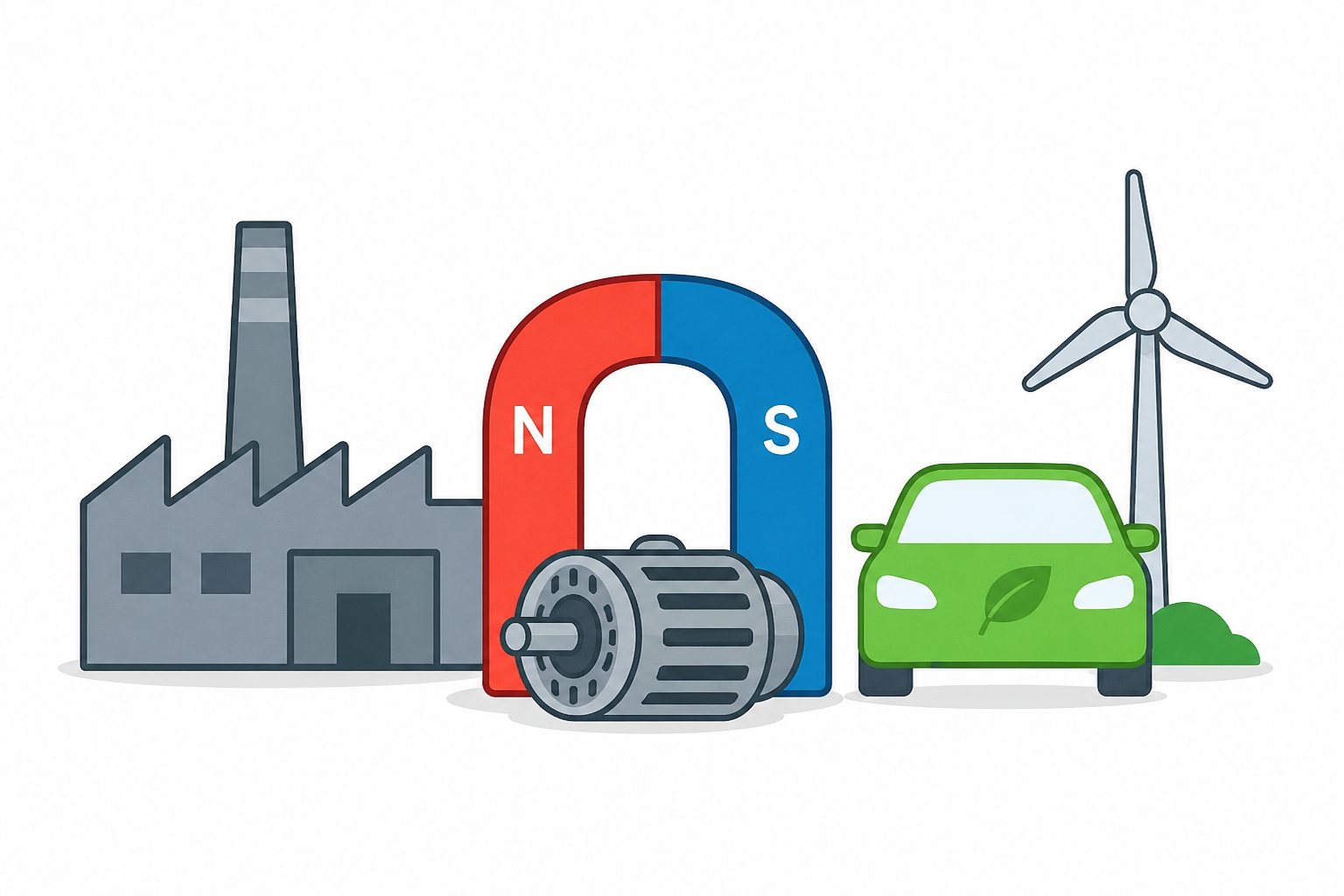
India’s electric vehicle industry, renewable energy sector and electronics manufacturers all depend heavily on rare earth permanent magnets.
These magnets sit inside electric motors, wind turbines, industrial equipment, smartphones and a wide range of advanced technologies. Despite their importance, India has historically relied on imports, particularly from China, for most of its rare earth magnet requirements.
Hyderabad-based Midwest Advanced Materials Private Limited (MAM) is attempting to change that.
In May 2024, the Technology Development Board (TDB) under the Department of Science and Technology approved support for Midwest Advanced Materials to commercialize the production of neodymium-based materials and rare earth permanent magnets in India. The project represents one of the country’s most ambitious efforts to establish a domestic rare earth magnet manufacturing ecosystem.
What Problem Is the Company Solving?
Rare earth permanent magnets, especially Neodymium-Iron-Boron (NdFeB) magnets, are among the strongest magnets commercially available.
These magnets are essential components in:
* Electric vehicle traction motors
* Wind turbine generators
* Smartphones and consumer electronics
* Industrial motors
* Medical imaging equipment
* Defence and aerospace systems
India currently imports much of its rare earth magnet requirement. This creates supply-chain vulnerabilities because global production is heavily concentrated in China.
Midwest Advanced Materials is trying to establish a domestic manufacturing chain that starts with rare earth oxides and ends with finished magnets. The goal is not merely assembling magnets but producing them through an integrated process within India.
How the Technology Works
The project is based on technology developed by the Nonferrous Materials Technology Development Centre (NFTDC), a research institution under the Ministry of Mines.
According to the Department of Science and Technology, NFTDC transferred its technology to Midwest Advanced Materials for commercial deployment. The technology focuses on producing neodymium materials and rare earth permanent magnets using a modified metal extraction process based on Molten Salt Electrolysis (MSE).
In simple terms, the process works in several stages.
Rare earth oxides are first obtained as raw material. Through electrochemical processing, these oxides are converted into metallic rare earth materials. The metals are then processed into magnet alloys, converted into powders and finally manufactured into finished NdFeB magnets.
The use of molten salt electrolysis is significant because it can reduce some of the environmental impacts associated with conventional extraction and refining methods. The government described the process as an environmentally sustainable electrolysis approach supported by proprietary cell designs.
Production Plans
The first phase of the project is designed as a commercial-scale demonstration facility.
According to the Technology Development Board, the initial production target is 500 tonnes of rare earth permanent magnets annually. The company plans to increase this capacity substantially over time.
The stated long-term target is 5,000 tonnes per year by 2030.
Government Support and Funding
One of the most important milestones for Midwest Advanced Materials came in May 2024 when the Technology Development Board approved financial support for the project.
Deployment Status
The project has moved beyond laboratory research.
Government documents describe it as a Technology Readiness Level 9 (TRL-9) demonstration effort, indicating that the technology has reached commercial deployment readiness.
The company is working toward establishing integrated production facilities capable of commercial magnet manufacturing.
A later government review of India’s rare earth ecosystem identified Midwest Advanced Materials as one of the key entities developing NdFeB rare earth permanent magnet manufacturing capability in the country.
Market Significance
Demand for NdFeB magnets is increasing globally due to rapid growth in electric mobility and renewable energy. Electric vehicles use these magnets in high-efficiency motors, while wind turbines require large quantities of permanent magnets for power generation.
The Department of Science and Technology specifically highlighted e-mobility and clean energy as major demand drivers for the project.
In December 2025, the Government of India approved a ₹7,280 crore scheme to build a domestic rare earth permanent magnet manufacturing ecosystem with a planned national capacity of 6,000 tonnes per year. Midwest Advanced Materials’ project predates and aligns closely with this broader policy effort.
Competing Players
Midwest Advanced Materials is entering a market dominated by global manufacturers.
China currently accounts for the overwhelming majority of global NdFeB magnet production. Multiple international efforts are underway to diversify supply chains and reduce dependence on a single geography.
Globally, companies such as MP Materials in the United States, VAC Group in Germany, Hitachi Metals’ successor operations in Japan, and emerging firms such as HyProMag in the United Kingdom are investing in domestic magnet manufacturing and recycling technologies.
Within India, the rare earth magnet manufacturing ecosystem remains relatively small, making Midwest Advanced Materials one of the earliest companies attempting vertically integrated production from oxide to finished magnet.
The Bigger Picture
Rare earth magnets are becoming a strategic technology rather than just an industrial product.
Countries around the world are investing heavily in “mine-to-magnet” supply chains because these materials underpin electric vehicles, renewable energy systems, defence equipment and advanced electronics. Governments in India, the United States, Europe and Japan are all supporting domestic manufacturing efforts in this sector.
Midwest Advanced Materials sits at the intersection of these trends. Its planned production facility aims to bring together domestic raw materials, Indian-developed processing technology and local manufacturing capability. If the company achieves its stated target of scaling from 500 tonnes to 5,000 tonnes annually by 2030, it could become one of the central players in India’s emerging rare earth magnet industry.
- Our correspondent