
For many people who lose a limb or need long-term physical support devices, the biggest challenge is not only medical recovery but access.
Advanced prosthetics and orthotic devices are often expensive, difficult to customize, and concentrated in a few urban medical centers.
Bengaluru-based Rise Bionics is one of the Indian companies trying to change that using digital manufacturing, scanning systems, and locally developed assistive devices.
Founded in 2015, Rise Bionics develops customized prosthetic and orthotic devices for people with limb loss and mobility impairments. The company designs artificial legs, prosthetic arms, spinal braces, foot orthotics, and other assistive devices using digital scanning and fabrication systems instead of many traditional casting methods.
The company was founded by Arun Cherian, a mechanical engineer and robotics researcher. Cherian completed a master’s degree in mechanical engineering at Columbia University, worked as a researcher at the University of California, Berkeley, and later pursued a PhD at Purdue University focused on biomechanics and wearable exoskeletal systems.
Cherian’s original idea came from observing cane furniture made from rattan in India. He became interested in whether flexible natural materials could be adapted into lightweight prosthetic limbs. That experimentation eventually evolved into a larger assistive-device company.
In its early phase, Rise Bionics focused heavily on lower-limb prosthetics made using natural composite materials. Over time, however, the company expanded into a broader digital prosthetics and orthotics platform covering multiple body areas. Rise Bionics now provides devices for the legs, arms, spine, neck, and feet.
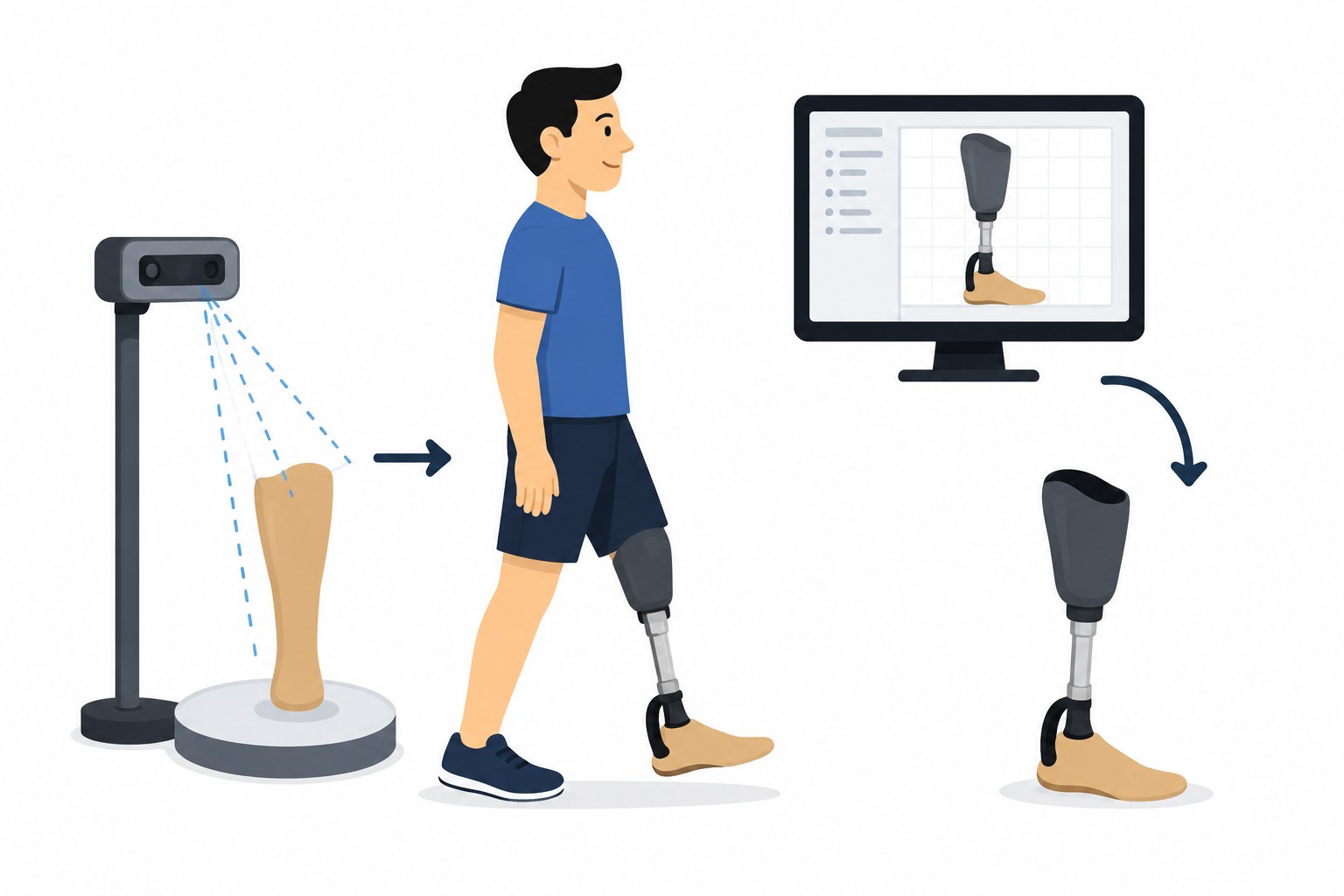
The core of the company’s system is digital measurement and fabrication. Traditionally, prosthetic and orthotic fitting often involves creating physical plaster casts around a patient’s body or residual limb. This process can take time, depends heavily on technician skill, and may require repeated hospital visits.
Rise Bionics instead uses portable 3D scanning systems. A local healthcare worker or hospital partner scans the affected body area digitally in a few minutes. The scan is uploaded to a cloud-based system, where technicians and clinicians modify the design digitally before fabrication begins.
According to the company and innovation-network documentation, the fabricated device can then be produced centrally and shipped back to the local practitioner for fitting. Rise Bionics says many devices can be delivered within one or two days after scanning.
One notable part of the company’s manufacturing process is that it does not rely primarily on conventional 3D printing for many products. Standard 3D printing can take 15 to 24 hours for a single device. Rise Bionics instead developed proprietary digital carving systems that reportedly reduce fabrication time to minutes for some components.
The company claims its systems achieve sub-millimeter fitting accuracy for assistive devices. These include prosthetic limbs as well as orthotic systems for conditions such as scoliosis, cerebral palsy, epilepsy-related mobility issues, and spinal support needs.
Rise Bionics received international attention after participating in Cybathlon, a global competition in Zurich involving advanced assistive technologies.
The company has also worked with hospitals, government agencies, and nonprofit programs.
Public information also suggests that the company has worked with ALIMCO, the central government public-sector company focused on assistive devices, and explored larger deployment programs with state governments.
Market feedback for the company has largely centered around affordability and turnaround time. Traditional imported bionic prosthetics can cost several lakh rupees and may require multiple fittings. Rise Bionics positions itself as a lower-cost alternative while still using digitally customized production methods.
The company operates in a growing global market for prosthetics, orthotics, and wearable assistive systems. Internationally, companies such as Open Bionics, Touch Bionics, and Ekso Bionics have developed advanced bionic limbs and robotic mobility systems. Some focus on robotic hands, while others specialize in powered exoskeletons or AI-assisted movement systems.
India’s market differs from many Western countries because affordability and geographic access are major barriers. Large numbers of patients live far from specialized prosthetic clinics, and many devices are still handcrafted using labor-intensive methods. Rise Bionics’ use of remote scanning and centralized fabrication is partly aimed at reducing that access problem.
Globally, prosthetics and orthotics are becoming more technology-driven. Advances in lightweight composites, digital scanning, AI-assisted gait analysis, wearable sensors, and robotic control systems are improving device functionality. However, high costs remain a major issue worldwide. Many advanced robotic limbs still remain inaccessible for large populations in low- and middle-income countries.
Rise Bionics represents a different approach from many high-end Western prosthetics companies. Instead of focusing only on premium robotic systems, the company has concentrated on reducing fabrication time, lowering costs, and increasing reach through distributed digital manufacturing.
- Our correspondent


Leave a Comment