Large parts of rural India still face a basic healthcare access problem.
Villages may have pharmacies and informal practitioners, but specialist consultations, diagnostic testing, chronic disease management, and organized follow-up care are often concentrated in towns and cities.
Odisha-based CureBay is one of several Indian health-tech companies trying to build structured healthcare delivery systems for these underserved regions.
Founded in 2021, CureBay operates a hybrid healthcare network that combines physical rural health centers, telemedicine consultations, diagnostics, pharmacy services, and digital patient management. The company focuses primarily on semi-urban and rural districts, especially in eastern India.
The company was founded by Priyadarshi Mohapatra, Lalit Mohan, and Dr. Manas Ranjan Sahoo. Priyadarshi Mohapatra serves as founder and CEO. Before CureBay, he worked in financial services and technology sectors, including leadership roles at companies such as Ola Financial Services and Religare Health Insurance.
Co-founder Lalit Mohan has a background in technology and healthcare operations, while Dr. Manas Ranjan Sahoo brings medical and healthcare administration experience to the company.
The company was built around a specific operational problem. Rural patients often travel long distances for consultations, diagnostics, and chronic disease treatment. Even when telemedicine exists, connectivity gaps, low digital literacy, and lack of local support can limit adoption. CureBay’s model therefore combines digital systems with physical neighborhood-level care points instead of relying entirely on smartphone apps.
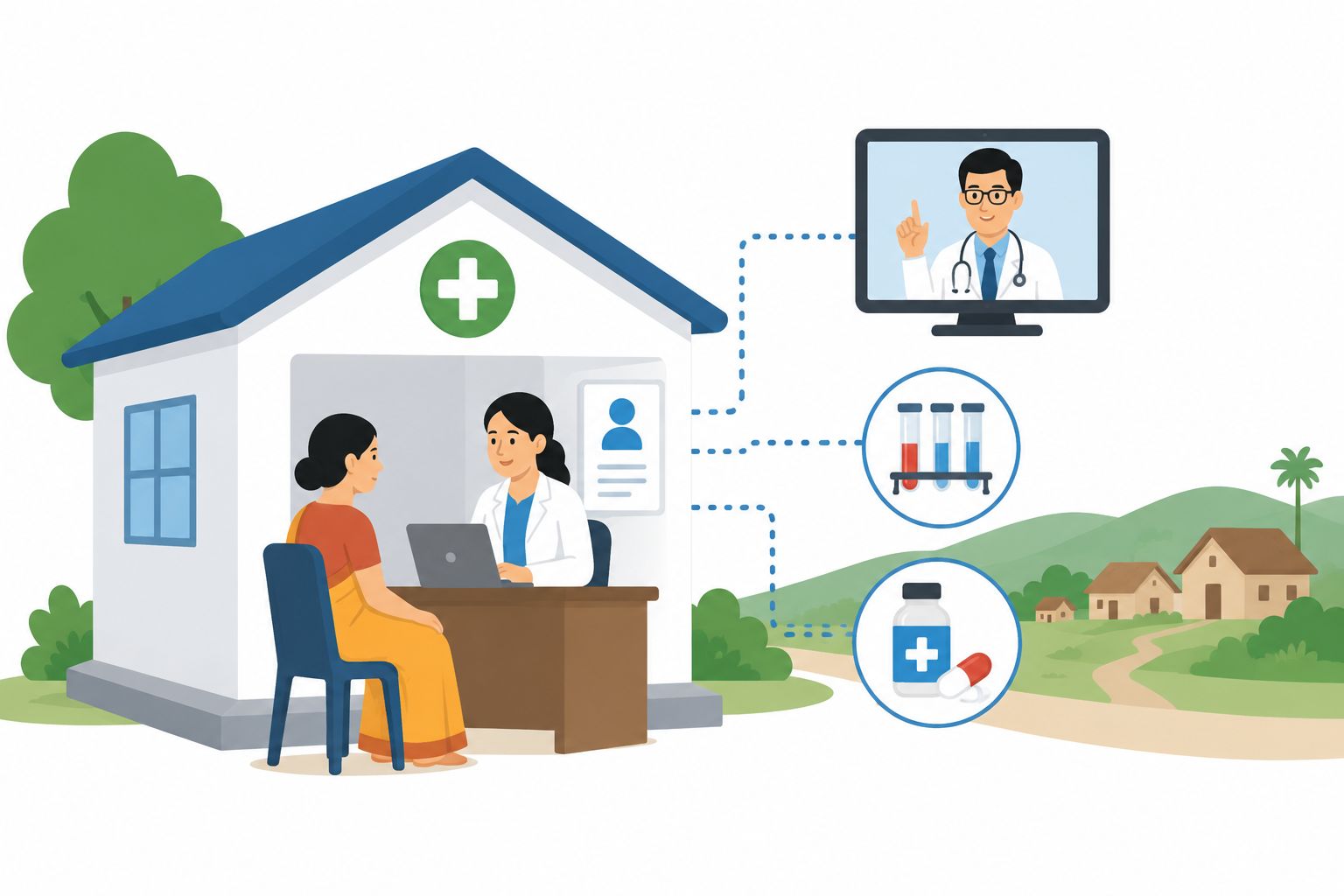
Its core operating unit is called the “eClinic.” These are small local healthcare centers run through trained rural entrepreneurs and healthcare workers. Patients visit these centers for primary consultations, digital health records, diagnostics coordination, medicine ordering, and teleconsultations with doctors located elsewhere.
In practical terms, the process works in stages. A patient arrives at a CureBay-linked eClinic in their village or nearby area. Staff members register the patient digitally and record symptoms, vital signs, and basic health data. If needed, the patient is connected through video consultation to a remote doctor. Diagnostic tests can be booked through partner laboratories, and medicines can be delivered through CureBay’s pharmacy network. Follow-up visits are then tracked through the platform.
The company places particular emphasis on chronic disease management. Conditions such as diabetes, hypertension, heart disease, and respiratory illnesses require repeated monitoring rather than one-time treatment. Rural patients often discontinue care because hospitals are distant and transport costs are high. CureBay says its system is designed to maintain continuity through local follow-up centers and digital records.
Diagnostics are another major component of the platform. Rural areas frequently lack organized sample collection and testing infrastructure. CureBay partners with diagnostic providers and organizes collection logistics through its centers. According to company statements, the platform also supports medicine delivery and home healthcare coordination in some regions.
A key feature of the model is that CureBay does not position itself only as a telemedicine app. Its approach depends heavily on physical local infrastructure and field workers. The company says its eClinics are operated through local entrepreneurs called “Swasthya Mitras,” who function as healthcare facilitators inside communities.
By 2024, CureBay stated that it operated more than 150 eClinics across Odisha and Chhattisgarh. The company says that a large percentage of its users are women and elderly patients, partly because local access reduces travel barriers.
In 2022, CureBay raised approximately $5 million in a seed funding round led by Elevar Equity, with participation from British International Investment and other investors.
In 2024, the company raised another $21 million in Series B funding led by Bertelsmann India Investments. Existing investors Elevar Equity and British International Investment also participated.
The company’s operations have expanded gradually and Odisha remains its strongest operating geography. This is partly because healthcare logistics in rural regions require local trust networks, field teams, and partnerships with hospitals and diagnostic providers.
CureBay operates in a competitive but still evolving category. Other Indian companies working in rural or distributed healthcare include DocsApp, Practo, Medibuddy, and 1mg in telemedicine and diagnostics, though many are more urban-focused. Companies such as Karma Healthcare and iKure have also built rural healthcare delivery models involving local clinics and digital systems.
Globally, similar healthcare delivery approaches exist in countries with large rural populations and healthcare shortages. In Africa, companies like Babyl Rwanda and mPharma have combined digital health systems with community-based healthcare delivery. In Southeast Asia and Latin America, hybrid telemedicine and physical-clinic networks have grown in regions where specialist healthcare access remains uneven.
The broader category is often referred to as “phygital healthcare” — a combination of physical and digital systems. Pure telemedicine models expanded rapidly during the COVID-19 pandemic, but many companies later discovered that remote healthcare alone often struggles in areas with low digital access or limited healthcare literacy. Hybrid systems with local facilitators have therefore gained attention in emerging markets.
India’s rural healthcare market remains difficult operationally. Recruiting clinicians, maintaining diagnostics quality, managing medicine supply chains, and sustaining economics in low-income areas are all major challenges.
What distinguishes CureBay from many urban-focused health-tech platforms is its attempt to build a structured healthcare network inside smaller towns and villages rather than simply extending city-based teleconsultations outward.
- Our Correspondent