Green hydrogen is often described as one of the most important clean-energy technologies for the future.
Industries such as steel, fertilizers, chemicals, shipping, and heavy transport are difficult to electrify fully with batteries alone. Hydrogen is increasingly seen as one possible alternative fuel for those sectors.
But there is one major problem: green hydrogen is still expensive to produce.
Bengaluru-based climate-tech startup Newtrace is building technology aimed at reducing those costs by improving one of the most critical components inside hydrogen production systems — the electrolyzer electrode.
Founded in 2021 by Prasanta Sarkar and Rochan Sinha, the company develops advanced electrode and electrolyzer technologies for green hydrogen production.
The founders come from technical and engineering backgrounds linked to hydrogen systems and fluid mechanics. Prasanta Sarkar has worked in fluid mechanics, while Rochan Sinha had worked on technologies related to green hydrogen generation before starting the company.
The founders initially worked on membrane-less electrolyzer concepts inside an IIT Madras laboratory environment before building Newtrace as a commercial venture. To understand what Newtrace does, it helps to understand how green hydrogen is made.
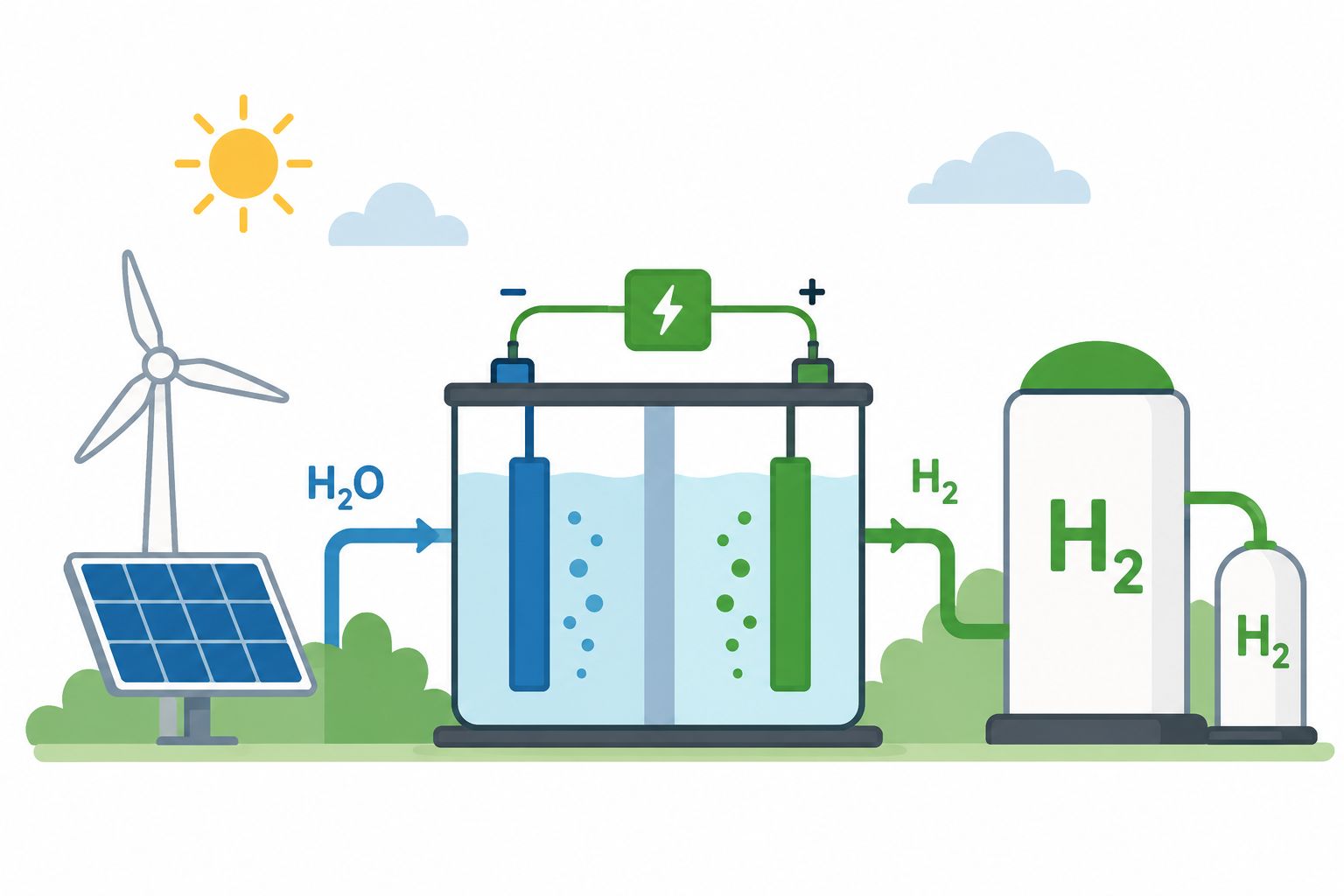
Green hydrogen is produced through a process called electrolysis. Electricity is passed through water, splitting water molecules into hydrogen and oxygen. If the electricity comes from renewable sources such as solar or wind power, the resulting hydrogen is called “green hydrogen.”
The machine that performs this process is called an electrolyzer.
Inside the electrolyzer, electrodes are among the most important components because they drive the chemical reactions required to split water molecules. The efficiency and durability of those electrodes strongly affect how expensive hydrogen becomes to produce.
That is the specific engineering problem Newtrace is targeting.
Instead of trying to build entire hydrogen plants, the company focuses heavily on component-level innovation. Its main technology platform is called Voltagen, a proprietary electrode system designed for alkaline water electrolyzers.
According to the company, Voltagen is designed to improve energy efficiency, increase electrolyzer lifespan, reduce operating costs, and work as a “drop-in replacement” inside existing alkaline electrolyzer systems. That last detail is important commercially.
Many industrial customers already operate or plan to deploy alkaline electrolyzers. If Newtrace’s electrodes can be integrated into existing systems without requiring complete redesigns, adoption becomes easier.
The startup also claims the system produces ultra-pure hydrogen and improves durability under commercial operating conditions. Newtrace operates in a part of the hydrogen industry that is far more engineering-heavy than most software startups.
Hydrogen hardware companies face challenges involving materials science, manufacturing precision, thermal management, electrochemistry, and industrial reliability. That makes the sector capital-intensive and slower-moving than conventional SaaS startups.
Despite that, Newtrace has attracted substantial investor interest for a relatively young deeptech company.
In 2022, the startup raised approximately $1 million in a pre-seed round led by Speciale Invest and Micelio Fund. In May 2023, the company raised $5.65 million in seed funding led by Sequoia Capital India and Aavishkaar Capital, with participation from Speciale Invest, Micelio Fund, Urban Ladder founder Ashish Goel, and IKP Knowledge Park.
Then in March 2026, Newtrace raised another $6.3 million in a Pre-Series A round led by HDFC Bank and Mitsui Sumitomo Insurance Venture Capital. Existing investors including Peak XV’s Surge, Aavishkaar Capital, Speciale Invest, and Micelio Technology Fund also participated.
Unlike EV startups that can demonstrate products directly to consumers, hydrogen infrastructure companies typically move through industrial pilot cycles. Deployment timelines are slower because customers are usually large industrial operators rather than retail buyers.
The broader market context around green hydrogen is becoming increasingly important globally.
Governments across Europe, Asia, Australia, and the Middle East are investing heavily in hydrogen infrastructure because industries like steelmaking, fertilizers, chemicals, and shipping are difficult to decarbonize using electricity alone.
India has also launched the National Green Hydrogen Mission, which targets 5 million metric tonnes of annual green hydrogen production by 2030. The government has announced incentives for electrolyzer manufacturing and hydrogen production infrastructure. Globally, several companies are working on advanced electrolyzer technologies.
Australian company Hysata develops high-efficiency alkaline electrolyzers and raised more than $100 million in funding backed by BP Ventures. Other international players include Ohmium, Nel Hydrogen, Plug Power, and ITM Power.
In India, startups such as Hydgen are also building localized green hydrogen systems for industrial applications.
But scaling deep industrial hardware is difficult. Manufacturing consistency, long-term durability, industrial certification, and supply-chain reliability all become critical challenges once pilot systems move into commercial deployment.
Newtrace is still early in that transition.
But the company represents a growing wave of Indian deeptech startups trying to build foundational climate infrastructure technologies rather than consumer-facing clean-energy products.
- Our correspondent