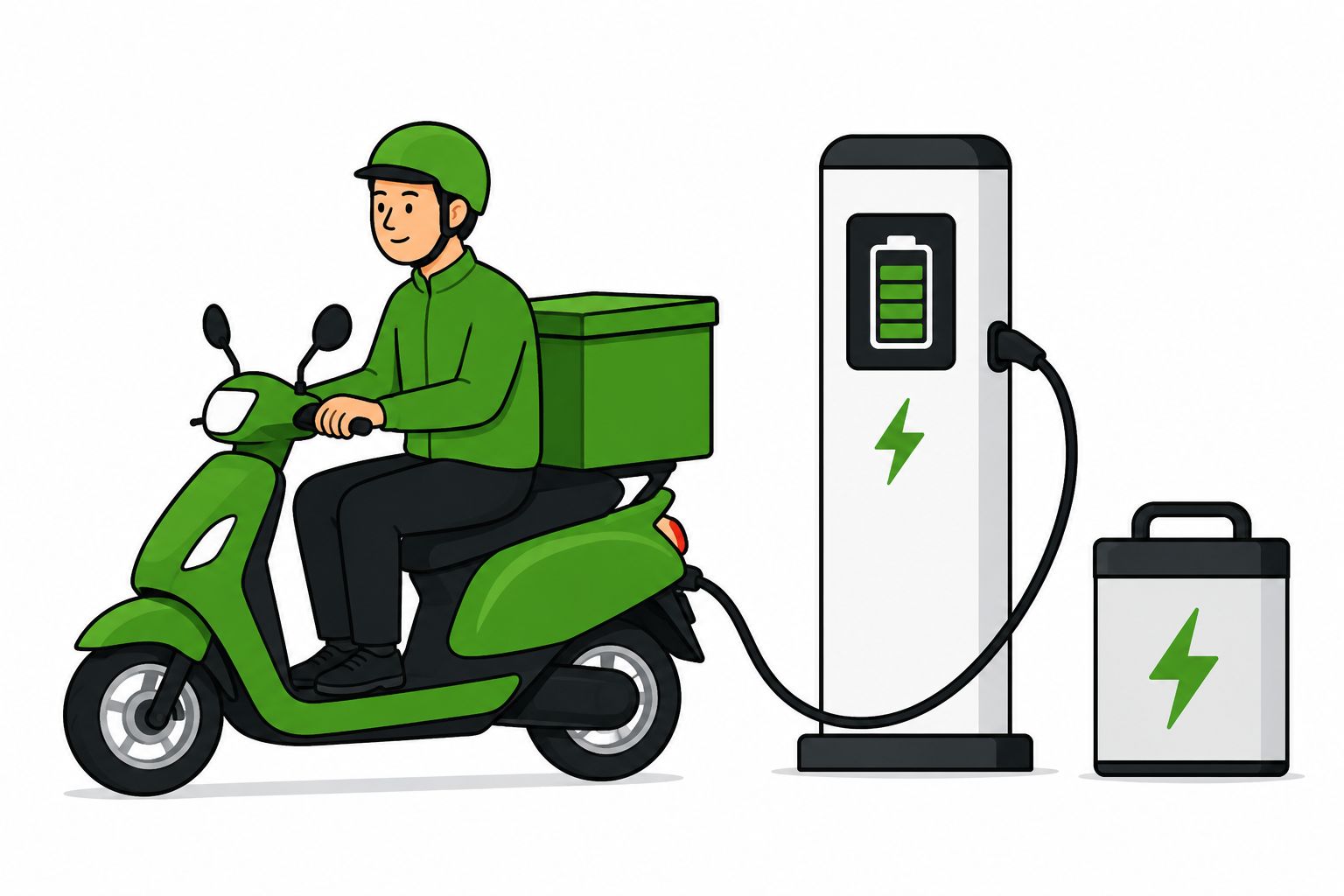
Electric scooters are now everywhere in Indian cities. Delivery riders working for quick-commerce and food-delivery platforms spend long hours on the road carrying groceries, meals, and packages across dense urban routes. But one major problem continues to slow large-scale electric fleet adoption: charging downtime.
A delivery rider cannot afford to wait several hours for a battery to charge in the middle of a workday.
Bengaluru-based startup EMO Energy is building battery systems specifically designed around that operational challenge. The company develops fast-charging battery packs, battery-management software, and charging infrastructure for electric two-wheelers used in commercial fleets.
Founded in 2022 by Sheetanshu Tyagi and Rahul Patel, the company focuses on urban mobility and energy-storage systems. Multiple investor reports and company profiles describe both founders as former engineers associated with companies such as Tesla, Rivian, Ather, and General Motors.
The founders started EMO Energy after observing a gap between how consumer electric scooters are designed and how commercial delivery fleets actually operate.
A personal EV owner may charge overnight at home. But commercial fleet riders often travel close to 100 kilometers a day while making repeated short-distance trips. That creates a very different battery requirement. The vehicle needs to charge quickly, survive constant charging cycles, and continue operating with minimal downtime.
EMO Energy’s core product is its battery technology platform called ZEN or ZenPac, depending on the deployment configuration. The company says its battery packs can charge to high levels within roughly 20 minutes.
That is a significant difference from conventional electric two-wheelers, which often require several hours for a full charge. The company’s approach combines both hardware and software.
On the hardware side, EMO develops liquid-cooled lithium battery packs for high-usage commercial vehicles. Heat management is one of the biggest technical challenges in fast charging because batteries degrade faster when exposed to repeated thermal stress.
Instead of treating the battery as a single large unit, EMO says its system models performance at the cell level. The platform continuously monitors heat, charge cycles, and battery health to predict degradation patterns.
The company also claims its battery-management software uses AI and machine-learning models to optimize battery performance and extend battery life. In practice, the company is trying to solve three operational problems at the same time: fast charging, battery lifespan, and fleet uptime.
EMO’s focus is not on premium personal scooters. The company primarily targets logistics fleets, commercial riders, and delivery networks. That has shaped the way its charging infrastructure is deployed.
The company calls this ecosystem SWFT fast charging.
In May 2023, the company raised approximately $1.2 million in seed funding led by Transition VC and co-led by Gruhas. The company later raised $6.2 million in a Series A round in January 2025 led by Subhkam Ventures, with participation from Transition VC and other investors including Microtek Group and SRK Family Office.
The company also claims to have accumulated operational data from more than 10 million kilometers of fleet usage.
Globally, EMO operates within a rapidly growing category of battery-tech and charging-infrastructure companies focused on commercial EV fleets.
In the United States, companies like Ample work on modular battery-swapping systems for electric vehicles. China has developed large battery-swapping ecosystems through companies such as NIO. In India, players like Ather Energy have focused heavily on consumer charging infrastructure, while startups including Battery Smart and Sun Mobility have expanded battery-swapping networks.
EMO’s positioning is somewhat different from both public charging networks and battery-swapping companies.
The company focuses more narrowly on high-utilization commercial fleets that require frequent rapid charging rather than battery replacement. Its model depends heavily on integrating chargers directly into logistics operations rather than building citywide public charging stations.
The broader market opportunity is large because urban delivery fleets are growing rapidly across India. Quick-commerce companies promise deliveries within minutes, which increases pressure on fleet efficiency and vehicle uptime. For electric mobility companies, charging speed increasingly becomes an operational economics problem rather than just an engineering problem.
That is where EMO is trying to differentiate itself.
Instead of treating the battery as a standalone hardware product, the company is building a tightly connected system involving battery packs, thermal management, predictive software, charging infrastructure, and fleet analytics.
- Our correspondent