Industrial inspection work often happens in places that are difficult and dangerous for humans to enter.
Aircraft engines, oil storage tanks, ship hulls, refinery pipelines, and confined machinery spaces need regular inspection and maintenance, but many of these environments involve heat, toxic materials, narrow openings, or difficult geometry.
Armatrix Automations, an Indian robotics startup founded by IIT Kanpur alumni, is building robotic systems designed specifically for these environments. The company develops flexible, snake-like robotic arms that can move through tight industrial spaces and carry out inspection and maintenance work without requiring humans to physically enter hazardous areas.
The startup was founded by Vishrant Dave, Ayush Ranjan, and Prateesh Awasthi, all graduates from IIT Kanpur with backgrounds in robotics and engineering.
According to the company’s timeline, the idea initially focused on control systems for “hyper-redundant” robotic arms. These are robotic systems with many joints and segments, allowing them to bend and move through curved or confined spaces in ways conventional robotic arms cannot. The founders presented early work on these control systems at the International Astronautical Congress in 2023 and won a Best Presentation award there.
The company was formally incorporated as Armatrix Automations Pvt. Ltd. in January 2024.
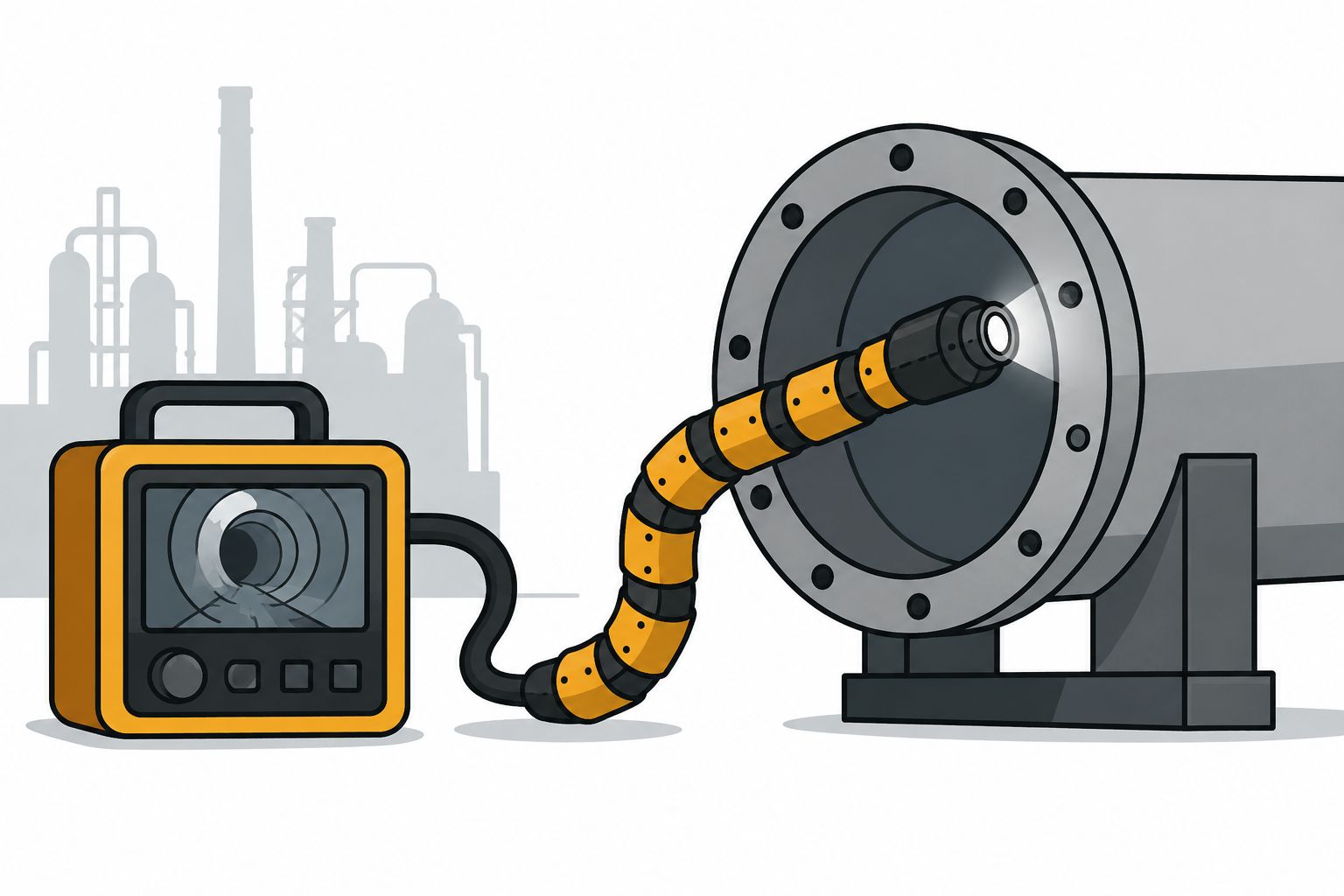
Armatrix’s core product is a modular robotic arm that resembles a flexible mechanical snake. The system is designed to enter spaces with diameters between 50 mm and 150 mm while reaching lengths of up to 3 to 5 metres.
In practical terms, this means the robot can move inside equipment such as aircraft engines, industrial tanks, turbines, or pipelines without requiring large-scale dismantling. Instead of opening up entire systems or sending human workers into confined spaces, operators can insert the robotic arm through a relatively small access point.
The robot uses an externally actuated system rather than embedding heavy motors throughout the arm itself. This matters because traditional robotic arms become bulky and rigid when many motors are packed into narrow structures. By placing much of the actuation system externally, Armatrix aims to keep the arm slim and flexible while still maintaining movement precision.
The arm can carry different end-effectors depending on the task. According to the company, these include visual inspection tools, welding tools, and painting modules.
The inspection use case is the company’s current primary focus. In industrial inspection, the robotic arm can carry cameras and sensors into hard-to-reach internal structures. The system is intended to help maintenance teams detect cracks, corrosion, structural wear, or faults early before they become expensive failures.
The company also states that its systems use AI-powered navigation and real-time spatial awareness.
Armatrix is targeting industries where confined-space inspection is routine and downtime is expensive. These sectors include aviation, oil and gas, shipbuilding, and defence manufacturing.
For example, aircraft engine inspection is a major maintenance operation globally. Engines contain narrow internal passages that are difficult to inspect manually. Similarly, crude oil tanks and industrial vessels often require shutdowns and human entry procedures involving extensive safety protocols. The company’s pitch is that robotic systems can reduce both downtime and worker exposure to hazardous environments.
In 2024, the startup also received support from Emergent Ventures, which awarded the company a $40,000 grant. The company later became part of the second cohort of Nikhil Kamath’s WTFund initiative and received a grant of ₹20 lakh in March 2025.
The largest disclosed funding round came in 2026, when Armatrix raised $2.1 million in a pre-seed round led by pi Ventures. Investors included Inuka Capital, Boundless Ventures, Boost VC, Turbostart, and gradCapital.
Public reporting suggests the startup may use a Robot-as-a-Service model in some sectors while also selling robots directly in industries where security or IP restrictions limit service-based operations.
Gobally, Armatrix operates in a specialised but growing robotics category focused on confined-space and hazardous-environment inspection.
One of the most important historical companies in this space was OC Robotics in the United Kingdom, which built snake-arm robots for aerospace inspection before being acquired by GE Aviation in 2017. Japanese company HiBot develops inspection robots for industrial infrastructure, pipelines, and nuclear environments.
The broader industrial robotics sector is also seeing increased investment globally. While many recent robotics headlines focus on humanoid robots, industrial inspection remains an important commercial segment because companies are willing to pay for systems that reduce downtime and improve safety.
India’s robotics ecosystem is also expanding quickly. Companies such as Addverb, GreyOrange, Unbox Robotics, and Perceptyne are working on warehouse automation, industrial robotics, and AI-driven robotic systems. Armatrix differs from many of them because its focus is specifically on confined-space industrial maintenance rather than warehouse operations or logistics automation.
The category itself remains technically difficult. Robots operating inside industrial machinery must deal with vibration, heat, limited visibility, irregular surfaces, and unpredictable geometry. A system that works in a controlled demonstration environment may fail in real industrial conditions. This is one reason why early pilots and field deployments matter far more than lab demonstrations in industrial robotics.
- Our correspondent