Drug discovery is usually a slow and expensive process. Scientists often spend years testing thousands of molecules in laboratories before identifying one that might eventually become a medicine. Most candidates fail somewhere along the way. Pharmaceutical companies can spend billions of dollars before a single drug reaches patients.
San Francisco-based Chai Discovery is part of a growing group of companies trying to change that process using artificial intelligence.
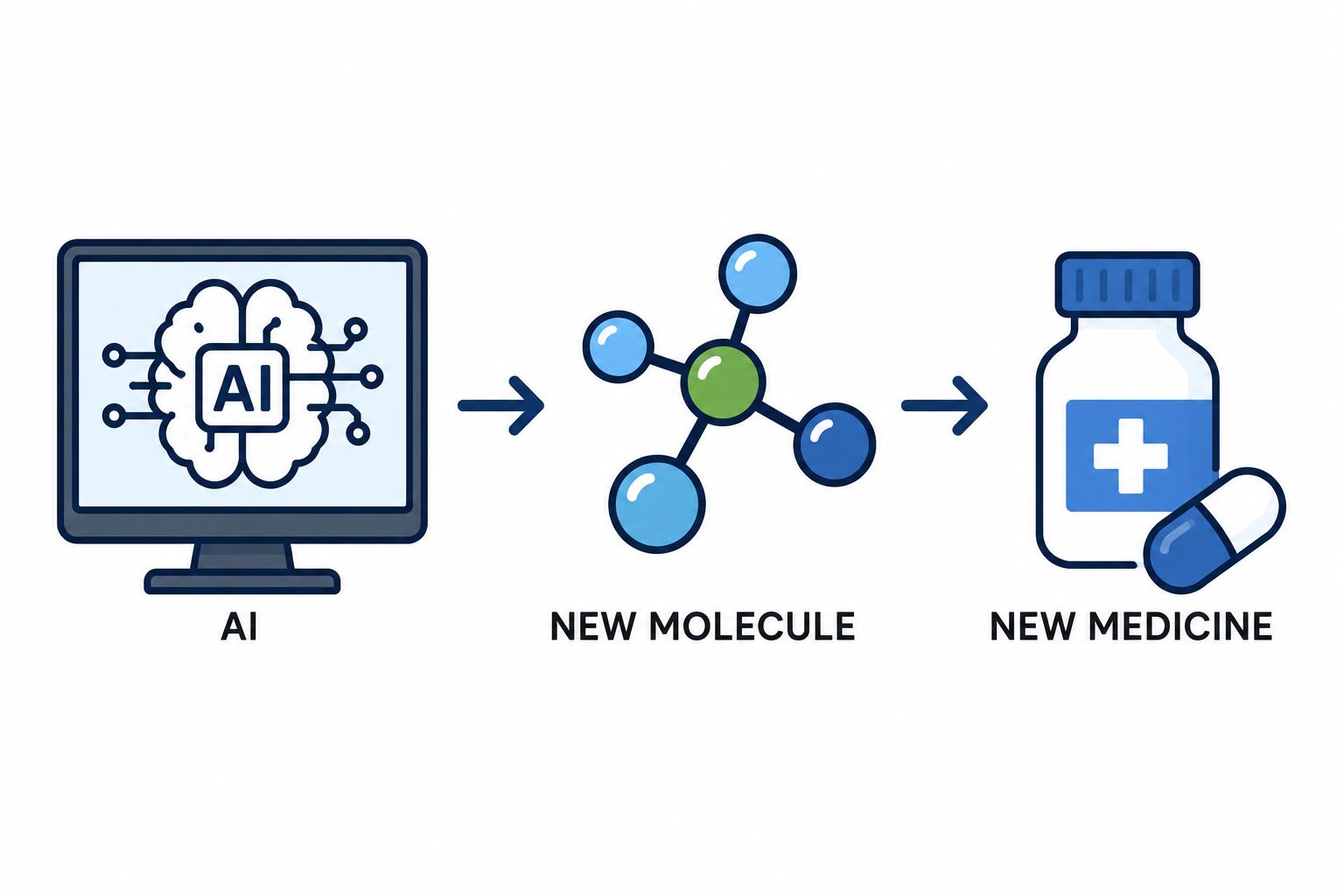
Founded in 2024, the company develops AI models designed to predict how biological molecules behave and interact. Instead of relying only on traditional laboratory screening, Chai Discovery aims to use machine learning systems to design entirely new molecules digitally before they are synthesized and tested in real-world experiments.
The company works in a field often described as AI-driven drug discovery or computational biology. The broader goal is to reduce the time and cost required to create new medicines by using AI systems to model proteins, antibodies, DNA, RNA, and small molecules with greater accuracy.
Chai Discovery was founded by researchers and engineers with backgrounds at OpenAI, Meta, and biotechnology companies including Absci.
The startup’s best-known product so far is Chai-1, an AI model released in 2024 for molecular structure prediction. The model predicts the three-dimensional structure of proteins and other biological molecules. This matters because the shape of a molecule determines how it behaves inside the human body and whether it can bind to disease-causing targets.
For decades, predicting protein structures was one of biology’s hardest computational problems. Traditional laboratory methods such as X-ray crystallography and cryo-electron microscopy are slow and resource-intensive.
AI models changed the field dramatically. Google DeepMind’s AlphaFold became globally famous for predicting protein structures with high accuracy. Chai Discovery entered this rapidly evolving space by building its own competing system.
One unusual decision by Chai Discovery was making parts of Chai-1 openly accessible for non-commercial scientific use. According to company statements, researchers could use the model through a web interface and open-source tools.
The company later expanded beyond structure prediction into antibody design.
Traditionally, antibody discovery involves screening extremely large libraries of candidate molecules in laboratories. Chai Discovery says its AI models instead attempt to design antibodies computationally for specific disease targets.
The company describes its approach as “de novo” molecular design. In simple terms, that means the AI is not merely searching existing chemical libraries but attempting to generate entirely new molecules optimized for particular biological interactions.
One major technical challenge in this field is that biology is extraordinarily complex. Predicting whether a molecule binds successfully is only one part of the problem. Scientists must also determine whether the molecule is safe, manufacturable, stable, and clinically effective inside humans.
This is why many AI drug discovery companies still partner heavily with pharmaceutical firms that handle later-stage development, clinical trials, and regulatory approval.
Chai Discovery has begun building those partnerships. According to Contrary Research, the company established collaborations with pharmaceutical giant Eli Lilly while continuing development of its AI design systems.
Funding has expanded rapidly as investor interest in AI-driven biotech grows.
Chai Discovery raised around $70 million in 2025 from investors including Menlo Ventures, DST Global Partners, Yosemite, Thrive Capital, and OpenAI. The round reportedly valued the company at roughly $550 million.
Later in 2025, the company raised another $130 million Series B round led by Oak HC/FT and General Catalyst, reportedly pushing valuation to around $1.3 billion.
The market response to AI drug discovery has been enthusiastic but cautious.
Investors have poured billions into the sector because traditional drug development remains extremely expensive and inefficient. Even modest improvements in molecule discovery speed could save pharmaceutical companies enormous amounts of money.
At the same time, the industry still faces skepticism because many earlier AI-biotech claims did not fully translate into approved medicines. Several companies generated promising computational results but struggled to produce clinically successful drugs.
Chai Discovery competes in a rapidly expanding global category that includes companies such as Isomorphic Labs, Insilico Medicine, Owkin, and XtalPi. These firms combine biology, machine learning, molecular simulation, and large-scale computing systems to accelerate pharmaceutical research.
Globally, the field is evolving quickly because several technological trends are converging simultaneously: falling computing costs, improved protein datasets, advances in generative AI, and better laboratory automation.
AI models are increasingly capable not only of predicting molecular structures but also generating candidate molecules, simulating interactions, optimizing chemical properties, and identifying previously “undruggable” biological targets.
But major uncertainties remain. Biology is still less predictable than language or image generation. Many molecules that look promising computationally fail in animal studies or human trials. Drug development timelines also remain extremely long because clinical testing and regulatory approval can take years.
Chai Discovery appears to be positioning itself not merely as a software company but as a platform for molecular engineering. Rather than only analyzing biology, its systems attempt to actively design biological molecules computationally.
- Our correspondent