The human brain remains one of the hardest organs to study and treat. Brain disorders such as tumors, epilepsy, stroke, depression, schizophrenia, and neurodegenerative diseases often involve extremely complex neural networks that are difficult to visualize clearly through standard scans alone.
Doctors can already use MRI scans to look at the brain’s structure. But understanding how different regions of the brain connect and communicate with each other is far more difficult. In neurosurgery, even a small mistake can damage areas responsible for speech, memory, movement, or emotion.
Bengaluru-based BrainSightAI is building software designed to help doctors map these brain networks more precisely using artificial intelligence and advanced neuroimaging analysis.
Founded in 2019, the company works in neuroscience, AI-driven medical imaging, and computational psychiatry. It develops software tools that analyze MRI and functional brain imaging data to generate personalized brain maps for clinicians. The startup was founded by Laina Emmanuel and Dr. Rimjhim Agrawal.
Laina Emmanuel came from a healthcare consulting and technology background before starting the company. Dr. Rimjhim Agrawal, the company’s CTO, comes from a neuroscience and computational psychiatry background. She completed a PhD at NIMHANS focused on how AI and machine learning could advance psychiatry and neurology. Her published work includes brain imaging, machine learning, neuroimaging analytics, and computational psychiatry.
BrainSightAI’s core idea is based on “connectomics.” Connectomics studies how different parts of the brain are connected through neural pathways and communication networks. Instead of looking only at isolated brain regions, connectomics tries to map how the brain functions as an interconnected system.
This is important because many neurological and psychiatric conditions affect not just one part of the brain, but communication between multiple regions.
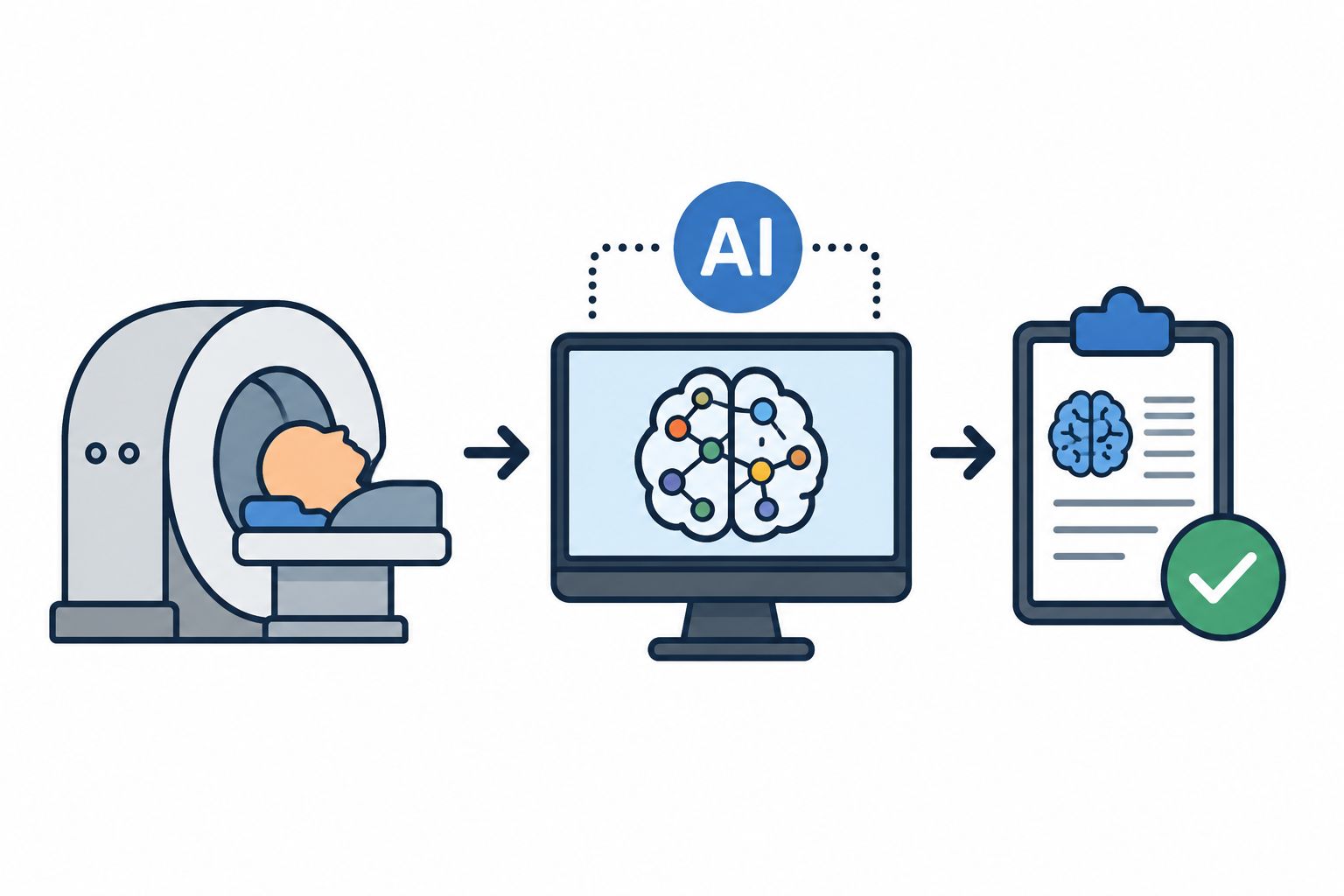
The company’s main product is called VoxelBox. According to BrainSightAI, VoxelBox uses AI models and MRI-based imaging data to generate detailed personalized brain maps for clinicians.
In practical terms, the system processes brain scans and attempts to identify critical neural pathways linked to functions such as language, cognition, movement, and emotional processing. This can help doctors in several ways.
In brain tumor surgery, surgeons need to remove as much tumor tissue as possible while avoiding damage to important functional regions. Standard imaging may show where the tumor is physically located, but not always how it interacts with surrounding neural networks.
BrainSightAI says its connectomics platform helps surgeons understand these functional connections more clearly before operating. The technology is also being explored for stroke rehabilitation, psychiatric disorders, chronic pain management, and neurological diseases. According to company statements, future applications may include treatment planning for depression, schizophrenia, and neurodegenerative disorders.
One major challenge in neuroscience is that advanced brain-image interpretation usually requires highly specialized experts. Many hospitals, especially outside major metropolitan research centres, may not have dedicated neuroscientists or computational imaging teams.
BrainSightAI positions its software as a way to make advanced neuroimaging analysis more accessible to clinical teams without requiring deep in-house neuroscience expertise.
The company says its software generates “actionable insights” for clinicians rather than functioning only as a research visualization tool. BrainSightAI has also developed another product called Snowdrop, described as a patient-care and treatment-compliance application designed to support people with neurological and psychiatric disorders.
In January 2025, the company raised a $5 million pre-Series A round led by IAN Alpha Fund, with participation from IvyCap Ventures, Silver Needle, and existing investors.
Brain imaging data is extremely complex. MRI and functional MRI scans generate large amounts of information that can vary depending on patient movement, scan quality, disease stage, and imaging protocols. AI models must also be clinically validated carefully because incorrect interpretation can directly affect medical decisions.
Another challenge is proving long-term clinical outcomes. Many AI healthcare tools perform well in pilot studies but face difficulty demonstrating consistent real-world improvements across diverse hospitals and patient populations.
Globally, BrainSightAI operates within a fast-growing neurotechnology and computational neuroscience sector. Companies such as Neuralink, Precision Neuroscience, and several brain-computer-interface startups focus on implantable neural systems and direct brain-machine communication.
Other companies, including Posit Science and various neuroimaging firms, work on cognitive analysis, brain training, or imaging interpretation systems.
BrainSightAI’s positioning is somewhat different. Instead of building implants or consumer brain devices, the company focuses mainly on AI-driven brain mapping and clinical decision support using imaging data already generated inside hospitals.
That approach may be particularly relevant in India, where advanced neuroscience expertise remains concentrated in relatively few institutions. AI-assisted imaging systems could help extend specialized analysis capabilities to more hospitals without requiring every centre to build large neuroscience teams internally.
At the same time, neuroscience remains one of medicine’s most difficult frontiers. Brain disorders are highly individualized, and many psychiatric conditions still lack clear biological markers.
BrainSightAI’s long-term success will likely depend on whether its systems can consistently improve clinical outcomes in real hospital settings — not only generating sophisticated brain maps, but helping doctors make better treatment decisions for patients.
- Our correspondent