Water management remains one of the most difficult challenges in Indian agriculture. Farmers often know how much water they pump from borewells or canals, but measuring how much water is actually used by crops is far more complex.
Irrigation decisions are frequently based on experience, visual observation, or fixed schedules rather than direct measurement of field-level water consumption. This can lead to over-irrigation, groundwater depletion, higher electricity usage, and lower water-use efficiency.
Bhopal-based Kritsnam Technologies is working on this problem through water intelligence systems designed for agriculture and water-resource management. The company develops Internet of Things (IoT)-based monitoring platforms that measure, analyze, and report water usage across farms, irrigation systems, industries, and water infrastructure.
Kritsnam was founded in 2015 by Dr. Anurag Srivastava and Dr. Yashonidhi Srivastava. Both founders have academic and research backgrounds linked to the Indian Institute of Technology (IIT) ecosystem.
The founders worked on engineering and technology solutions related to water measurement and resource management before building the company.
Kritsnam emerged from efforts to solve a practical problem that had long existed in irrigation systems: the lack of reliable, scalable measurement tools for water usage in open channels and agricultural environments.
The company originated from technology research associated with IIT Kanpur. According to IIT Kanpur-related publications, Kritsnam was created to commercialize water-measurement technologies that could operate in difficult field conditions where conventional metering systems were often unreliable or expensive to deploy.
In 2022, Kritsnam raised approximately ₹6 crore in a pre-Series A funding round led by VC Grid and the KITVEN Fund. Existing investors including Indian Angel Network also participated. The company later raised additional capital through strategic investors and climate-focused funding programs.
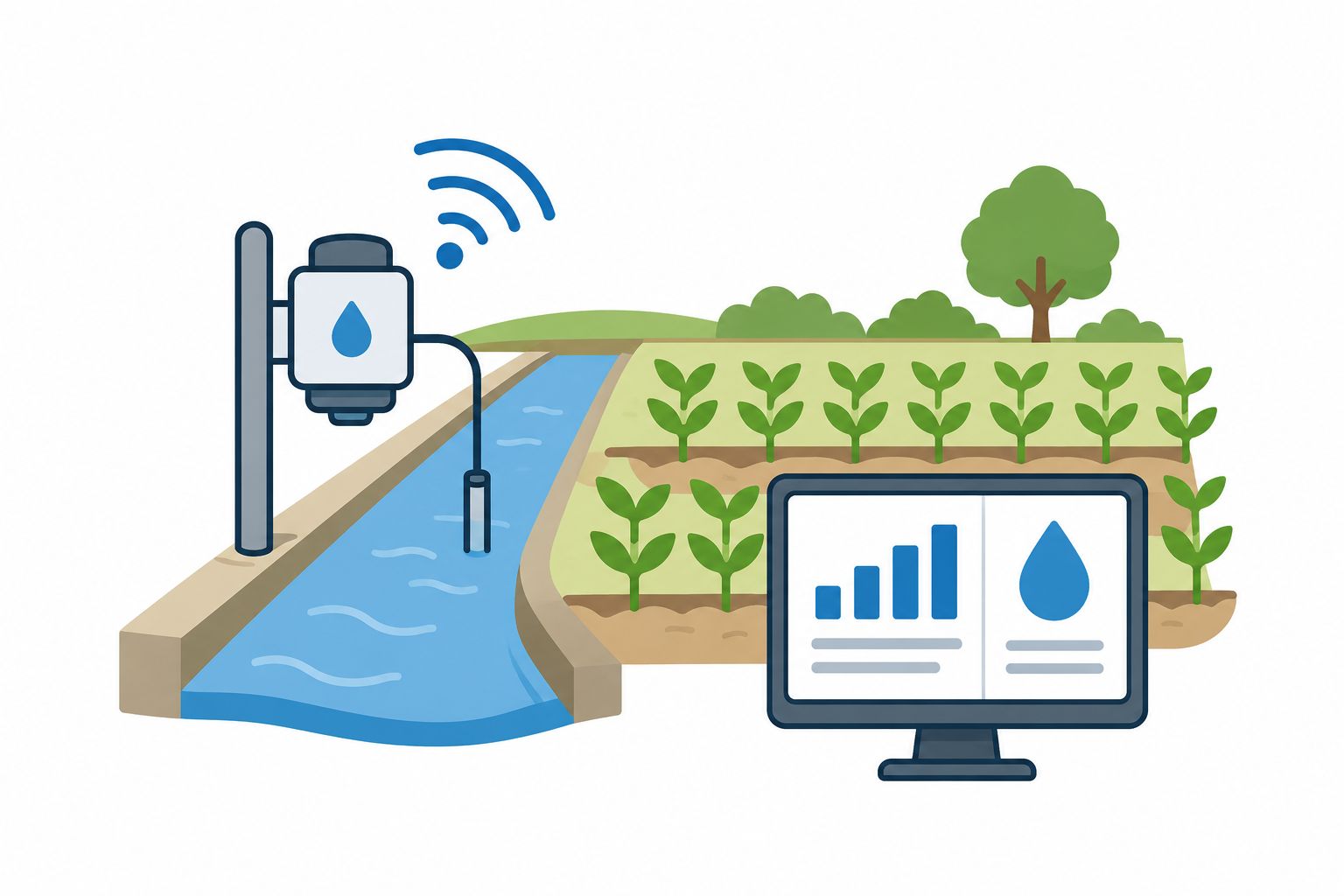
The company’s best-known product is Dhaara Smart, a water measurement system designed specifically for open canals and irrigation channels. Measuring water flow in open channels is significantly harder than measuring water in closed pipes. Traditional flow meters often require expensive installations or infrastructure modifications. Kritsnam’s system instead combines sensors, electronics, telemetry, and analytics software to estimate water flow continuously in irrigation networks.
The core idea is relatively straightforward. Sensors installed near canals or water-distribution structures collect field measurements. These measurements are transmitted through communication networks to cloud-based platforms where software calculates flow rates, water volumes, and usage patterns. Operators can then monitor water movement remotely through dashboards and analytics systems.
According to Kritsnam, Dhaara Smart can help irrigation departments understand where water is being distributed, identify losses, improve allocation decisions, and support data-driven management of irrigation infrastructure. The company positions the system as a way to move from estimated water distribution toward measurable water accounting.
The technology is also used in agriculture. Kritsnam’s platforms generate water-use data that can help evaluate irrigation efficiency and support more precise resource management. Instead of treating water as an unmeasured input, the company attempts to convert it into a measurable operational parameter similar to electricity consumption or fuel usage.
One reason this matters is that agriculture accounts for the majority of freshwater use in India. According to government and water-sector studies, agriculture consumes roughly 80 percent of India’s freshwater resources. Yet large portions of irrigation systems still operate without detailed real-time monitoring. This creates challenges for groundwater management, canal distribution planning, and drought response.
Kritsnam’s systems are designed not only for farms but also for water-resource agencies, irrigation departments, industrial users, and watershed programs. The company states that its monitoring infrastructure can be deployed across canals, rivers, reservoirs, treatment facilities, and distribution networks.
One of the larger deployment areas has been canal monitoring infrastructure. Public company information states that Dhaara Smart systems have been installed across irrigation networks to support water accounting and distribution management. The company reports monitoring thousands of kilometers of canal systems through its technology platforms.
Kritsnam has also stated that its systems are being used in projects linked to the Jal Jeevan Mission ecosystem and broader water-management programs.
The broader market for water intelligence technologies has expanded globally over the past decade. Increasing water scarcity, climate variability, groundwater depletion, and regulatory pressure have created demand for better measurement systems. Companies such as CropX, Arable, AquaSpy, HydroPoint, and Aquasight have developed various combinations of sensors, irrigation analytics, remote monitoring, and water-management software. Some focus on farm-level irrigation optimization while others target municipal and industrial water systems.
In India, water technology companies are increasingly focusing on measurement, monitoring, leak detection, groundwater management, and irrigation efficiency. The country’s combination of water stress, large agricultural demand, and expanding digital infrastructure creates a significant market for data-driven water-management systems.
Kritsnam’s differentiation comes from its emphasis on measuring water in open-channel environments, particularly irrigation infrastructure. Many conventional smart-water systems are designed for pressurized pipelines, while irrigation canals create different technical challenges involving variable flow conditions, sediment, and large geographic coverage areas.
- Our correspondent