Access to agricultural advice in India is uneven. Information exists in large volumes across government portals, agritech platforms, and research institutions, but most of it does not reach farmers in a usable form.
Language, literacy, and interface complexity are major barriers. KissanAI is focused on solving this specific problem by building voice-based AI systems that allow farmers to interact with technology in their own language.
The company’s approach is not to build a marketplace or a farm management tool. Instead, it is building an AI layer that sits between farmers and existing agricultural knowledge systems, translating complex information into conversational, accessible responses.
Origins
KissanAI was founded by Pratik Desai and Akash Sharma. The founders come from backgrounds in artificial intelligence, language technologies, and applied machine learning.
The idea emerged from a clear observation: most digital agriculture tools assume that users can read, type, and navigate structured interfaces. In reality, a large share of farmers are more comfortable speaking than typing, especially in regional languages. This gap led the founders to focus on voice as the primary interface.
From the beginning, the company positioned itself as an infrastructure layer rather than a standalone consumer app. The goal was to build systems that could be embedded into multiple platforms, including government services, agri startups, and advisory networks.
Product
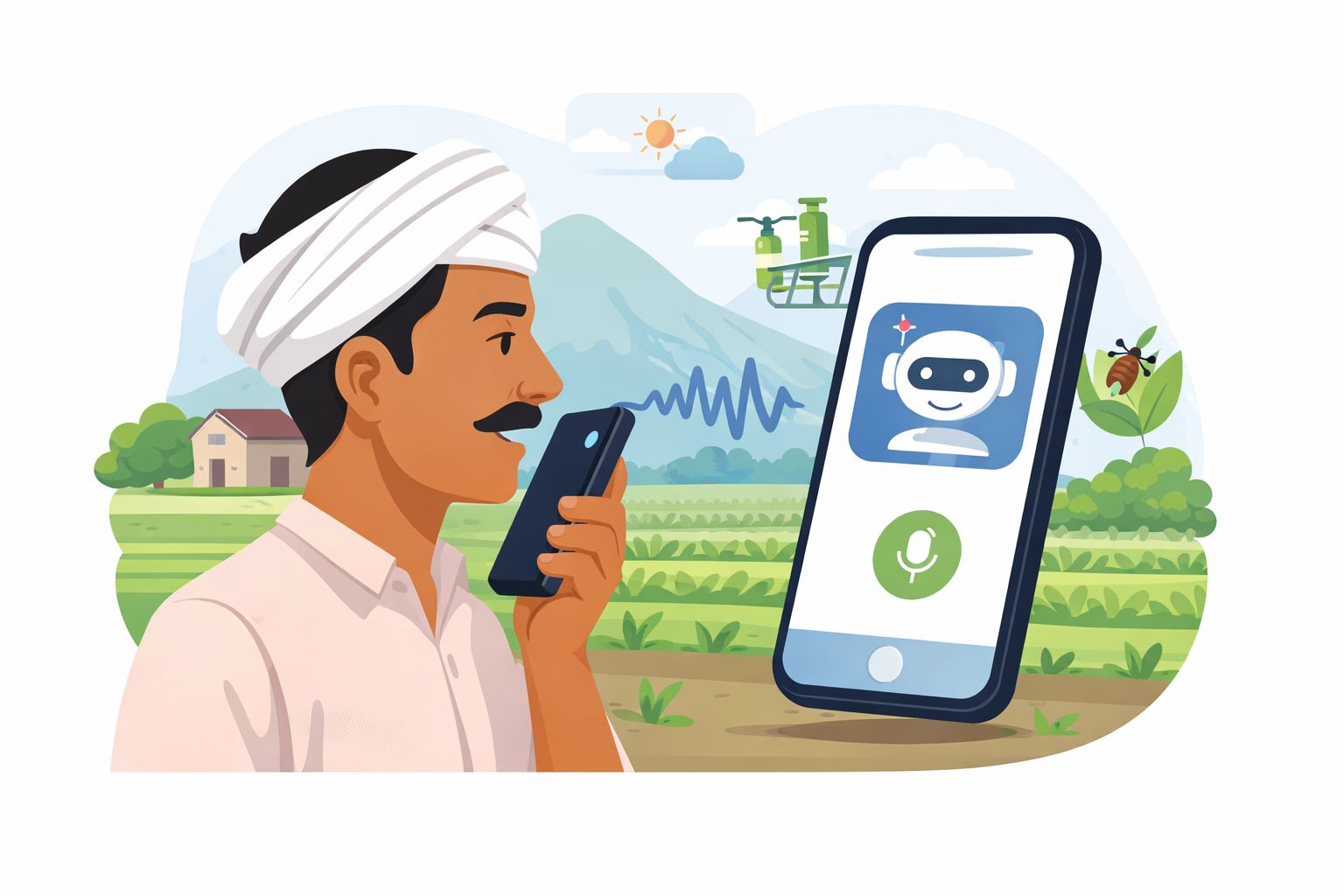
KissanAI’s core product is a voice-based AI assistant designed for agriculture. It allows users to ask questions in natural language, using speech, and receive responses that are relevant to their crops, location, and context.
The system is built to handle multiple Indian languages and dialects. This is important because agricultural practices vary significantly across regions, and advice needs to be localized.
The assistant can respond to queries such as crop selection, pest management, weather-related decisions, and input usage. Instead of presenting long documents or generic answers, it provides concise, actionable responses.
The company also offers APIs and integration layers, allowing other platforms to embed this capability into their own applications. This makes it possible for KissanAI to scale through partnerships rather than relying solely on direct user acquisition.
How it works
At a basic level, the system converts spoken input into text, processes the query, and then converts the response back into speech. However, the complexity lies in how it understands agricultural context.
The first layer is speech recognition tuned for Indian languages and rural accents. Standard speech models often struggle with these variations, so the system is trained on domain-specific datasets.
Once the query is transcribed, it is processed by language models that are adapted for agriculture. This means the system is not just answering general questions but is trained to understand crop names, local terminology, and farming practices.
The system then pulls from structured knowledge sources. These can include agricultural databases, advisory content, and partner data. The response is generated in a way that is concise and relevant, avoiding unnecessary detail.
Finally, the answer is converted back into speech in the user’s language. The interaction is designed to feel conversational rather than transactional.
Deployment
KissanAI has been deployed through partnerships with organizations that already work with farmers. This includes agritech platforms, advisory services, and potentially government-linked systems.
By integrating into existing networks, the company avoids the need to build its own distribution from scratch. Farmers interact with the system through mobile apps, call-based interfaces, or embedded voice assistants.
One of the key use cases is real-time advisory. Instead of waiting for scheduled visits or searching through content, farmers can ask questions at the moment they face a problem.
The system is also useful in customer support scenarios for agri-input companies, where large volumes of farmer queries need to be handled efficiently.
Performance
The effectiveness of a system like KissanAI depends on two factors: accuracy of understanding and usefulness of responses. Early feedback has focused on ease of use, particularly for users who are not comfortable with text-based interfaces.
Voice reduces friction significantly. Farmers can ask questions in their own words without needing to navigate menus or type in specific formats.
At the same time, challenges remain. Agricultural queries are often context-heavy, and incomplete information can lead to generic responses. Improving personalization based on location, crop type, and season is an ongoing area of work.
There are also technical challenges related to speech recognition in noisy environments and across diverse dialects. Continuous training and data collection are required to improve performance.
Similar Companies
KissanAI operates in a space that combines conversational AI with agriculture. There are companies working on related problems, though often with different approaches.
In India, platforms like DeHaat and Cropin provide advisory and farm management services, but their interfaces are largely app-based rather than voice-first.
Globally, conversational AI platforms such as Microsoft and Google have developed general-purpose voice assistants, but these are not tailored for agricultural use cases or local contexts.
KissanAI’s differentiation lies in combining domain-specific knowledge with multilingual voice interfaces, and in positioning itself as an infrastructure layer rather than a standalone product.
Global context
The use of AI in agriculture is expanding rapidly, but much of it has focused on supply chains, precision farming, and analytics. Farmer-facing interfaces have received less attention, especially in developing markets.
At the same time, advances in speech technology and large language models are making it possible to build more natural and accessible interfaces. This is particularly relevant in regions where literacy and language diversity are significant factors.
Voice-based systems can reduce the barrier to entry for digital tools. Instead of learning how to use an app, users can interact with technology in a way that is closer to everyday communication.
However, scaling such systems requires large amounts of localized data and continuous adaptation to regional contexts. This is where domain-focused companies have an advantage over generic AI platforms.
- Our correspondent