In most industries, methane is viewed as a fuel or a greenhouse gas. Bengaluru-based String Bio sees it differently.
The company has spent more than a decade developing technology that uses methane as a raw material for producing proteins, agricultural inputs, and other industrial ingredients.
Founded in 2013, String Bio is one of the earliest companies in Asia to commercialize gas fermentation technology. Its goal is to convert methane—a potent greenhouse gas—into products that can be used in animal nutrition, agriculture, human nutrition, and other industrial sectors.
The company’s work sits at the intersection of biotechnology, climate technology, and advanced manufacturing.
How the Company Started
String Bio was founded in Bengaluru by Dr. Ezhil Subbian and Vinod ML Kumar.
Dr. Ezhil Subbian, the company’s CEO and co-founder, is a biotechnology scientist with more than two decades of experience in bio-based product development. Her work focuses on using biology to create sustainable and cost-effective alternatives to conventional industrial products. She received the Women Transforming India Award in 2018 from NITI Aayog and the United Nations for her contributions to innovation and entrepreneurship.
Vinod ML Kumar, Managing Director and co-founder, has held leadership roles at major technology companies including Nokia and Juniper Networks. His experience spans product development, manufacturing operations, supply chain management, and business transformation. At String Bio, he focuses on commercialization, scaling operations, and business strategy.
The founders established the company around a simple idea: biology can perform chemical transformations that are difficult, expensive, or environmentally harmful using conventional industrial methods. Rather than using crops such as corn or sugarcane as feedstock, they chose methane as the starting material.
Funding Raised So Far
String Bio has raised approximately $ 24.4 million in funding according to multiple startup databases and investor reports.
Alongside the investment, String Bio entered into a strategic development agreement with Woodside Energy Technologies, which is exploring the use of String’s methane-conversion technology in energy-sector applications.
What String Bio Actually Does
At the heart of String Bio’s business is a proprietary platform called SIMP (String Integrated Methane Platform). The technology uses naturally occurring microorganisms that consume methane as their food source.
The process works in several stages.
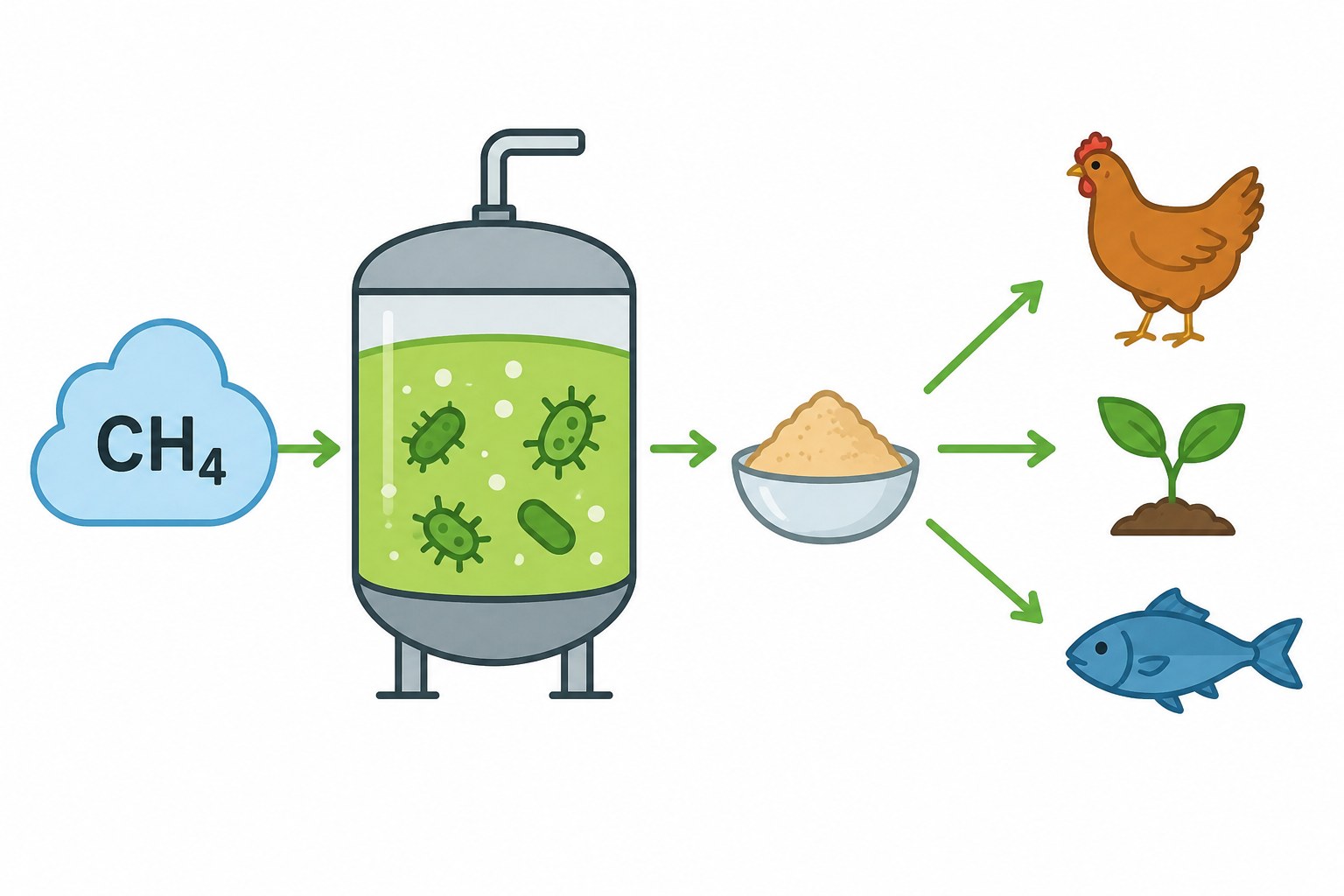
Methane is supplied from natural gas or biogas sources. This methane is fed into fermentation systems containing specialized microbes. As the microorganisms grow, they convert methane into microbial biomass rich in protein and other useful compounds. The resulting material can then be processed into commercial products.
Unlike traditional protein production, which requires agricultural land, irrigation, fertilizers, and large crop harvests, this approach relies mainly on methane and fermentation infrastructure.
The company has developed products across four areas: animal nutrition, human nutrition, agriculture, and emerging industrial markets.
Its best-known work has been in protein ingredients for animal feed.
Animal Feed Protein From Methane
The company’s most publicized product category is alternative protein for livestock and aquaculture feed.
Traditionally, fishmeal and soybean meal are widely used as protein sources in animal feed. However, both face supply, cost, and sustainability challenges.
String Bio produces microbial protein using methane-fed microorganisms. The resulting protein can be incorporated into feed formulations for poultry, aquaculture, and livestock sectors. This is significant because feed protein is one of the largest operating costs in many livestock industries.
Beyond protein production, String Bio has developed biological products for agriculture.
The company has created multiple biostimulant products aimed at horticulture and large-acreage crops. Biostimulants are materials used to improve plant growth, nutrient uptake, and crop performance.
One of the biggest challenges in industrial biotechnology is moving from laboratory experiments to commercial production.
String Bio reports that it has scaled its technology through laboratory, demonstration, pilot, and commercial stages. The company says its manufacturing systems can be deployed commercially for target products.
The company won the Future Food Asia Award in 2017 and has been recognized internationally for its methane-to-protein technology. The World Economic Forum has also profiled String Bio as a company using greenhouse-gas carbon streams to manufacture ingredients for multiple industries.
String Bio operates in the growing field of gas fermentation and alternative proteins. Globally, similar companies include: LanzaTech (United States/New Zealand), Calysta (United States), Unibio (Denmark), Again (Canada), Solar Foods (Finland)
Among these firms, Calysta and Unibio are particularly relevant because they also focus on producing microbial protein using methane-consuming microorganisms.
The category String Bio operates in has grown rapidly over the past decade.
Governments and investors are increasingly interested in technologies that can reduce emissions while creating valuable industrial products. Gas fermentation has emerged as one of the most promising approaches because it can convert carbon-containing gases into proteins, chemicals, fuels, and materials.
Several companies worldwide are attempting to build “carbon-to-product” manufacturing systems that rely less on agricultural inputs and more on biological conversion processes. Alternative proteins produced through fermentation are also attracting attention as the global demand for animal feed and food ingredients continues to rise.
- Our correspondent