India’s construction industry still runs largely as a site-based activity. Materials arrive in stages, contractors coordinate multiple vendors, weather affects schedules, and delays are common.
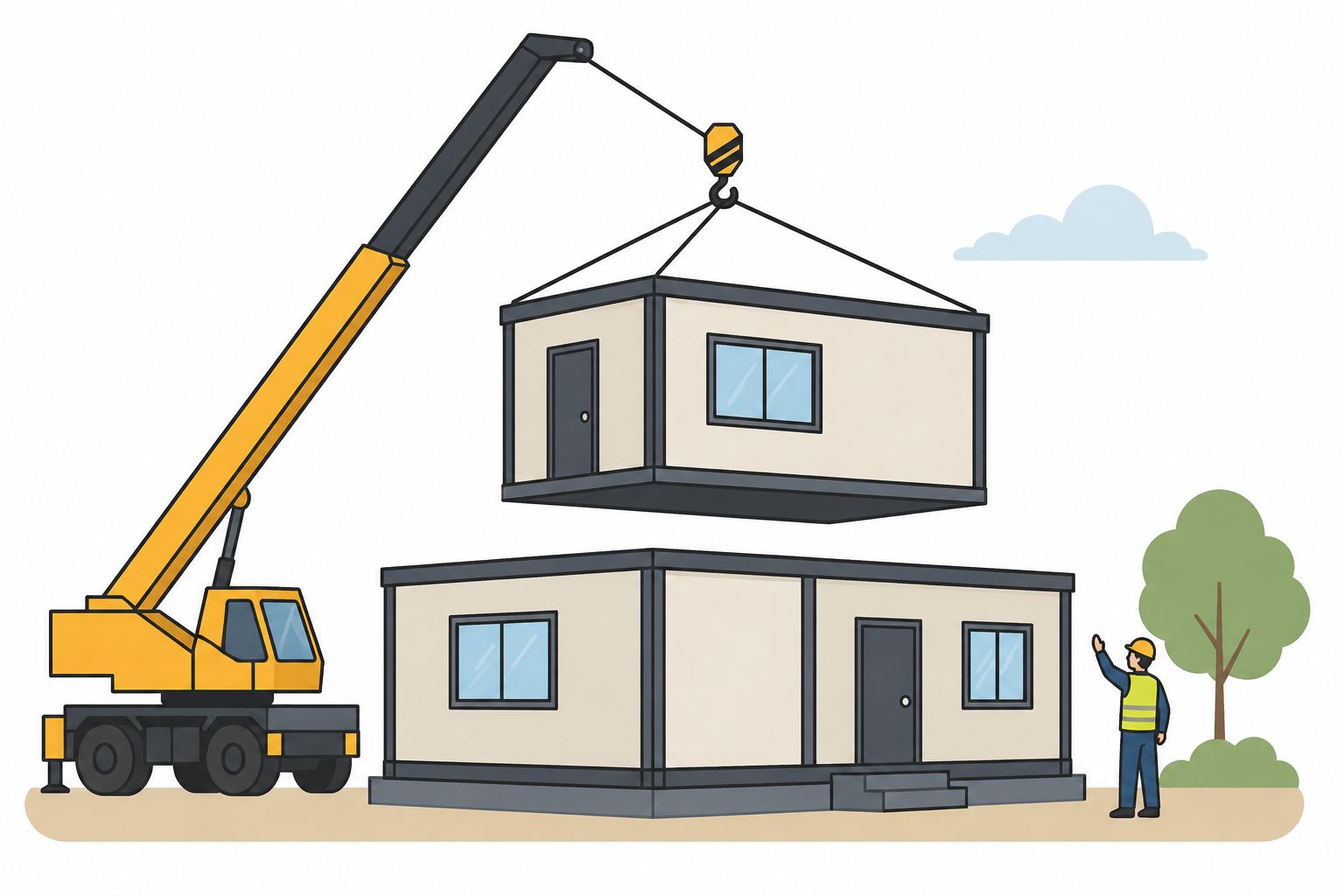
Chennai-based Modulus Housing is building its business around a different model: manufacture most of the building in a factory, transport it to the site, and assemble it quickly with standardized systems.
Founded in 2018 by IIT Madras alumni Shreeram Ravichandran and P. Gobinath, Modulus Housing develops modular and prefabricated building systems for healthcare facilities, schools, offices, housing, industrial infrastructure, storage facilities, and disaster-relief deployments.
The company describes itself as a factory-built construction company focused on low-rise infrastructure and distributed construction projects across India.
The idea traces back to the devastating Chennai floods of 2015. Ravichandran, Gobinath, and Jawahar Rajasekar were students at IIT Madras when they participated in flood-relief work.
During that period, they began studying the long timelines involved in rebuilding homes and public infrastructure after disasters. The founders initially focused on temporary and transition shelters before expanding into broader modular construction applications.
Modulus Housing was formally established in 2018, the same year the founders graduated. Ravichandran serves as Chief Executive Officer while Gobinath leads operations.
The company’s approach differs from traditional construction contractors. Instead of treating every building as a unique project executed entirely on-site, Modulus designs standardized building systems that can be manufactured in controlled environments and then assembled where required.
According to the company, it handles design, engineering, manufacturing, logistics, installation, and project management within a single delivery framework.
Its product portfolio includes foldable prefabricated structures, flat-pack modular units, volumetric modules, portable healthcare facilities, educational infrastructure, storage units, site offices, and residential buildings. Some modules arrive at the site almost fully completed, while others are shipped in flat-pack form and assembled on location.
The distinction is important because logistics often determine whether modular construction is economically viable. Fully assembled units can be deployed rapidly but occupy more transportation space. Flat-pack systems reduce transportation costs and can be shipped to remote locations more efficiently. Modulus says its foldable structures are designed to collapse for transport and expand on-site, reducing logistics requirements while maintaining usable interior space.
The company also manufactures volumetric modules, which are essentially finished rooms produced in factories. Electrical wiring, plumbing systems, insulation, interior finishes, and fixtures can be integrated before delivery. Once transported to the site, multiple modules can be connected to form larger facilities such as clinics, schools, offices, or housing units. [Kalaari Capital]
One of the most visible use cases for the company emerged during the Covid-19 pandemic. According to Forbes India, Modulus assembled roughly 600 portable modular hospital units during the period. The company stated that some of these units could be assembled by four people within about two hours after delivery. [Forbes India]
Healthcare infrastructure remains one of the sectors where modular construction has gained practical acceptance. Traditional hospitals often require long approval cycles and extensive construction timelines. Portable clinics, isolation wards, diagnostic facilities, and emergency-care units can be deployed much faster when significant portions of the building are manufactured off-site.
Over time, Modulus expanded beyond healthcare into what investors describe as “micro-construction” projects. These include primary health centres, schools, anganwadis, cold-storage facilities, construction-site offices, warehousing support infrastructure, and distributed commercial facilities.
Financially, Modulus remained bootstrapped for several years before raising institutional capital. In December 2025, the company announced a Series A funding round of $7.8 million. The round was led by Kalaari Capital, Hero, and Samarthya, with participation from SVAS, Sigma, Srinath Ramakkrushnan of Zetwerk, Sanjiv Rangrass, and other investors.
A notable aspect of the company’s model is its manufacturing network. Rather than relying entirely on a single centralized factory, Modulus describes its approach as a cloud-manufacturing system supported by partner factories. Investors argue that this structure allows production capacity to be distributed geographically while maintaining common engineering standards and designs.
The broader market for modular construction has attracted attention globally because of labour shortages, construction delays, urbanisation pressures, and demand for faster infrastructure deployment. In modular construction, portions of a building are manufactured in factories and later assembled on-site. This can reduce construction time, improve quality control, and lower material waste, although transportation costs and design limitations remain challenges.
Globally, companies such as Boxabl, VBC, Sekisui House, and the now-defunct Ilke Homes have pursued variations of factory-built construction. The sector has seen both successes and failures. While some firms have demonstrated faster construction timelines and standardized quality, others struggled with manufacturing economics, project financing, and scaling factory operations.
In India, the competitive landscape includes modular construction firms such as Zetwerk’s infrastructure initiatives, Magicrete, and several prefabricated construction specialists serving industrial, healthcare, and commercial sectors.
What makes Modulus notable is not a new building material or a single flagship product. Its proposition is operational: move more of the construction process into factories, standardize repeatable infrastructure types, and reduce the amount of work that must happen on-site. Whether that model scales across thousands of projects will depend on manufacturing capacity, logistics execution, regulatory approvals, and customer adoption.
For now, the company has moved beyond its original disaster-relief concept and positioned itself as a supplier of factory-built infrastructure across healthcare, education, industrial, commercial, and public-sector projects.
In an industry where delays are often measured in months or years, Modulus is betting that construction can increasingly resemble manufacturing rather than traditional site work.
- Our correspondent