Indian agriculture faces two connected problems at the same time. Farmers are under pressure from rising input costs, declining soil health, water stress, and climate variability, while large companies are trying to reduce carbon emissions across their supply chains.
Mumbai-based Grow Indigo is trying to connect these two sides through carbon farming and regenerative agriculture.
Founded in 2018–19 as a joint venture between Indian seed company Mahyco and US-based Indigo Ag, Grow Indigo works on regenerative agriculture, carbon-credit generation, and biological farm inputs for Indian farmers. The company’s core business is helping farmers adopt farming practices that improve soil health and reduce greenhouse-gas emissions, while generating carbon credits that can later be sold to companies seeking sustainability offsets.
The company emerged from collaboration between Mahyco, one of India’s older agricultural technology firms, and Indigo Ag, the Boston-based agricultural technology company known globally for microbial seed treatments and agricultural carbon programs. Indigo Ag itself was founded in the United States in 2013 and later expanded into agricultural carbon markets and regenerative farming systems.
Grow Indigo positions itself around regenerative agriculture. In practical terms, regenerative agriculture refers to farming methods intended to improve soil organic matter, reduce excessive tillage, improve water retention, and lower chemical-intensive farming practices. The company promotes techniques such as direct-seeded rice, low tillage farming, crop residue management, cover cropping, and optimized fertilizer use.
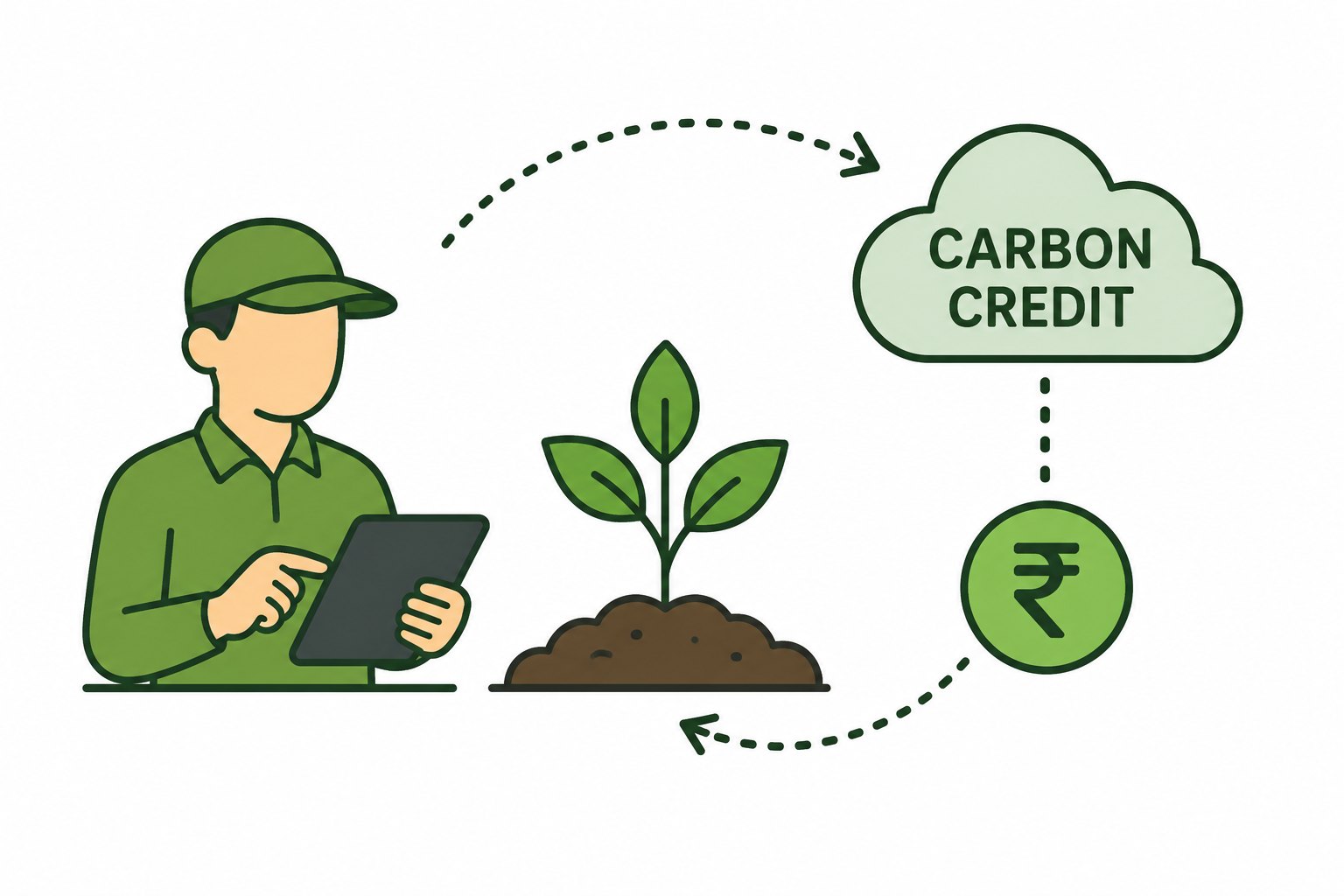
The company’s most important business today is its carbon farming platform. Under this model, farmers who adopt certain regenerative farming practices can generate carbon credits based on measurable reductions in greenhouse-gas emissions or increases in soil carbon storage. These carbon credits are then sold in voluntary carbon markets to corporations seeking to meet sustainability or net-zero commitments.
The operational model is more complicated than traditional farm advisory systems. Farmers first enroll through Grow Indigo’s carbon program. The company then tracks farming practices, land-use data, and soil-related parameters through digital monitoring systems, satellite data, field verification, and carbon accounting methodologies.
Carbon credits are only issued after verification by internationally recognized standards and auditors. Grow Indigo says its projects are based on Verra’s VM0042 methodology, one of the internationally recognized frameworks for soil-carbon accounting.
One of the biggest challenges in agricultural carbon markets globally is proving that carbon reductions are real and measurable. Soil carbon changes are difficult to estimate accurately across millions of farms. Because of this, carbon projects depend heavily on digital monitoring systems, sampling, satellite imagery, and statistical models.
Grow Indigo says it has built systems that allow even smallholder farmers to participate in carbon-credit markets by grouping many small farms into larger carbon projects. This is important in India because average farm sizes are relatively small compared to countries such as the United States or Australia.
The company also emphasizes that farmers receive additional income from carbon-credit generation. Farmers adopting regenerative practices can earn revenue from carbon-credit sales alongside improvements in soil health and reduced input costs.
One of the company’s major public milestones came in 2026, when Grow Indigo announced India’s first issuance of high-integrity soil carbon credits under Verra’s VM0042 methodology. The first issuance covered approximately 30,000 acres across Punjab and Haryana and generated more than 50,000 carbon credits.
The company also stated that its regenerative agriculture footprint already covered more than one million acres and thousands of farmers, with plans to scale further.
Another major area of Grow Indigo’s business is biological agricultural products. The company markets microbial and biological solutions intended to improve soil health and crop resilience while reducing dependence on synthetic agricultural chemicals
Funding has supported the company’s expansion. In 2023, Grow Indigo announced that it had raised more than $6 million in fresh funding from Indigo Ag, Mahyco, and high-net-worth investors. The company said cumulative funding at that stage had crossed approximately $13 million.
In 2025, British International Investment (BII), the UK’s development finance institution, announced a $10 million investment into Grow Indigo to support expansion of carbon farming and regenerative agriculture programs in India.
The broader agricultural carbon market globally has expanded rapidly over the last decade. Agriculture contributes significantly to greenhouse-gas emissions through fertilizer use, soil degradation, methane emissions, and land-use changes. At the same time, agricultural soils can potentially store carbon if farming practices change.
Companies globally are increasingly experimenting with “carbon farming” systems where farmers are paid to adopt regenerative practices that improve soil carbon retention. Global companies operating in related categories include Indigo Ag in the United States, Nori, and several European carbon-farming finance startups.
However, the carbon farming industry also faces criticism and operational challenges. Soil-carbon measurement remains scientifically complex, and some researchers question whether long-term carbon storage claims can always be verified reliably. Carbon-credit prices also fluctuate significantly depending on market demand and verification standards.
Another challenge is farmer adoption. Regenerative farming often requires changes in cultivation methods, equipment use, and crop-management practices. In some cases, farmers may initially face uncertainty about yields or operational costs during transition periods.
Grow Indigo’s business depends heavily on solving these implementation challenges at scale. The company operates not only as a sustainability platform but also as an agricultural coordination system involving farmer enrollment, training, verification, digital monitoring, carbon accounting, and corporate carbon-credit sales.
The company is also part of a broader shift within agriculture toward climate-linked revenue systems. Traditionally, farmers earned income mainly from crop sales. Carbon farming introduces a second possible revenue stream tied to environmental outcomes rather than only agricultural production.
- Our correspondent