India is the world’s largest milk producer, but much of its dairy sector still operates through fragmented and manually managed systems.
Milk moves through millions of small farmers, village collection centres, transport operators, chilling facilities, processors, and retailers before reaching consumers. Along the way, problems such as spoilage, adulteration, delayed payments, low cattle productivity, and poor traceability can reduce farmer income and affect milk quality.
Bengaluru-based Stellapps was founded to address these operational gaps using sensors, connected devices, software platforms, and data analytics.
Started in 2011 and incubated at IIT Madras’ Rural Technology Business Incubator, the company positions itself as an end-to-end dairy technology platform focused on digitising milk production, procurement, and cold-chain operations.
The company was founded by Ranjith Mukundan, Ravishankar Shiroor, Praveen Nale, Venkatesh Seshasayee, and Ramakrishna Adukuri, many of whom previously worked at Wipro before moving into the dairy technology sector.
Stellapps did not initially begin as a dairy company. The founders first experimented with IoT applications across multiple industries before narrowing their focus to dairy after working on a monitoring system for an organic dairy farm near Bengaluru.
That experience exposed them to the complexity of India’s dairy ecosystem. Unlike large industrial farms in some countries, India’s milk supply chain depends heavily on smallholder farmers who often own only a few cattle. Milk collection happens multiple times a day across thousands of villages, making quality control and traceability difficult.
Stellapps built its business around creating digital infrastructure for this fragmented network.
The company’s technology stack is built on what it calls the SmartMoo platform — a combination of IoT devices, cloud software, analytics systems, and mobile applications designed for dairy operations.
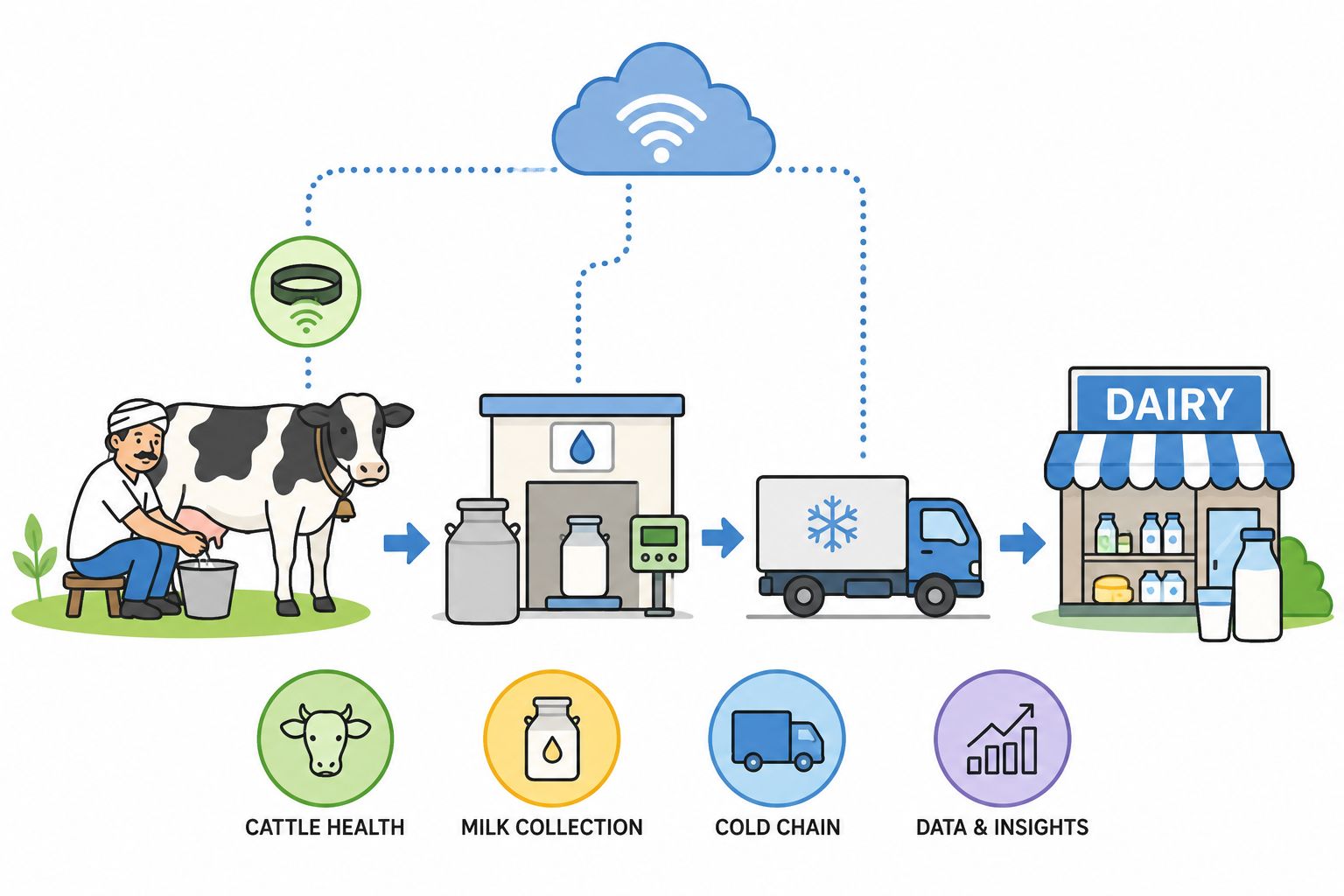
Its systems cover several stages of the dairy chain.
For cattle monitoring, Stellapps developed wearable devices called “mooON.” These wearables are attached to cattle and track parameters linked to animal activity, breeding cycles, movement, and health. The idea is to help farmers identify heat cycles, improve breeding timing, monitor animal wellness, and improve milk productivity.
The company also operates milk procurement systems used at village collection centres. These systems automate milk weighing, quality testing, pricing calculations, and transaction records. Instead of relying entirely on handwritten registers and manual calculations, procurement centres can digitally record fat content, quantity, pricing, and farmer payments.
Another major area is cold-chain monitoring. Milk spoils quickly if temperature conditions are not maintained properly during storage and transport. Stellapps’ ConTrak system monitors chilling centres using connected sensors that track temperature, volume, power conditions, and equipment performance in real time.
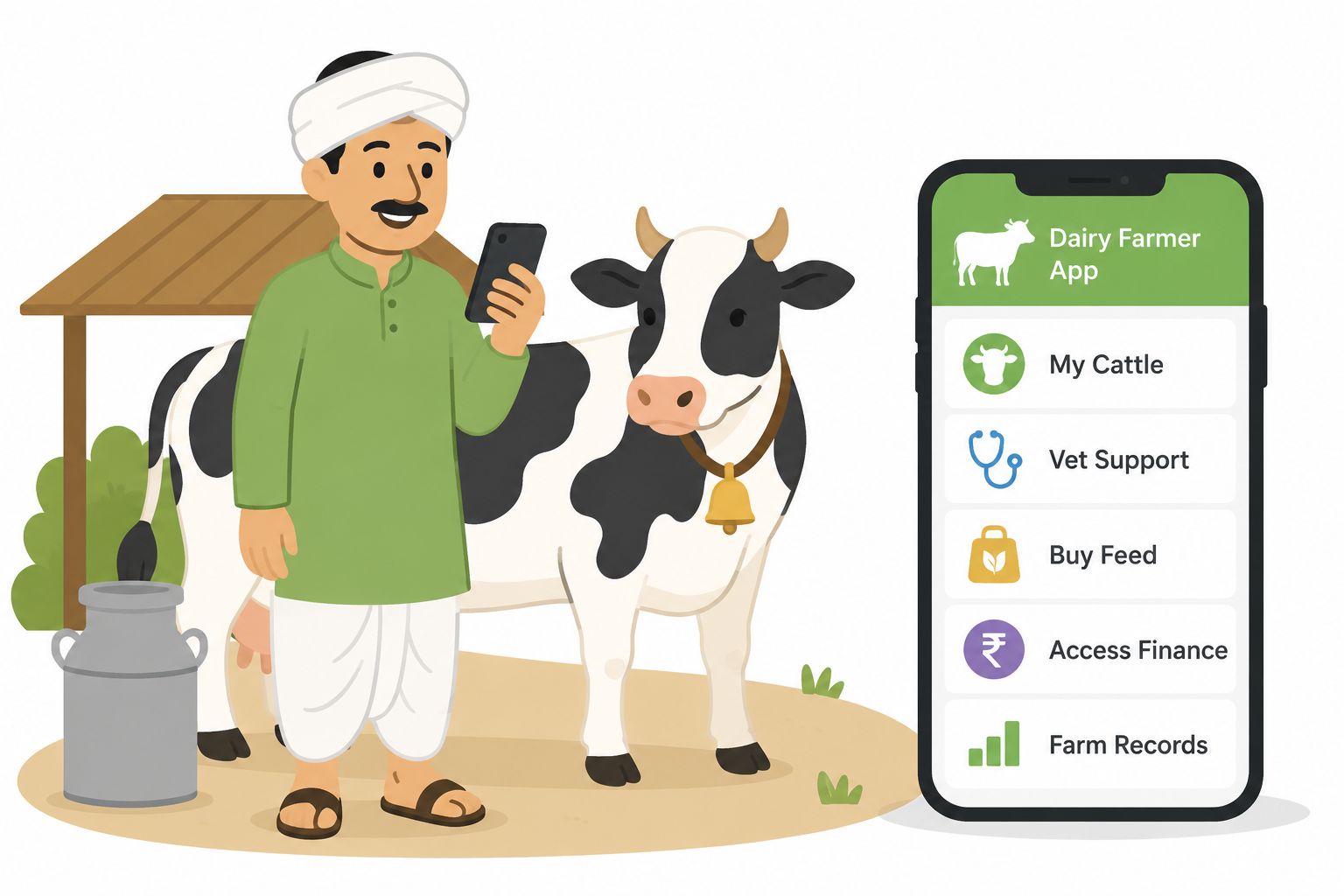
The company also developed software tools such as mooOpt for analytics and supply-chain optimization, mooFlow ERP for dairy workflow management, and mooPay for financial services linked to rural dairy farmers.
One practical challenge in rural India is connectivity. The company says many of its systems are designed to work even with low-bandwidth 2G networks because rural internet infrastructure can be inconsistent.
Stellapps’ business model differs from many consumer-facing agritech startups because it works heavily with dairy cooperatives, processors, and institutional dairy networks rather than selling directly to individual consumers.
The company received seed funding from Omnivore in 2013 after its IIT Madras incubation phase. Over the years, investors have included Blume Ventures, Qualcomm Ventures, ABB Technology Ventures, Nutreco, Bill & Melinda Gates Foundation, Venture Highway, Celesta Capital, IDH Farmfit Fund, and Binny Bansal.
In October 2024, Stellapps raised $26 million in a Series C round through a mix of equity and debt financing. Investors included Blume Ventures, Omnivore, Bill & Melinda Gates Foundation, IDH Farmfit Fund, 500 Startups, Blue Ashva Capital, and Miledeep Capital, while debt funding came from the U.S. International Development Finance Corporation.
By that stage, the company had reportedly raised close to $50 million overall.
Over time, Stellapps expanded beyond pure software and IoT infrastructure into dairy product manufacturing through a vertical called mooMark. According to company statements, mooMark focuses on contract manufacturing and private-label dairy products with traceability systems linked back to the company’s technology stack.
This reflects a broader shift happening globally in agritech. Many supply-chain technology companies eventually move closer to physical commerce because software alone can be difficult to monetise in fragmented agricultural ecosystems.
Globally, dairy digitisation has become an important agritech category. Companies in the United States, Israel, Europe, and New Zealand use sensors, wearables, robotic milking systems, AI-driven herd monitoring, and supply-chain analytics to improve dairy operations.
International firms such as DeLaval, Afimilk, and Connecterra operate in related areas including cattle monitoring, automated milking, and dairy analytics. But India’s dairy market differs significantly because of its dependence on smallholder farmers and highly decentralised procurement systems.
That makes Stellapps’ operating environment more logistically complex than many Western dairy technology systems designed for large industrial farms.
The company’s growth also reflects broader structural changes in India’s dairy sector. Consumers increasingly expect traceability, better cold-chain management, and quality assurance. Processors are under pressure to reduce spoilage and improve procurement efficiency. Financial institutions and insurers also want reliable farm-level data before extending services to rural producers.
At the same time, dairy digitisation remains operationally difficult. Rural hardware deployment is expensive. Sensors must survive dust, moisture, and power instability. Farmers may hesitate to adopt unfamiliar systems unless financial benefits are clear. Maintaining hardware networks across thousands of villages also requires significant field operations.
Stellapps has become one of India’s most visible dairy-tech companies by focusing less on consumer apps and more on building operational infrastructure for one of the country’s largest agricultural supply chains.
- Our correspondent