Every year, thousands of road accidents in India are linked to fatigue, distraction, poor visibility, or delayed driver reactions. For commercial fleets, these incidents are not just safety problems — they also create insurance losses, vehicle downtime, cargo damage, and operational disruption.
Ahmedabad-based startup DrivebuddyAI is building technology aimed at reducing those risks using artificial intelligence, computer vision, and vehicle telematics. Founded in 2018, the company develops Advanced Driver Assistance Systems (ADAS) and driver monitoring platforms for commercial fleets. Its systems use cameras and onboard AI software to continuously monitor both the road and the driver inside the vehicle cabin.
The company was founded by Nisarg Pandya, an engineer and entrepreneur who has publicly spoken about building autonomous and AI-assisted driving technologies specifically for Indian road conditions. DrivebuddyAI was created to “deploy AI assistance to drivers” and reduce collisions for logistics and fleet operators.
Unlike passenger-car ADAS systems that are typically built into premium vehicles, DrivebuddyAI focuses mainly on commercial transport fleets — trucks, buses, logistics operators, and enterprise mobility systems. That distinction matters because commercial fleets face very different operating conditions. Vehicles often run long distances, drivers work extended shifts, and roads can vary sharply in lighting, traffic density, and lane discipline.
DrivebuddyAI says its platform has been trained specifically for these kinds of environments. The system combines AI-powered dashcams, driver monitoring, telematics, and behavioral analytics into a single platform.
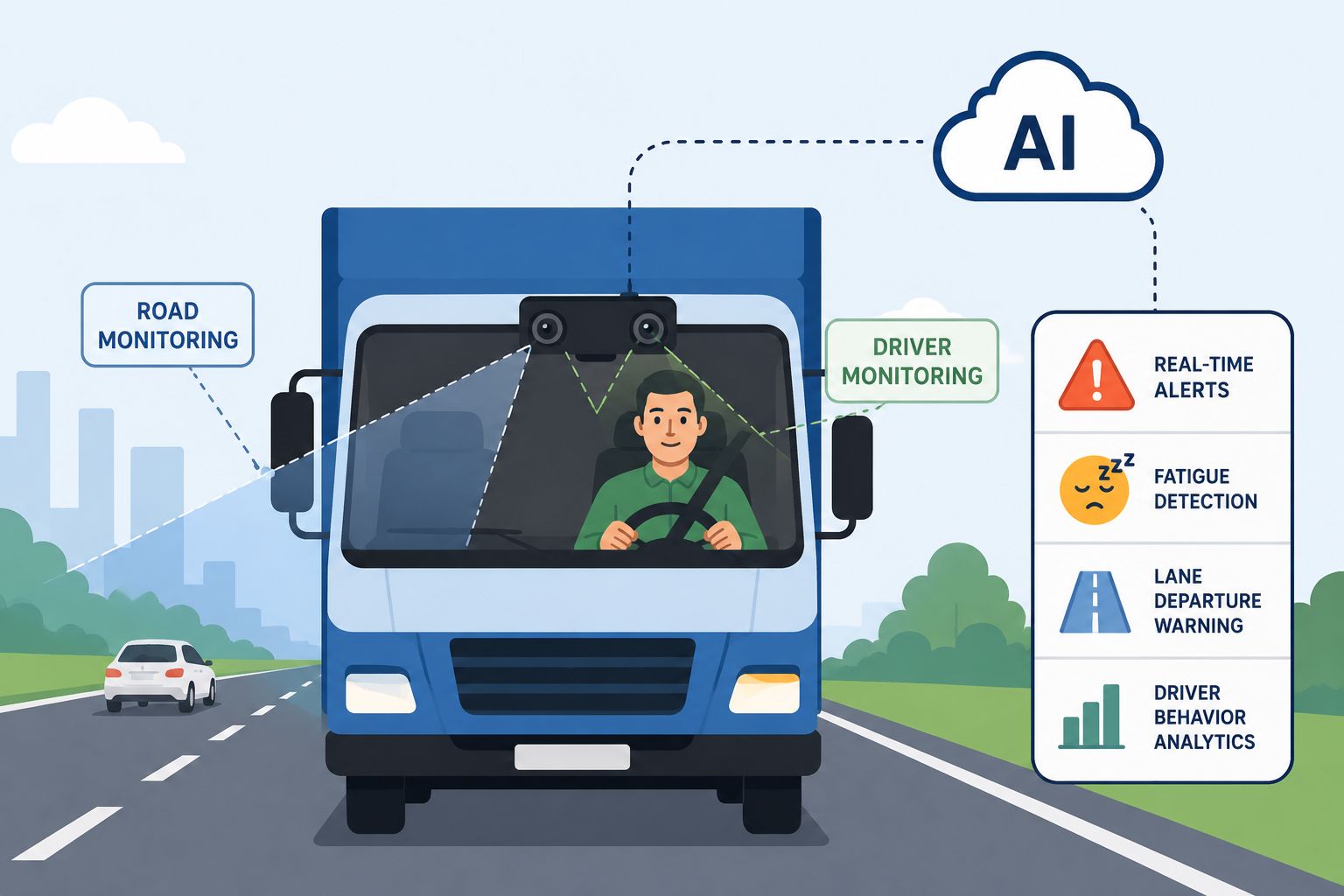
The company’s best-known hardware platform is called DRISHTI. According to DrivebuddyAI, the device uses two cameras — one facing the road and another facing the driver inside the cabin. The road-facing camera monitors lane movement, collision risks, and traffic conditions, while the inward-facing camera tracks signs of fatigue, distraction, or inattentiveness.
The device also includes GNSS positioning sensors and inertial measurement systems that track vehicle movement and orientation. This data is processed together with the video feed so the system can determine whether a situation is potentially dangerous and alert the driver in real time.
In practical terms, the system works like an AI co-driver. If a driver begins drifting out of a lane, appears drowsy, or gets dangerously close to another vehicle, the platform generates audio alerts inside the cabin. The goal is to intervene before an accident occurs rather than simply recording footage afterward like a conventional dashcam.
The company also places heavy emphasis on driver behavior analytics. Beyond real-time alerts, the platform evaluates patterns such as harsh braking, distraction frequency, unsafe driving behavior, and fatigue indicators. Fleet operators can then use dashboards and reports to identify higher-risk driving patterns across their operations.
DrivebuddyAI says this behavioral analysis is designed not only for safety but also for fleet efficiency and insurance risk management. The company has described its longer-term vision as creating a “CIBIL-like structure” for drivers using AI-generated driver scoring systems. In 2025, it announced that it had received a patent for its CARD system — Cognitive Assessment of Risk for Drivers — which scores driver behavior patterns using AI models.
Over the past few years, DrivebuddyAI has steadily expanded its visibility within the automotive AI ecosystem. In 2024, Roadzen announced that the company’s ADAS platform became the first system to receive Automotive Research Association of India (ARAI) certification under India’s AIS-184 driver monitoring standards.
According to Roadzen, the platform has also crossed one billion kilometers of real-world driving data. More recent company statements have claimed validation across nearly four billion kilometers of driving data.
One reason companies are increasingly adopting driver monitoring systems is regulation. Globally, regulators are beginning to mandate more active safety systems in vehicles. Europe’s General Safety Regulation has accelerated adoption of driver monitoring technologies, while India has begun moving toward formal ADAS and driver-safety standards for commercial transport.
This broader market is becoming highly competitive. Globally, companies such as Netradyne, Motive, Mobileye, and Samsara have built large businesses around AI fleet monitoring, video telematics, and driver safety systems.
What makes India difficult — and commercially interesting — is the complexity of its driving environment. Lane markings are inconsistent, mixed traffic is common, road conditions vary sharply, and drivers frequently encounter unpredictable obstacles. Systems trained primarily on North American or European roads often require significant adaptation before working reliably in India.
DrivebuddyAI positions itself as an “Indian-road-refined” ADAS platform. The company says its AI systems have been trained specifically on local driving conditions and vehicle environments.
The company has also expanded internationally. At CES 2026, DrivebuddyAI showcased its AI-powered fleet intelligence platform and said its models had processed driving data from India and Europe.
Technically, the company’s platform reflects a broader shift happening across the automotive industry: moving AI processing from cloud servers into the vehicle itself. According to Manufacturing Today India, DrivebuddyAI’s systems process camera and vehicle data directly on edge-computing hardware running real-time operating systems.
That matters because safety systems need to react instantly. A warning delayed by even a few seconds may be useless in real driving conditions.
The category itself is expected to grow significantly over the next decade. Governments, insurers, and logistics operators are increasingly treating driver monitoring and ADAS systems as operational safety infrastructure rather than optional upgrades. In India, commercial fleet operators are also under pressure to reduce accident rates, insurance costs, and downtime.
Still, challenges remain. Fleet technology adoption in India is highly cost-sensitive. Hardware deployment across thousands of vehicles requires maintenance support, driver training, calibration, and software updates. There are also concerns around driver privacy and constant in-cabin monitoring.
DrivebuddyAI’s long-term success will likely depend on whether it can move beyond early deployments and become deeply integrated into large-scale commercial transport systems. That requires not just AI models and cameras, but long-term fleet relationships, service infrastructure, regulatory compliance, and sustained reliability in difficult real-world environments.
- Our correspondent