CoRover started with a simple observation. Most digital systems are hard to use. Whether it is booking a train ticket, filing a complaint, or finding information about a government scheme, people often struggle to navigate websites and forms. The problem is not lack of technology. It is how that technology interacts with people.
The company was founded in 2016 in Bengaluru by Ankush Sabharwal, along with co-founders including Kunal Bhakhri and Manav Gandotra. Their goal was to make machines easier to talk to. Instead of forcing users to learn how systems work, they wanted systems to understand how people naturally speak.
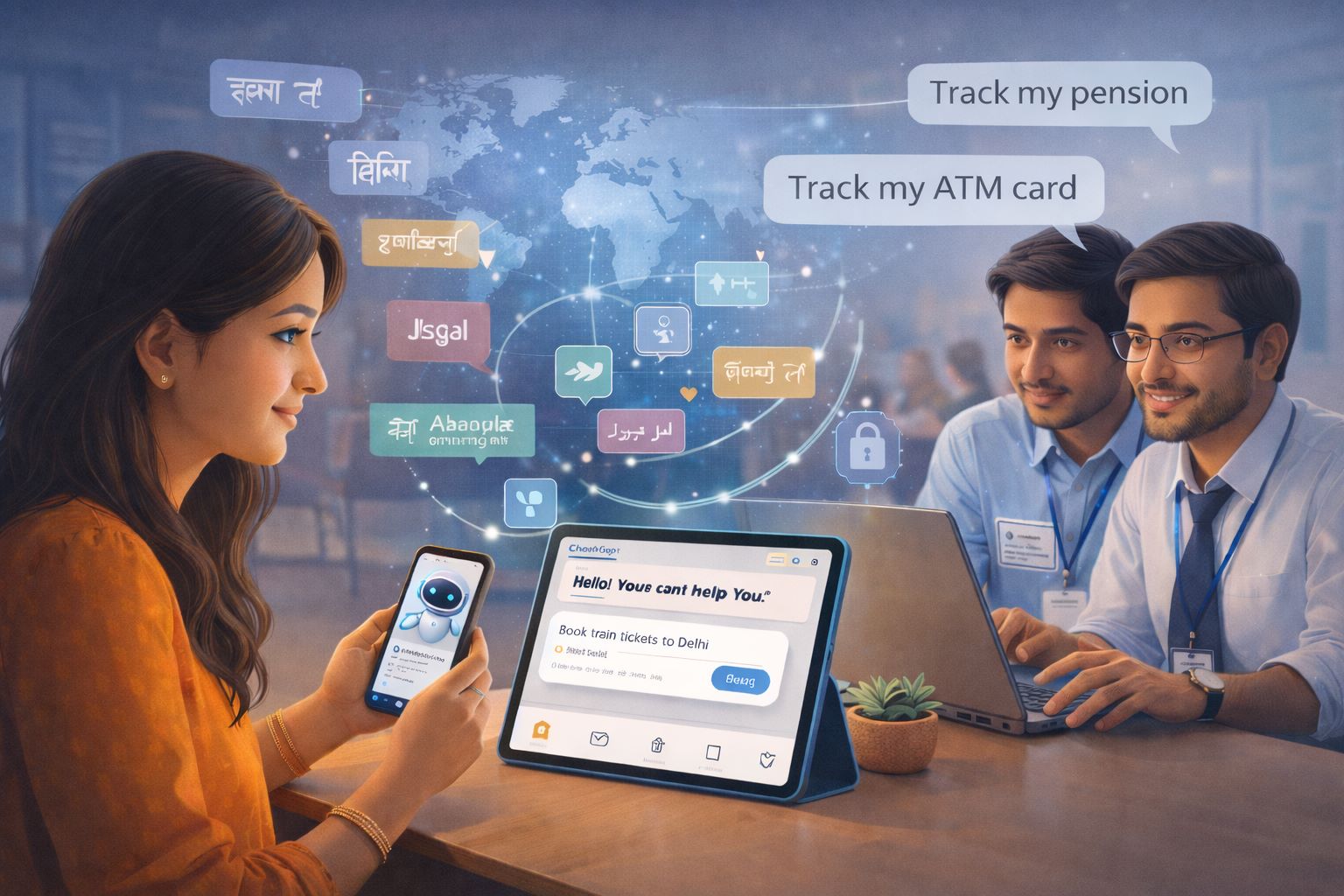
In the early years, CoRover focused on building chatbots for enterprises. These were not simple bots that answered basic questions. They were designed to understand context, handle multiple queries at once, and respond in different languages. Over time, this evolved into a broader platform that supports text, voice, and even video interactions.
One of the company’s early breakthroughs came with AskDISHA, a chatbot used by Indian Railways for ticket booking and customer support. This was a high-pressure environment. Millions of users access railway systems at the same time, especially during peak booking hours. The chatbot had to handle large volumes while still giving accurate responses. This helped CoRover prove that its systems could work at national scale.
From there, the company expanded into multiple use cases. It built systems like AskSarkar for government services, AskMitra for insurance, and eSevak for grievance management. These are all variations of the same idea: instead of navigating complex portals, users can simply ask questions and get answers in natural language.
At the core of CoRover’s platform is conversational AI. This means the system can understand and respond to human language. But what makes CoRover different is how it applies this idea. Its systems are designed to work in more than 100 languages and across multiple formats, including chat, voice, and video. This is important in a country like India, where users speak different languages and may not be comfortable with typing or navigating apps.
The company has also developed its own foundational model called BharatGPT. This is a large language model designed specifically for Indian use cases. Unlike global models that are trained mostly on English data, BharatGPT focuses on local languages and contexts. This makes it more relevant for government services and mass-market applications.
Another important aspect of CoRover’s approach is control. Many organizations are cautious about using AI because of concerns around data privacy. CoRover allows clients to run its systems within controlled environments, using only their own data if needed. This makes it easier for banks, government agencies, and large enterprises to adopt the technology.
The scale of deployment gives a sense of how widely the platform is used. CoRover claims to have impacted over one billion users globally and works with tens of thousands of enterprises, developers, and institutions. Its systems operate across more than 20 channels, including websites, messaging apps, and voice systems.
Performance data from deployments also shows clear gains. Organizations using CoRover’s AI assistants have reported up to 70 percent reduction in operational costs and significant improvements in efficiency. The platform has also achieved high accuracy levels, with some implementations reaching around 99 percent accuracy in responses.
Funding for CoRover has been relatively modest compared to many AI startups. Early funding included around $1 million, with additional rounds and strategic investments over time. More recently, the company raised about $4 million to expand its generative AI capabilities and scale its operations. It has also attracted interest from large institutions, including strategic investments from financial players like HDFC Bank.
What stands out is that CoRover has been profitable for several years, even with smaller revenue numbers. This is unusual in the AI space, where many companies focus on rapid growth over profitability. CoRover has taken a more measured approach, focusing on building technology and real-world deployments.
Market feedback has been strong, especially in sectors where user interaction is critical. Governments use the platform to handle citizen queries. Banks use it for customer support. Enterprises use it to automate workflows. The common thread is that these systems reduce friction. Instead of filling forms or navigating menus, users can simply ask questions.
At the same time, adoption is not always straightforward. Large organizations move slowly. Integrating AI into existing systems takes time. There are also concerns around accuracy and trust, especially in sensitive areas like finance or governance. CoRover has addressed this by focusing on domain-specific models and controlled deployments, rather than one-size-fits-all solutions.
By allowing people to interact with systems in their own language and in simple conversational ways, CoRover reduces this gap. A user does not need to understand how a government portal works. They can simply ask a question and get an answer. This makes public services more inclusive.
Globally, CoRover is part of a larger shift toward conversational interfaces. Companies like Google, Amazon, and Microsoft have built voice assistants and chat-based systems. Many startups are also working on AI agents that can perform tasks on behalf of users.
However, most of these systems are designed for consumer use in developed markets. They work well in English and in environments where users are already comfortable with technology. The challenge is different in emerging markets, where diversity of language and access creates additional complexity.
This is where CoRover fills a gap. It focuses on high-volume, real-world use cases in complex environments. Its systems are built to handle multiple languages, different channels, and large-scale deployments. They are not just answering questions. They are part of how services are delivered.
As governments and enterprises become more digital, the way people interact with these systems will shape access and outcomes. If systems remain complex, many users will be left behind. If they become conversational and intuitive, access becomes wider. CoRover is working on that transition.
- Our correspondent