ConveGenius.AI started with a problem that is easy to see but hard to fix. Millions of children go to school every day, but many do not actually learn at the level expected for their age. A child in Class 6 may still struggle with basic reading or arithmetic. Teachers know this, but classrooms are large, time is limited, and it is difficult to give each student individual attention.
The company was founded in 2013 by Jairaj Bhattacharya and Shashank Pandey with a clear goal: make learning more personalised, even in large and resource-constrained classrooms.
Instead of trying to replace schools or teachers, they focused on building tools that could work alongside them. From the beginning, the company positioned itself as a “social enterprise,” meaning its goal was not just growth, but measurable impact in education.
In its early years, ConveGenius worked closely with schools and governments to understand how learning actually happens on the ground. This shaped its approach.
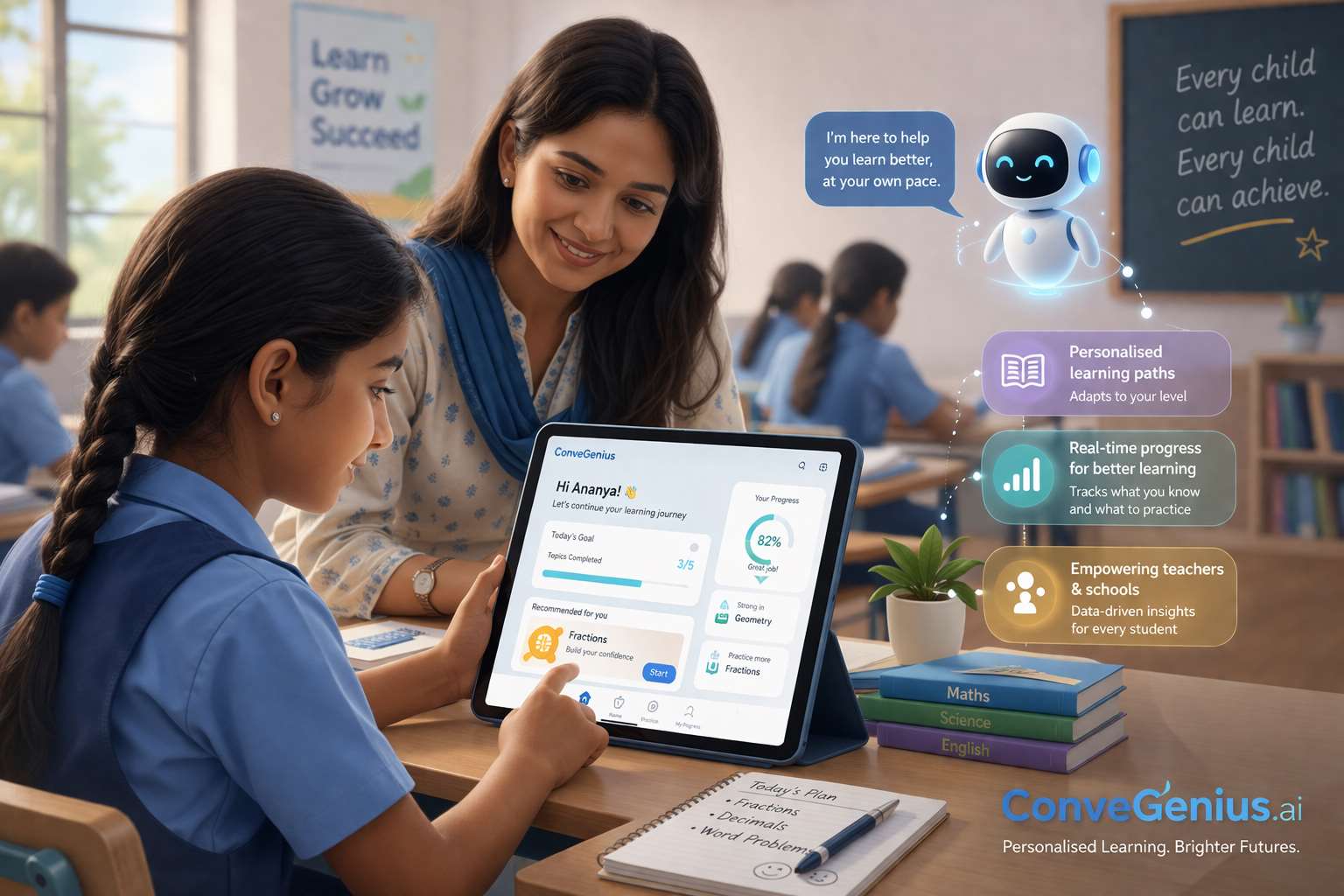
Rather than building a single app, it developed a set of systems that could support different parts of the education process. Over time, three main products emerged: a personalised learning platform, a conversational AI system, and a data analytics layer that tracks student progress.
The first major system was a personalised adaptive learning platform, often called PAL. This works in a simple way. Students answer questions, and the system adjusts the difficulty based on their responses. If a student struggles, it moves to easier concepts. If they perform well, it increases the level. This creates a learning path that fits each student, instead of forcing everyone to follow the same pace. The platform has been deployed in thousands of schools across India and has reached large numbers of students, especially in government systems.
The next step was SwiftChat, a conversational AI system. This is essentially a chatbot designed for learning. Students can ask questions, get explanations, and practice concepts through simple conversations.
What makes it useful is that it works in multiple languages and can run on basic devices. This is important in a country like India, where access to high-end technology is uneven. SwiftChat has now reached over 150 million learner profiles, making it one of the largest AI-driven education systems in the country.
The third layer is analytics. ConveGenius collects data on how students learn and uses it to generate insights for teachers and administrators. This helps identify where students are struggling, which schools need support, and what interventions are working. In some cases, this data has been used by governments to guide policy decisions.
Funding for ConveGenius has come from a mix of impact investors and venture funds. The company raised around $5 million in earlier rounds and later secured $7 million to expand its AI capabilities and international presence.
More recently, it has also raised smaller rounds to strengthen its technology stack and cloud infrastructure. The presence of investors like the Michael & Susan Dell Foundation and UBS Optimus Foundation shows that the company is seen as both a business and an impact-driven initiative.
One of the strongest indicators of performance is how the platform has worked in real-world deployments. In Andhra Pradesh, a large-scale program using ConveGenius’s adaptive learning system showed that students improved at more than twice the usual rate. In another evaluation, students achieved learning gains equivalent to nearly two years of schooling within about 17 months. These results are important because they come from government school systems, which are often the hardest environments to improve.
The company has also been integrated into large public systems like Vidya Samiksha Kendras, which are data-driven education monitoring centers adopted by multiple Indian states. This shows that ConveGenius is not just a classroom tool but part of a broader education infrastructure.
Market feedback reflects both opportunity and challenge. On one hand, there is strong demand for solutions that can improve learning outcomes at scale. Governments and institutions are actively looking for ways to use data and technology to improve education. On the other hand, adoption can be slow. Education systems are complex, and changes take time. There are also challenges around teacher training, infrastructure, and consistent usage.
What sets ConveGenius apart is its focus on scale and inclusion. Many edtech companies build products for urban users who already have access to devices and internet. ConveGenius builds for the opposite segment. Its systems are designed to work in low-resource settings, with limited connectivity and diverse languages. This makes it relevant for large parts of India and other emerging markets.
There is also an important shift in how the company approaches technology. Instead of treating AI as a tool for efficiency, it uses AI to personalise learning.
Globally, ConveGenius is part of a broader movement toward personalised and AI-driven education. Companies in the United States and China have built adaptive learning systems, and large platforms like Duolingo and Khan Academy have also introduced AI-based features. However, most of these products are designed for individual users, often in well-connected environments.
The gap that ConveGenius fills is different. It focuses on large, public education systems where millions of students need support. These systems have constraints that are very different from private or urban settings. Devices may be shared, connectivity may be limited, and classrooms may be overcrowded.
By designing for these constraints, ConveGenius has created a model that can scale across entire regions.
- Our correspondent