Indian agriculture is becoming increasingly data-driven, but most small and mid-sized farmers still rely on visual inspection, local experience, and fragmented advisory systems.
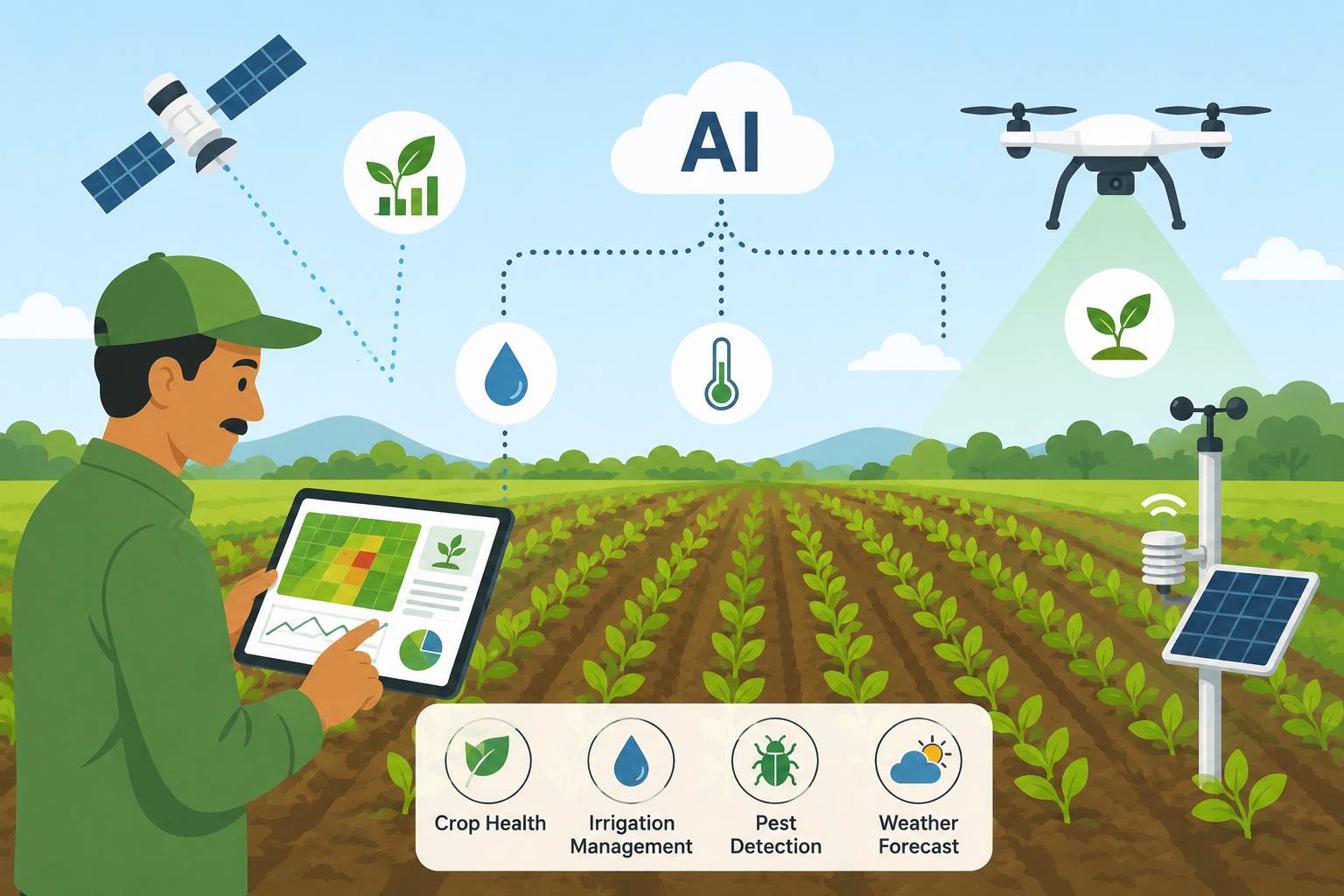
AgriPilot.ai is one of several startups trying to change that by combining satellite imagery, AI models, drones, weather data, and farm-level analytics into a single decision-support platform for agriculture.
The company says its system is designed to help farmers monitor crop health, irrigation, soil conditions, pest risks, and field performance in near real time.
AgriPilot.ai was founded in 2023 by Prashant Mishra and is based in Nagpur.
AgriPilot.ai operates in the precision agriculture category. In practical terms, that means using data from multiple sources to monitor farms continuously rather than depending only on periodic manual inspections. AgriPilot.ai says its platform combines AI, machine learning, satellite imagery, IoT devices, and drone-based sensing systems.
The core idea behind the platform is to create a digital layer over agricultural land. Farmers or agricultural institutions can monitor crop conditions through dashboards and alerts generated from field data. The platform offers crop health monitoring, soil health analysis, soil moisture tracking, crop planning, weed detection, weather forecasting, and irrigation insights.
One part of the system uses satellite imagery and vegetation indices to identify crop stress patterns that may not yet be visible to the human eye. For example, if a section of a field is experiencing water stress, nutrient deficiency, or early pest damage, the platform attempts to detect those changes through image analysis and AI models. Farmers can then focus intervention only where required instead of applying fertilizers or pesticides uniformly across the entire farm.
AgriPilot also works with drones for field mapping and spraying applications. It uses NDVI mapping, precision spraying, and crop monitoring systems. NDVI, or Normalized Difference Vegetation Index, is commonly used in agriculture to measure plant health based on how crops reflect light. Healthier vegetation reflects light differently compared to stressed crops, allowing software systems to estimate field conditions remotely.
AgriPilot.ai positions itself not only as a farm analytics company but also as an operational automation platform. In a 2025 interview, Prashant Mishra described the company’s work in Baramati as an “AI-powered agricultural living lab” using spatial analytics, cloud agronomy, and real-time data ingestion. The interview also mentioned integrations involving Microsoft’s Planetary Computer ecosystem and long-term environmental datasets.
AgriPilot is also trying to simplify user interaction by building vernacular and WhatsApp-native interfaces so that farmers do not need to learn complex software systems. Mishra argued that reducing interface complexity is important because many farmers may not be comfortable using enterprise-style dashboards or technical applications.
Globally, precision agriculture has become one of the largest segments within agritech. Companies are using AI and computer vision to improve irrigation efficiency, crop monitoring, disease detection, and farm automation. US-based PrecisionHawk earlier focused on aerial agricultural mapping using drones before later expanding into broader industrial drone services. FarmWise developed autonomous robotic weed-removal systems using AI and computer vision for vegetable farms in California. Swiss company Gamaya built hyperspectral imaging systems for crop analysis and precision agriculture applications.
In India, the category has grown rapidly alongside government support for drones and digital agriculture systems. Companies including Garuda Aerospace, Fuselage Innovations, and several regional agritech firms are working on crop spraying drones, field analytics, and AI-driven farm monitoring tools.
What differentiates AgriPilot.ai is its attempt to combine multiple layers — satellite monitoring, AI models, IoT systems, drone imaging, and conversational farmer interfaces — into a single platform targeted at operational farm decisions rather than isolated analytics tools. The company also appears focused on integrating public environmental datasets and cloud-based agronomy systems into its workflow.
The larger challenge for companies in this category is commercial scalability. Precision agriculture systems often require reliable connectivity, sensor infrastructure, training, localized crop models, and consistent farmer engagement. Small landholdings in India also make unit economics more difficult compared to large industrial farms in North America or Europe.
Farmers and agribusinesses increasingly want systems that do more than generate dashboards. They want tools that can reduce fertilizer costs, improve yields, lower water usage, or detect disease earlier in ways that clearly improve profitability. The precision agriculture market is growing globally, but long-term adoption will depend on whether these AI systems consistently deliver usable decisions in real farm conditions rather than only producing data visualizations.
- Our correspondent