DeHaat began with a simple operational problem: small farmers in India don’t have reliable access to inputs, advice, or markets in a coordinated way.
Each of these services exists, but they are fragmented, inconsistent, and often exploitative. DeHaat’s approach has been to stitch these pieces together into a single, working system that farmers can actually use season after season.
Origin
The company was founded in 2012 by Shashank Kumar, Manish Kumar, Shiv Kumar, and Shantanu Kumar. The founding team had roots in rural Bihar and had seen firsthand how farmers were navigating broken supply chains.
Early on, they focused on building a network of local micro-entrepreneurs who could act as last-mile access points for farmers. This was not a software-first approach. It was a network-first model, with technology layered in to make it scalable.
In its early years, DeHaat operated in Bihar and eastern Uttar Pradesh, working closely with farmers growing staple crops. The model evolved gradually: first input delivery, then advisory, then market linkage. Over time, it became clear that offering any one of these in isolation did not solve the core problem. Farmers needed all of them, and they needed them in sync.
Funding
Funding followed as the model showed traction. DeHaat has raised over $200 million across multiple rounds from investors including Sequoia Capital India, Prosus Ventures, RTP Global, Lightrock, and Temasek. The capital has largely gone into expanding geographic reach, strengthening the supply chain, and acquiring complementary businesses such as agri-input companies and advisory platforms.
What does DeHaat do?
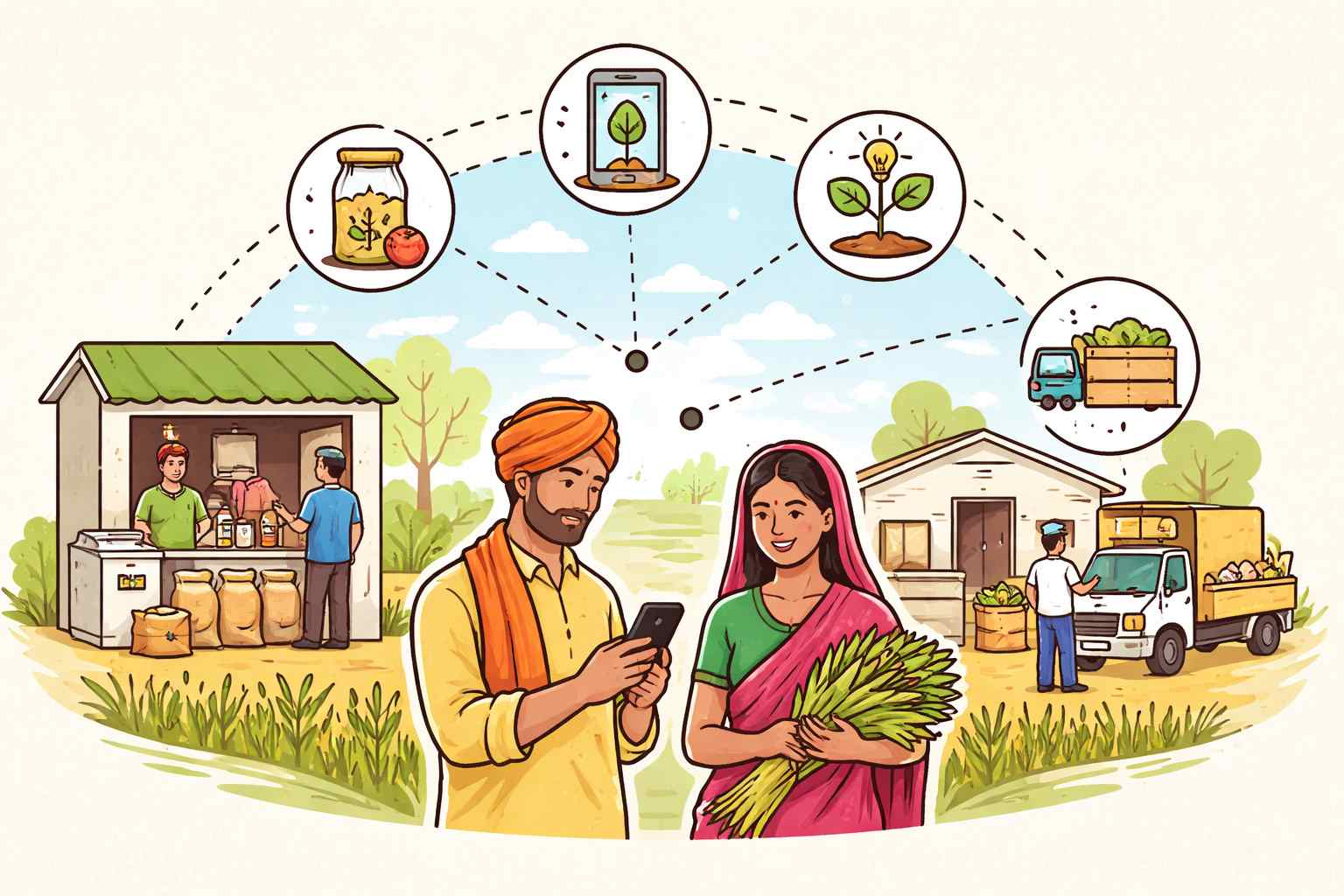
At its core, DeHaat operates as a full-stack platform that connects farmers to three things: inputs, information, and markets.
On the input side, farmers can order seeds, fertilizers, pesticides, and other crop essentials through a local DeHaat center. These centers are run by trained micro-entrepreneurs, often from the same village or nearby areas.
Instead of farmers traveling long distances to uncertain retail shops, the inputs come through a more predictable channel. The platform aggregates demand and works directly with manufacturers, which helps with both pricing and quality control.
The advisory layer is built around crop-specific guidance. Farmers receive recommendations on what to sow, when to apply inputs, and how to deal with pests or diseases. This is delivered through a mix of call centers, mobile apps, and on-ground agronomists.
The technology component includes data from soil tests, weather forecasts, and historical crop patterns. The idea is not to overwhelm farmers with data, but to convert it into clear, actionable steps.
The market linkage piece closes the loop. Once the crop is ready, DeHaat connects farmers to institutional buyers such as food processors, exporters, and large retailers. Instead of selling to local traders at uncertain prices, farmers can access more transparent demand. DeHaat handles aggregation, grading, and logistics, which are typically the hardest parts for smallholders to manage.
What makes the system work is how these pieces interact. Input recommendations are aligned with expected market demand. Advisory is tied to the specific inputs being used. Market linkage is informed by what has been grown and how it has been managed. This reduces the mismatch that often exists in agriculture, where farmers grow crops without clear visibility into demand or pricing.
Deployment
In terms of deployment, DeHaat has scaled to serve over a million farmers across multiple states including Bihar, Uttar Pradesh, Jharkhand, Odisha, and parts of West Bengal.
The company operates thousands of DeHaat centers, each acting as a node in the network. These centers are not just retail points; they are service hubs that combine commerce with advisory and logistics coordination.
Performance on the ground has been mixed but generally positive. Farmers using the platform have reported improvements in yield and better price realization, largely due to more consistent input use and access to better buyers. However, adoption is not uniform.
The company’s differentiation lies in its integrated approach. Many agritech startups focus on one layer—either inputs, advisory, or market linkage. DeHaat attempts to control the full stack. This increases complexity but also creates stronger lock-in. Once a farmer is using the platform for multiple needs, switching becomes less likely.
Competition
There are, however, strong competitors in each segment. Companies like Ninjacart focus heavily on market linkage and logistics. AgroStar has built a strong presence in input delivery and advisory. Bijak operates as a digital marketplace for agricultural produce. Each of these players has gone deep in specific parts of the value chain, while DeHaat spreads across all of them.
Global context
Globally, the category DeHaat operates in is often referred to as “full-stack agritech” or “digitally enabled agri platforms.” In the United States, companies like Indigo Agriculture have tried to build integrated models combining inputs, advisory, and market access. In Africa, platforms like Twiga Foods focus on linking farmers to urban markets with logistics and financing layers. In Southeast Asia, companies such as TaniHub have attempted similar integrations.
What sets India apart is the scale and fragmentation of its smallholder base. Any solution has to work across diverse crops, climates, and market structures. It also has to operate in environments where digital literacy is uneven and infrastructure can be unreliable. DeHaat’s hybrid model—combining physical centers with digital systems—is a response to these constraints.
There are also structural challenges. Agriculture margins are thin, and logistics costs can quickly erode value. Weather variability adds another layer of uncertainty. Building a profitable business while keeping services affordable for farmers is a constant balancing act. DeHaat’s expansion into adjacent services like credit and insurance could improve unit economics, but it also introduces regulatory and operational complexity.
DeHaat is not trying to replace existing agricultural systems entirely. It is trying to reorganize them into something more predictable and coordinated. The success of that effort depends less on technology alone and more on whether the system continues to work reliably at the farm level, season after season.
- Our correspondent