Kidaura Innovations is building digital tools to identify and manage developmental disorders in young children, particularly autism.
The company focuses on the early years—between ages 3 and 6—when intervention has the highest impact, and where access to structured assessment and therapy is still limited in many parts of India.
Origin
Kidaura Innovations was founded in 2019 and is based in Nashik, Maharashtra.
The founding team includes Shiv Kumar, Paras Sharma, and Sarthak Behl, with contributions from domain experts such as Madhushree Mahesh in psychology.
Shiv Kumar, one of the co-founders, comes from a technology and operations background and has been closely involved in building assistive solutions for early childhood development. Paras Sharma, who has a background in computer science engineering, leads product and technical development.
The company emerged from programs like Digital Impact Square (a Tata Consultancy Services initiative), where the founders developed the initial idea of using digital tools to support children with developmental challenges.
The central problem they focused on was early identification. In many cases, autism and related conditions are diagnosed late, which reduces the effectiveness of intervention.
Product
Kidaura’s product stack is built around two main components: a screening tool and a therapy management platform.
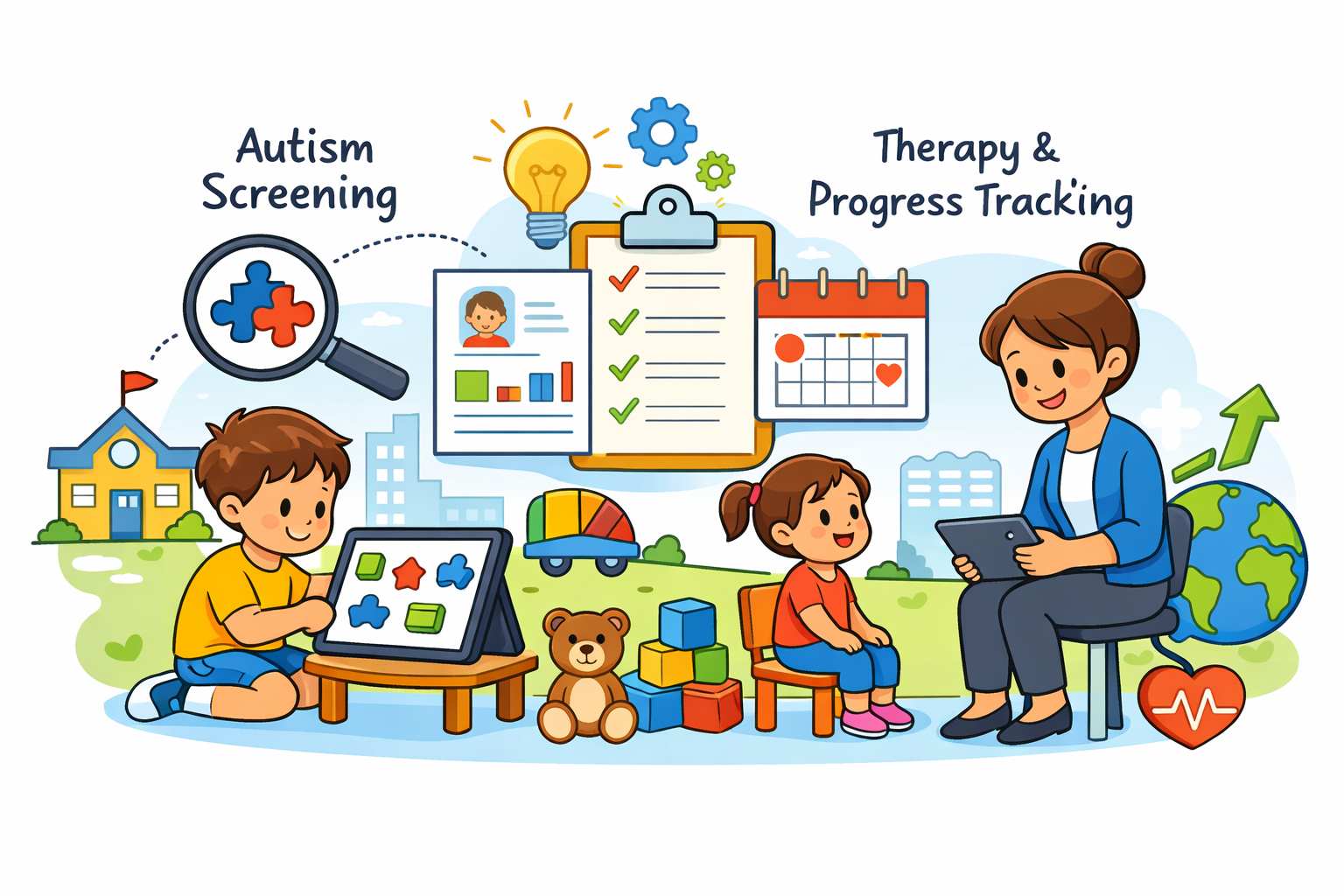
The first product, called ScreenPlay, is a game-based digital screening tool. It is designed to identify early signs of autism and related developmental conditions in children aged 3 to 6. Instead of formal tests, the system uses interactive games to observe how a child responds to stimuli, tasks, and patterns.
The second product, often referred to as Kidaura Care or the therapy platform, is used by therapists, parents, and care providers to manage treatment. It includes tools to track progress, assign activities, document sessions, and maintain communication between stakeholders.
Together, these systems create a pipeline: early identification through games, followed by structured therapy and monitoring.
How it works
The workflow begins with screening. A child interacts with the ScreenPlay application, which presents a set of game-like activities. These are designed to measure behavioral indicators such as attention, response patterns, and interaction style.
Because the interaction is game-based, it reduces the pressure associated with traditional assessments and captures more natural behavior. The system collects data during gameplay and analyzes it to flag potential developmental risks.
Once a child is flagged or identified, the therapy platform comes into use. Therapists can create structured plans, assign exercises, and monitor progress over time. Parents are also included in the loop, receiving daily updates and guidance on how to reinforce activities at home.
The platform maintains child profiles, tracks therapy sessions, and generates insights based on progress data. This reduces manual documentation and allows therapists to focus more on intervention rather than administration.
Pricing data from startup disclosures indicates that the screening tool has been offered at around ₹500 per child, while the therapy platform operates on a subscription model of roughly ₹599 per child per month.
Deployment
Kidaura has been deployed across therapy centers and screening programs in India and internationally.
In India, screening initiatives have been conducted in collaboration with institutions and care centers. One such example includes a screening camp at the National Institute for the Empowerment of Persons with Visual Disabilities in Dehradun, where children were assessed using the ScreenPlay tool.
These deployments show that the system is being used both in institutional settings and in structured screening programs.
Funding
Kidaura has participated in multiple grant and accelerator programs, though detailed venture funding disclosures are limited.
The company has received support through initiatives such as the Biotechnology Ignition Grant (BIG), which supports early-stage biotech and healthcare startups in India.
It has also been part of programs like TIDE 2.0 (MeitY) and BIRAC-backed initiatives, indicating public sector support for its technology development.
Differentiation
Kidaura’s primary differentiation lies in how it conducts screening.
Traditional autism assessments rely on questionnaires and structured observation by trained professionals. These methods can be time-consuming and often require clinical settings.
Kidaura replaces this with game-based interaction. By embedding assessment into play, it captures behavioral signals in a more natural environment.
Another key difference is the integration between screening and therapy. Instead of treating these as separate processes, the company connects them through a single platform.
This creates continuity, where insights from screening directly inform therapy plans.
Market Landscape
Kidaura operates in the assistive technology and early childhood development space.
Globally, companies like Kinedu, Cubo AI, and SKIDOS operate in adjacent areas such as child development tracking, early learning, and behavioral monitoring.
However, many of these platforms focus on general development or education. Kidaura’s focus is narrower, centered on early detection and therapy for neurodevelopmental conditions.
This positioning places it at the intersection of healthcare, education, and assistive technology.
Global Context
Early identification of developmental disorders is a global priority.
Healthcare systems worldwide are shifting toward earlier screening because interventions are significantly more effective when started early in a child’s development.
Digital tools are increasingly being used to:
- standardize screening
- reduce reliance on specialists
- expand access in underserved areas
Game-based and AI-assisted systems are emerging as alternatives to traditional assessments, particularly in regions where trained professionals are limited.
Kidaura fits into this shift by combining digital screening with therapy management in a single system.
- Our correspondent