India’s farming sector faces a difficult combination of problems: shrinking water availability, rising temperatures, unpredictable rainfall, and pressure to grow more food from less land.
Rajasthan-based agritech company Eeki is trying to address part of that challenge through controlled-environment farming systems that grow vegetables without soil and with sharply reduced water usage.
Founded in 2018, Eeki develops and operates climate-controlled farms that use hydroponic and aeroponic techniques to grow vegetables such as tomatoes, cucumbers, chilies, and leafy greens. The company says its systems are designed to work even in extreme weather conditions and on barren land.
The company was founded by Abhay Singh and Amit Kumar, both graduates of the Indian Institute of Technology (IIT) Bombay.
The founders started working on the idea after observing how conventional farming struggled in regions with poor soil quality and water scarcity. Rajasthan became an important testing ground because temperatures can become extremely high and water access is inconsistent. Instead of trying to improve traditional field farming incrementally, the founders focused on creating a tightly controlled growing system where temperature, humidity, irrigation, and nutrients could be monitored continuously.
The company’s early years were spent building and testing its growing chambers. Eeki says it established its first research and development farm in Rangpur in 2021 on roughly 10,000 square feet of land to test scalability. By early 2022, it had expanded to four commercial farms in Rajasthan.
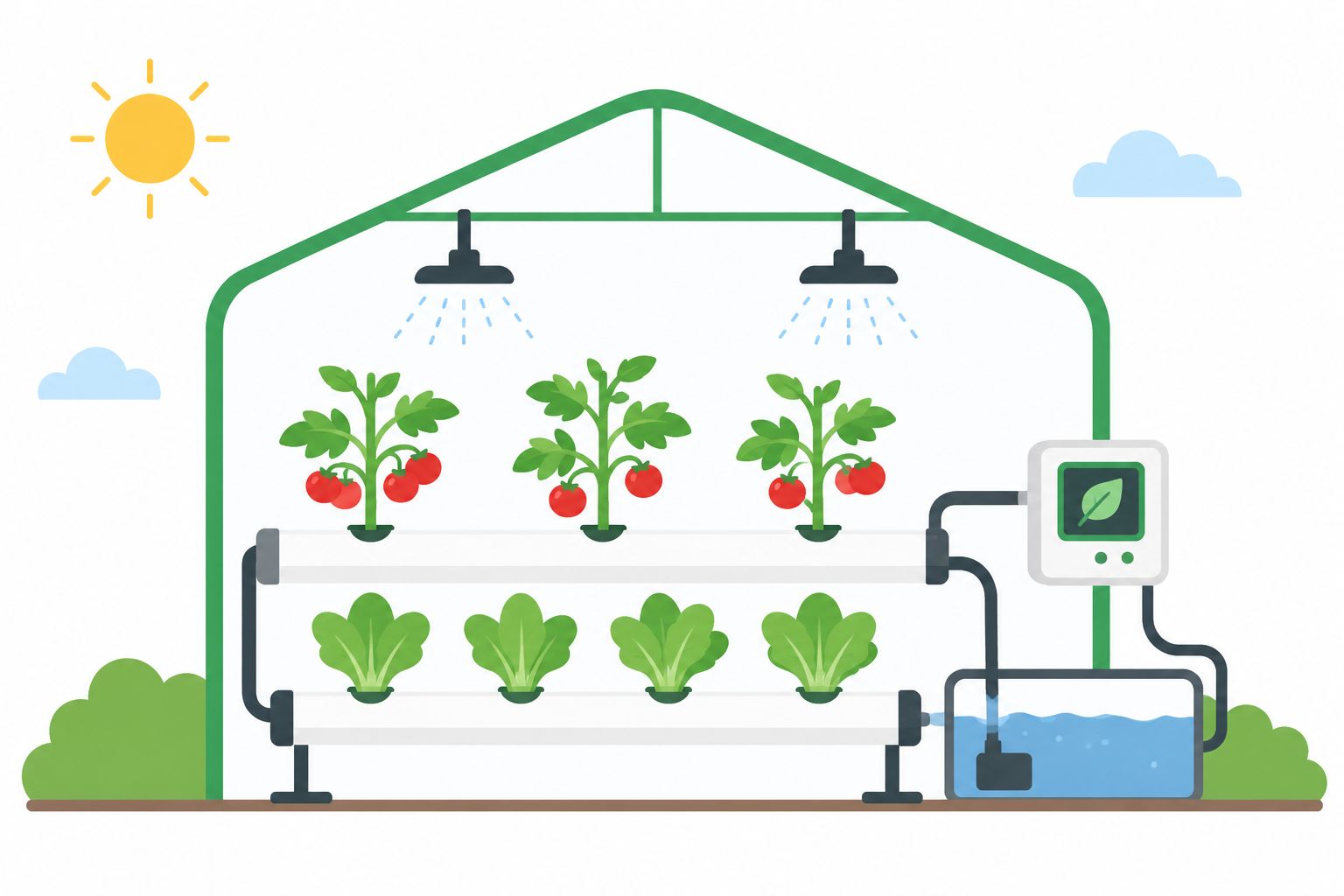
The core of Eeki’s system is a patented growing chamber that combines hydroponic and aeroponic farming principles. In conventional farming, crops grow in soil and absorb nutrients from the ground. In Eeki’s system, plants are grown without soil. Their roots receive nutrients through controlled water delivery systems. The company says this approach uses about 80 percent less water compared to conventional agriculture.
The growing chambers are enclosed and monitored using sensors and software. Eeki has built an in-house IoT system that tracks crop conditions in real time. The system includes weather monitoring tools, temperature sensors, humidity and carbon dioxide sensors, light intensity monitoring, and software that automates irrigation and nutrient delivery.
In practical terms, the system works more like an industrial production setup than a traditional farm. Crops are grown in controlled rows inside polyhouse structures. Sensors continuously collect information from the environment. Software then adjusts irrigation cycles and nutrient dosing depending on crop needs. Because the environment is managed more tightly, the company says it can maintain year-round production rather than depending entirely on seasons.
One of the company’s central claims is that its system allows cultivation on barren or otherwise unproductive land. Eeki says it has restored more than 202 acres of barren land for agricultural production.
The company also claims that its farming system produces higher yields per square meter than conventional farming.
Eeki received early-stage backing from local investors and later from GSF Accelerator.In 2022, the company raised approximately $6.5 million in funding from investors including General Catalyst, Avaana Capital, and Better Capital.
In 2025, Eeki raised another $7 million in a Series A2 funding round led by Sixth Sense Ventures. The company said the capital would be used to expand farm infrastructure, invest in research and development, and deploy its third-generation aeroponic growing chambers.
Eeki’s business model has evolved beyond simply selling vegetables. The company now operates multiple layers of business activity. It builds and manages farms, provides “Farming as a Service” support, licenses or deploys automation systems, and also offers investment partnerships for farm development.
Market response to controlled-environment agriculture has been mixed globally. Investors are attracted by the possibility of growing crops with less water, lower pesticide usage, and more predictable yields. However, the sector is also capital intensive. Building climate-controlled farming infrastructure requires significant upfront investment in polyhouses, sensors, cooling systems, automation equipment, and water management systems.
Eeki itself acknowledges this challenge. Its public FAQ notes that the company’s business model is “capital heavy” and requires long-term investment horizons.
The company competes in the broader category of controlled-environment agriculture and hydroponic farming. In India, companies such as Clover Ventures, Future Farms, UrbanKisaan, and Barton Breeze are also working in hydroponics and precision farming. Internationally, companies like Gotham Greens in the United States have built large greenhouse-based urban farming operations using hydroponic systems.
Globally, the controlled-environment agriculture market has grown because of increasing concerns around climate instability, water scarcity, food supply resilience, and pesticide use.
Countries in the Middle East, Singapore, Japan, the Netherlands, and the United States have invested heavily in greenhouse and indoor farming technologies. However, profitability remains a challenge across the sector because energy, infrastructure, and maintenance costs can be high.
What makes Eeki notable in the Indian context is its attempt to adapt these technologies for large-scale production under Indian cost conditions rather than focusing only on premium urban produce. The company repeatedly emphasizes “Indian market prices” in its public messaging, suggesting that affordability is central to its commercial strategy.
- Our correspondent