
Artificial intelligence has already transformed medical imaging, diagnostics, and clinical documentation.
Surgery, however, remains one of healthcare’s most difficult environments for AI. Every operation generates enormous amounts of video and procedural data, yet most of that information remains unused once a surgery is completed.
Bengaluru-based Curium Life is attempting to change that.
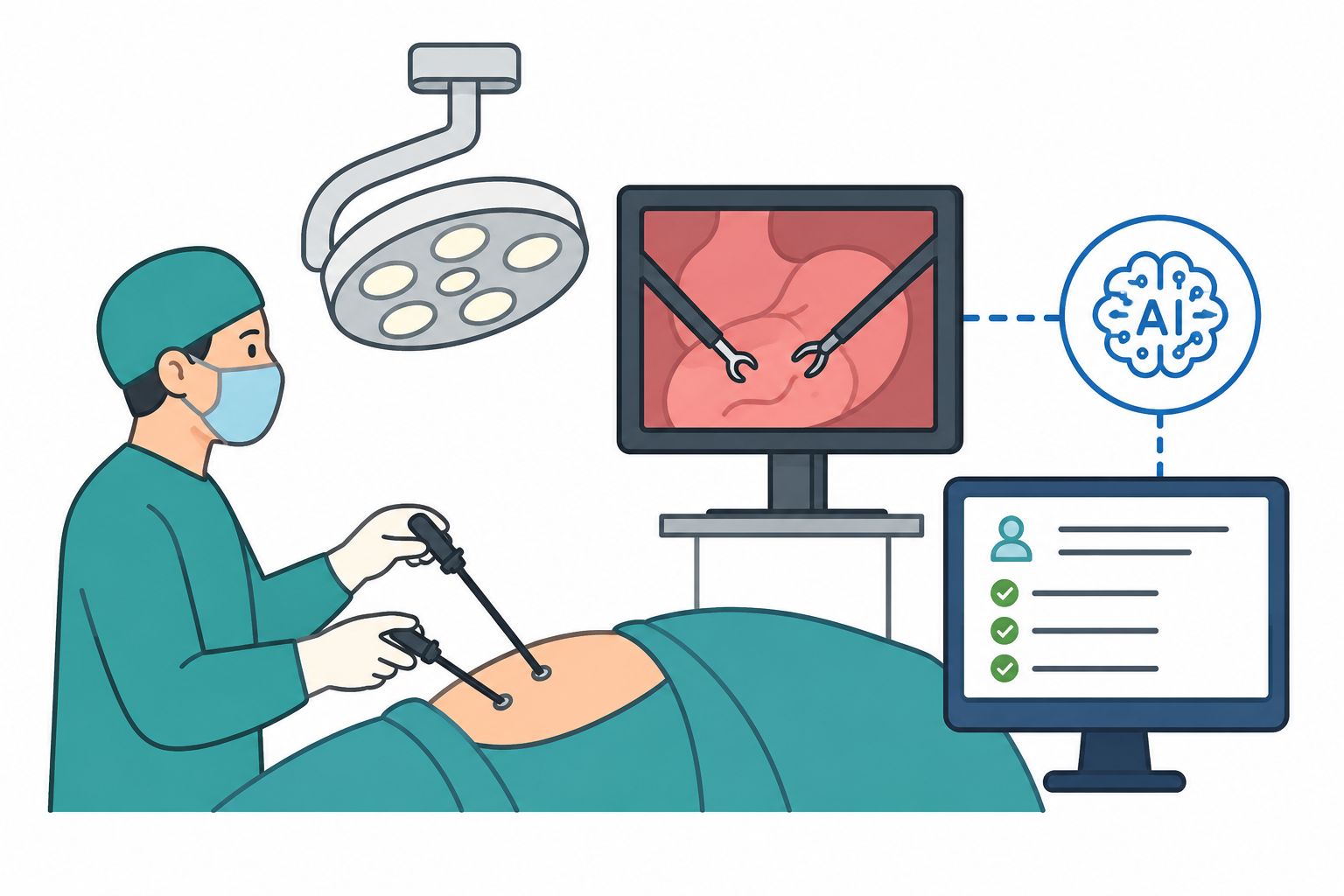
The startup is developing what it describes as a foundational surgical AI model capable of understanding surgical procedures across specialties rather than being limited to a single operation type. Its goal is to create an AI system that can assist surgeons before, during, and after surgery by analyzing video, anatomy, workflow, and risk patterns in real time.
Origins of the Company
Curium Life was founded by three co-founders: Dr. Vinayak S. Rengan, Balachandran (Balu) Seetharam, and Mani R. The company emerged from efforts to improve surgical decision-making through artificial intelligence and computer vision technologies.
Dr. Vinayak S. Rengan serves as Clinical Lead and Co-Founder. According to the company, he is a pediatric surgeon with expertise in hernia surgery and abdominal wall reconstruction (AWR). His role is to guide the clinical direction of the platform and ensure the technology addresses real operating-room challenges. Balu Seetharam serves as Business Lead and Co-Founder. The company describes him as a technologist and serial entrepreneur responsible for commercialization, business growth, and scaling strategy. Mani R serves as Technology Lead and Co-Founder and is responsible for the company’s AI infrastructure and foundational model development.
What Problem Is Curium Life Trying to Solve?
Modern operating rooms generate huge quantities of surgical video.
Laparoscopic and robotic procedures are routinely recorded, producing thousands of hours of footage. Yet most hospitals archive these videos without extracting useful insights from them.
At the same time, surgical outcomes often depend heavily on individual experience levels, procedural judgment, and the surgeon’s ability to recognize anatomical structures under pressure. Cognitive fatigue and procedural variability can affect outcomes.
Most existing surgical AI systems are narrow in scope. A model trained to assist during gallbladder surgery, for example, may not be useful during a colorectal procedure or hernia repair. Curium argues that this fragmented approach limits scalability and clinical usefulness. The company is therefore developing a broader AI system capable of learning from multiple surgical specialties and procedural types.
Competitors and Similar Companies
Curium operates within the rapidly growing surgical AI sector.
Internationally, companies such as Caresyntax, Cydar Medical, MediView, and ClearPoint Neuro are developing technologies that use AI, imaging, and data analytics to improve surgical precision and workflow. Many existing systems focus on specific procedures, specialties, or imaging workflows.
Curium’s main point of differentiation is its attempt to create a foundational model that can work across multiple surgical specialties rather than being trained for a single procedure type.
The Global Context
Surgical AI has become one of the fastest-growing segments within digital health.
Hospitals increasingly use computer vision systems to analyze imaging scans, monitor workflows, assist robotic surgery, and support clinical decision-making. The next frontier is creating AI systems that understand entire surgical procedures in real time.
Researchers and companies worldwide are working toward what is often called a “surgical foundation model”—an AI system trained on massive datasets spanning many types of operations. Such systems could eventually assist with anatomy recognition, procedural guidance, training, risk prediction, and documentation. Curium Life is positioning itself within this emerging category.
- Our correspondent