Cornext began in Hyderabad in 2015 with a problem that affects nearly every part of India’s dairy economy.
India has the world’s largest cattle population and is the biggest milk producer globally, yet dairy farmers across the country regularly struggle to find nutritious cattle feed throughout the year. Green fodder is seasonal, storage is difficult, and dry fodder often lacks nutrition. During droughts or summer months, feed shortages become severe enough to directly reduce milk production.
The founders of Cornext believed the problem was not simply about growing more fodder. It was also about preservation, transportation, and access.
The company was founded by Madhav Kshatriya and Feroz Ahmed, along with early founding team members including Amarnath Sarangula. The founders have experience in dairy cattle management, logistics, and agricultural operations.
The company focused on a technology called silage baling. Silage is fermented green fodder that can be preserved for long periods without losing much nutritional value. Farmers across Europe and North America have used silage systems for decades, but the infrastructure is usually expensive and designed for very large farms. Cornext’s founders believed Indian dairy farmers needed a smaller and cheaper version adapted for fragmented rural conditions.
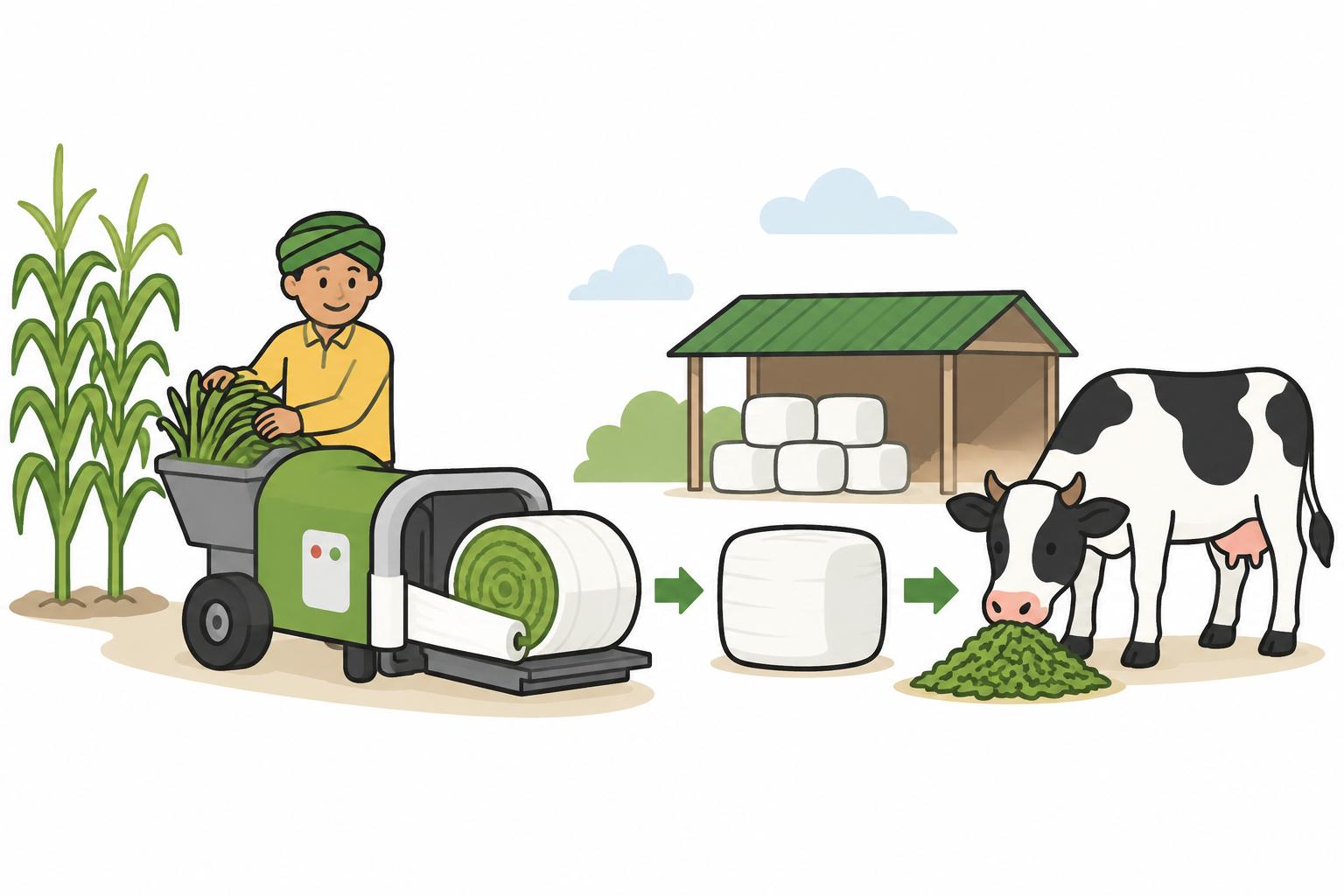
Cornext developed compact silage baling systems that compress freshly harvested green fodder into sealed bales. The fodder naturally ferments inside airtight packaging, allowing it to remain usable for 12 to 18 months. Instead of depending on seasonal green fodder availability, farmers can store feed and use it gradually throughout the year.
The company’s core innovation was not just silage itself but the creation of a smaller “Mini Silage Baler” designed specifically for Indian villages and small dairy operations. The machine produces compact 50-kilogram silage bales and costs significantly less than imported European balers. The company says its equipment costs less than one-tenth of comparable imported systems.
This mattered because traditional silage infrastructure in India was mostly limited to large dairies or industrial farms. Small dairy farmers usually could not afford large machinery or maintain massive silage pits. Cornext tried to decentralize the process by allowing local entrepreneurs to produce silage closer to villages and dairy clusters.
The company calls this its “Fodder Entrepreneur Network.” Instead of operating every production unit itself, Cornext supplies machines, training, and technical support to village-level entrepreneurs who produce and distribute silage locally.
In practice, the system works like a distributed feed manufacturing network. Farmers or local entrepreneurs harvest crops such as corn, sorghum, sugarcane, wheat fodder, or jowar at the right moisture stage. The crops are chopped, compressed into airtight bales, wrapped in special film, and naturally fermented. The finished bales are then supplied to nearby dairy farmers as ready-to-use cattle feed.
The company says the system improves consistency in cattle nutrition because silage remains stable across seasons. According to Cornext, dairy farmers using silage often report improvements in milk yield, cattle health, and reproductive performance.
Cornext initially gained traction through government-linked dairy programs. The startup worked with the Andhra Pradesh government as a PPP partner to distribute baled silage to marginal dairy farmers at subsidized prices.
As demand grew, Cornext expanded beyond feed distribution into machinery manufacturing and rural entrepreneurship.
The scale of feed production has also expanded significantly. Cornext claims it now supplies millions of animal rations annually and serves more than 10,000 dairy farmers across India.
The company’s customer base includes large dairy cooperatives and institutional dairy operators. These partnerships indicate that the company has moved beyond small pilot projects into larger dairy supply systems.
Cornext has also expanded internationally. The company says its baling machines are now exported to more than 20 countries across Asia, Africa, Latin America, and the Middle East.
Investor interest in the company increased as agritech investors began focusing more on climate resilience and livestock productivity. In 2024, agritech investment firm Omnivore invested $2.2 million in seed funding into Cornext.
The broader category in which Cornext operates is sometimes referred to as fodder technology or livestock feed infrastructure. Globally, dairy productivity depends heavily on feed quality because nutrition directly affects milk yield, cattle health, fertility, and disease resistance. Countries with advanced dairy sectors invest heavily in feed preservation systems, mechanized harvesting, silage production, and nutrition science.
International companies such as CLAAS, John Deere, and Krone manufacture large-scale baling and forage systems for industrial dairy farms. However, these systems are usually expensive and designed for large agricultural operations. Cornext’s approach is different because it focuses on low-cost decentralised infrastructure suitable for smallholder dairy ecosystems.
India’s dairy economy is structurally different from Western markets because most dairy farmers own only a few cattle rather than large industrial herds. That creates a different kind of technology challenge. Instead of building giant automated dairy systems, Indian agritech companies often focus on reducing fragmentation and improving access to basic infrastructure.
Cornext’s model attempts to solve multiple problems simultaneously: fodder preservation, rural employment, livestock nutrition, and decentralized manufacturing. The company is effectively building a distributed feed ecosystem where small entrepreneurs produce preserved fodder close to consumption centres instead of relying entirely on centralized feed supply chains.
The long-term challenge for the company will be scaling operational quality across hundreds of local entrepreneurs while keeping feed quality consistent. Silage quality depends heavily on moisture levels, sealing quality, fermentation conditions, and harvesting timing. Maintaining those standards across a decentralized network is operationally difficult.
Even so, Cornext represents a larger shift taking place inside India’s dairy sector. Instead of treating cattle feed as an informal agricultural byproduct, companies are increasingly approaching it as a structured supply chain and technology problem. Cornext’s business is built around the idea that improving dairy productivity in India may depend as much on feed preservation infrastructure as on cattle genetics or milk collection systems.
- Our correspondent