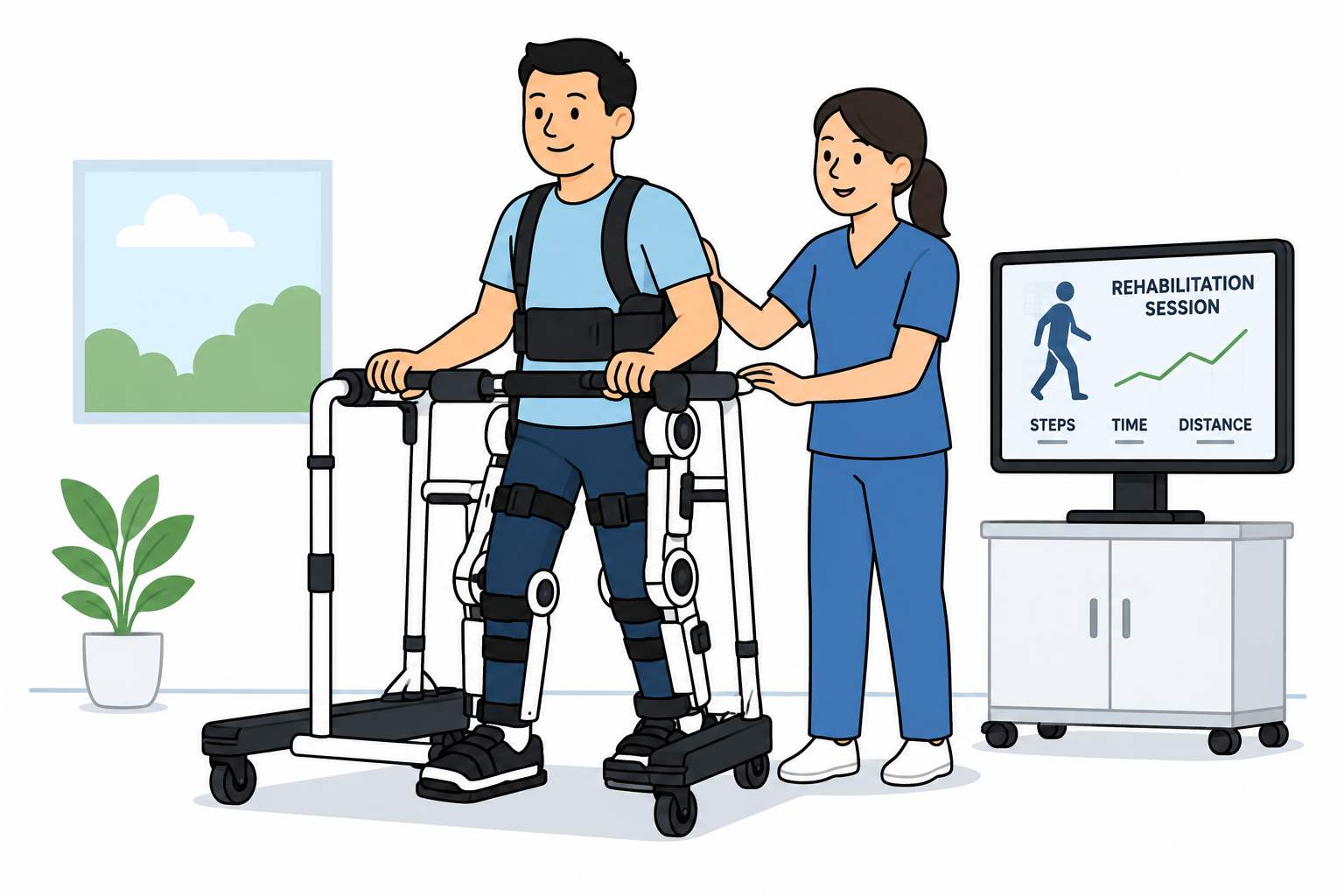
For patients recovering from spinal cord injuries, strokes, neurological disorders, or major orthopedic surgeries, rehabilitation often begins with a basic challenge: standing and walking safely again.
In many hospitals, this process still depends heavily on manual physiotherapy. Therapists physically support patients while helping them relearn movement patterns step by step. The work is physically demanding for caregivers and often limited by concerns around patient falls, fatigue, and inconsistency across rehabilitation sessions.
Bengaluru-based Bionic Yantra was founded to build robotic systems around that problem.
The company develops wearable robotic exoskeletons designed for rehabilitation and assisted mobility. These systems are intended to help patients stand, walk, and perform rehabilitation exercises in controlled and safer conditions.
Bionic Yantra was incorporated in 2017 by Vaidyanathan Narayanan and Shivakumar Nagarajan.
The core product developed by the company is called REARS — short for Robotic Exoskeleton Assisted Rehabilitation System.
The system combines a wearable robotic exoskeleton with a mobile support frame and safety mechanisms designed to help patients walk during rehabilitation sessions. Instead of requiring therapists to physically support body weight continuously, the robotic system assists limb movement while maintaining fall protection.
The exoskeleton itself is a motorized wearable frame attached around the patient’s legs and lower body. Motors, drives, sensors, and embedded control systems coordinate movement at the hip and knee joints. The system is programmed to provide calibrated assistance during standing and walking exercises.
One of the company’s main design priorities has been fall safety.
Conventional rehabilitation systems sometimes require expensive overhead harness infrastructure to prevent patient falls. Bionic Yantra instead developed a mobile robotic support system integrated directly with the exoskeleton platform. The company claims this creates a “100 percent fall-safe” rehabilitation environment for early-stage mobility training.
The company says the system is currently designed mainly for patients recovering from spinal cord injuries and strokes, though future versions may support additional neurological and orthopedic rehabilitation applications. The rehabilitation workflow is designed for supervised hospital usage.
Patients wear the exoskeleton while medical professionals control and monitor therapy sessions. Sensors inside the system track movement metrics such as walking speed, range of motion, and step counts.
Bionic Yantra says the system can potentially reduce rehabilitation timelines significantly compared to conventional therapy methods. The rehabilitation duration can be reduced to roughly one-third in some scenarios.
One important aspect of the company’s approach is affordability. Imported robotic rehabilitation systems are often too expensive for widespread adoption in Indian hospitals. Bionic Yantra says its systems are designed and manufactured locally using simulation-led engineering and Indian production infrastructure to lower costs.
The company’s systems have been showcased through institutions including IIIT Bangalore and rehabilitation-focused medical events. Social Alpha, one of India’s science and technology startup incubators, has also supported the company.
Funding for the company has come through early-stage innovation and impact-investment channels. Bionic Yantra has raised funding from investors including Social Alpha, KITVEN Fund, and IIIT-B Innovation Centre.
The broader market Bionic Yantra operates in is known as robotic rehabilitation and wearable exoskeleton systems.
Globally, companies such as Ekso Bionics, ReWalk Robotics, and Cyberdyne have developed wearable robotic systems for rehabilitation and mobility assistance. These devices are increasingly used in neurological rehabilitation, spinal cord injury recovery, elderly mobility support, and industrial movement assistance.
However, most advanced exoskeleton systems remain expensive and concentrated in high-income healthcare systems. That creates a different challenge in countries like India.
Large rehabilitation centres are limited, trained therapists are stretched, and access to advanced rehabilitation technologies remains uneven outside major cities. Many patients also discontinue therapy early because of cost, travel difficulty, or caregiver burden.
Bionic Yantra’s strategy appears focused on making robotic rehabilitation more accessible to Indian hospitals rather than building only premium research-grade systems.
There is also the issue of scale. Rehabilitation robotics remains a niche category compared to mainstream medical devices, especially in emerging healthcare markets.
Even so, the direction of rehabilitation technology globally is moving toward more sensor-driven, data-assisted, and robotic systems.
Bionic Yantra’s larger ambition appears to be building that category within India — creating robotic rehabilitation systems that move beyond experimental labs and become part of routine mobility recovery infrastructure in hospitals and rehabilitation centres.
- Our correspondent