As electric vehicles, battery storage systems, and renewable energy installations grow, one problem is becoming increasingly important: what happens to batteries after they reach the end of their useful life?
Lithium-ion batteries contain valuable materials such as lithium, cobalt, nickel, graphite, copper, and manganese. Most of these materials are expensive to mine, heavily concentrated in a few countries, and difficult to replace in battery manufacturing. As EV adoption rises globally, governments and manufacturers are increasingly treating battery recycling as both an environmental issue and a strategic supply-chain issue.
Noida-based Lohum is one of the Indian companies trying to build infrastructure around that transition.
Founded in 2018, Lohum works on lithium-ion battery recycling, battery repurposing, critical mineral refining, and production of battery-grade materials. The company’s goal is not simply to dispose of old batteries, but to recover valuable materials from them and return those materials back into the clean-energy supply chain.
The company was founded by Rajat Verma, with a background in industrial operations, energy systems, and materials processing before starting Lohum.
In its early years, Lohum focused mainly on recycling used lithium-ion batteries from consumer electronics and electric vehicles. Over time, the company expanded into what it calls “energy transition materials,” a broader category that includes recycled critical minerals, refined battery materials, and second-life battery systems.
The core business operates across three connected areas. The first is battery recycling.
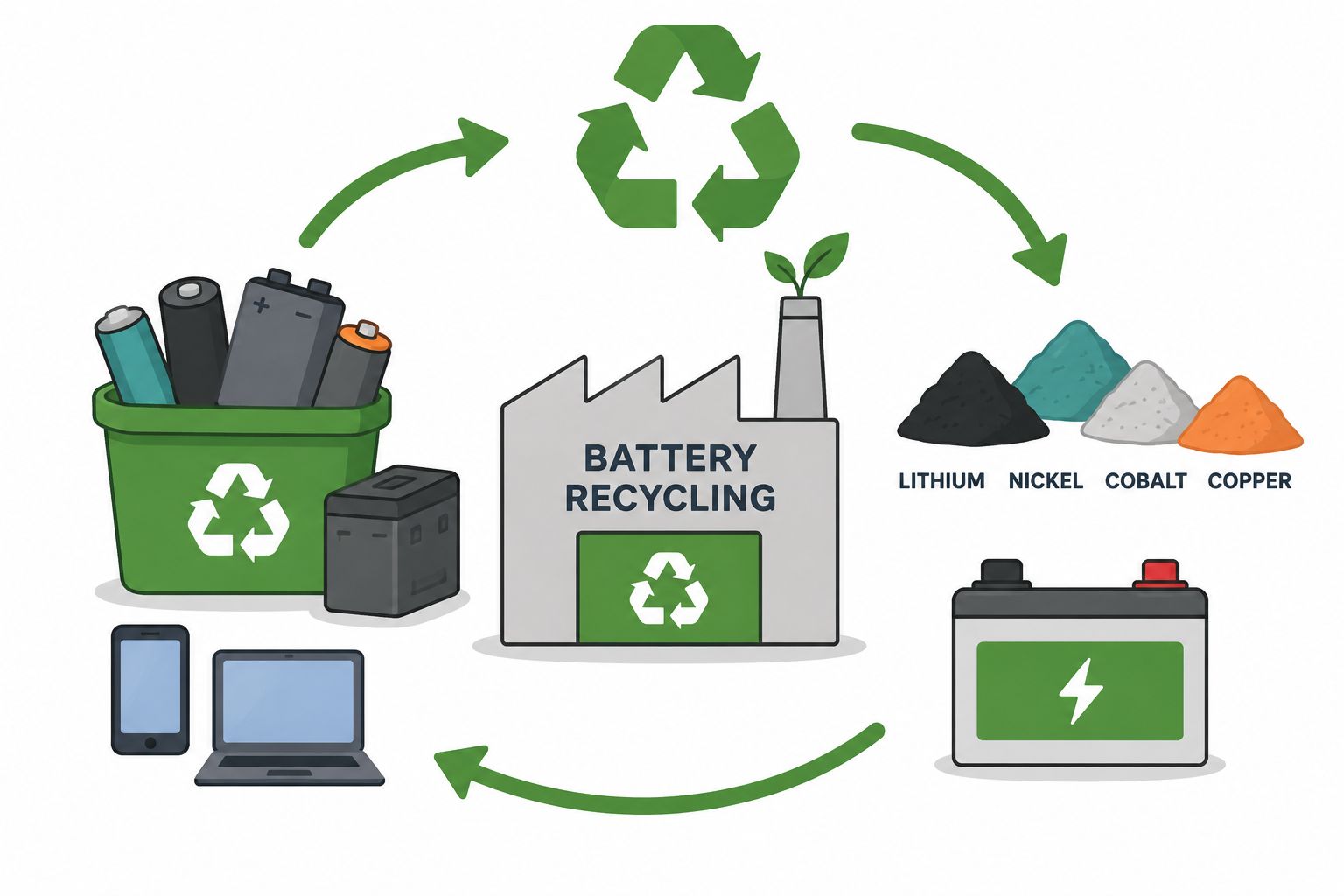
Used lithium-ion batteries are collected from EV manufacturers, electronics firms, industrial operators, and waste channels. These batteries are dismantled and processed to recover materials such as lithium, cobalt, nickel, copper, graphite, and aluminum.
The second area is battery repurposing or “second life” systems.
Not all EV batteries become unusable when removed from vehicles. In many cases, the batteries no longer deliver sufficient performance for mobility applications but still retain significant storage capacity. Lohum refurbishes some of these batteries for stationary energy storage systems instead of immediately recycling them.
The third area is refining and manufacturing battery materials.
Instead of stopping at raw recovery, the company increasingly focuses on converting recycled material into battery-grade chemicals and cathode-related inputs that can be used again in battery manufacturing.
This is important because India imports a large share of its battery materials and remains dependent on overseas supply chains, especially China, for refining and processing.
Lohum now refines a large percentage of India’s lithium recycling output. The company operates multiple facilities across Uttar Pradesh and Gujarat.
The scale of the broader battery-recycling market is growing rapidly because EV adoption is accelerating globally.
Large volumes of EV batteries have not yet reached end-of-life because the industry itself is relatively young. However, recycling firms are preparing for a future where battery disposal and material recovery become major industrial sectors.
India sees battery recycling as strategically important for reducing mineral imports and building domestic clean-energy supply chains. Industry projections suggesting recycling could eventually supply a significant portion of India’s future lithium, cobalt, and nickel demand.
Lohum positions itself as part of that emerging infrastructure layer.
The company says its recycling systems follow a “closed-loop” model where recovered materials are fed back into battery production rather than discarded as waste. It also claims to operate “zero waste” recovery systems and provide proof-of-recycling documentation for compliance and Extended Producer Responsibility (EPR) requirements.
One challenge in battery recycling is economics.
Recovering battery materials is technically complex and requires high-purity processing. Profitability depends on recovery efficiency, commodity prices, collection networks, logistics, and processing scale.
The industry is also moving beyond recycling alone toward what companies call “urban mining” — extracting critical minerals from discarded electronics, industrial scrap, and battery waste rather than mining new raw materials.
Lohum has increasingly expanded into this larger critical-minerals strategy.
The company has also worked with international researchers and advanced-materials scientists. In 2026, Nobel Prize-winning physicist Konstantin Novoselov, known for his work on graphene, joined discussions with Lohum around advanced battery materials and recycling systems.
Globally, Lohum operates in a market that includes major battery-recycling companies such as Redwood Materials in the United States and several Chinese and European recycling firms building closed-loop battery supply chains.
India’s battery-recycling ecosystem is still relatively early-stage compared to China, which dominates much of the global battery-materials processing industry. However, the sector is receiving growing attention because governments increasingly view critical minerals as strategic infrastructure rather than simply industrial commodities.
The challenge for Lohum is scale and supply-chain coordination.
Battery recycling depends on collection networks, standardized disposal systems, transportation infrastructure, safety compliance, and consistent battery supply. India still has a fragmented recycling ecosystem where informal waste handling remains widespread.
There is also a technological challenge. Different battery chemistries require different recovery processes, and battery designs continue changing rapidly as manufacturers experiment with new materials.
Even so, the broader direction of the industry is becoming clearer.
As EV adoption expands, companies are increasingly trying to build circular battery ecosystems where minerals are recovered, refined, and reused domestically instead of repeatedly imported through global mining supply chains.
Lohum’s strategy appears aimed at positioning itself not only as a recycler of old batteries, but as a long-term supplier of critical materials for India’s broader energy-transition economy.
-Our correspondent