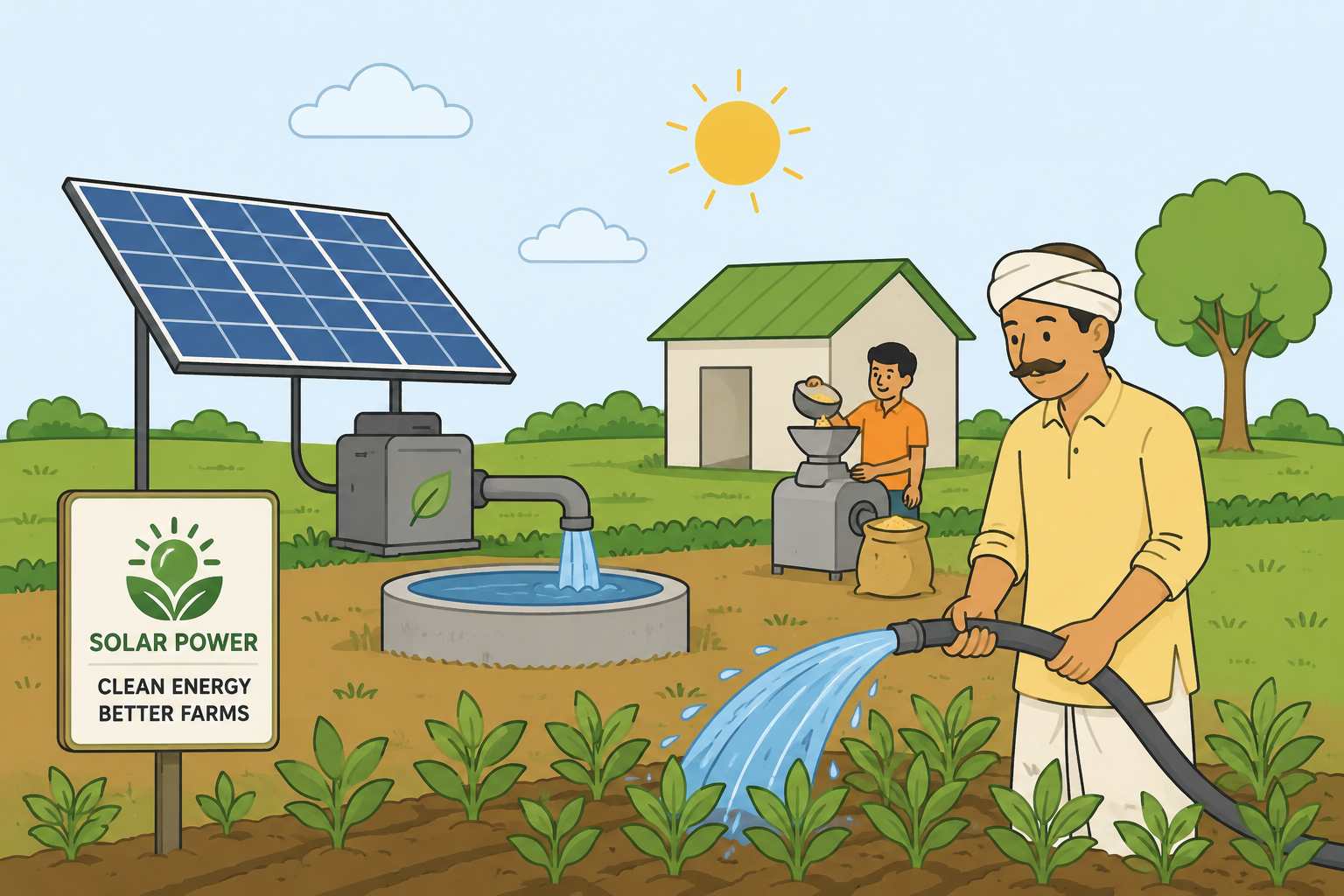
For millions of small farmers in India, irrigation still depends on diesel pumps.
The fuel is expensive, prices fluctuate regularly, and access can be unreliable during peak farming seasons. Many farmers also cannot afford to buy solar irrigation systems outright, even though solar pumps reduce long-term operating costs.
Delhi-based Oorja was founded to address that gap.
The company installs and operates solar-powered irrigation and agricultural processing systems and then sells these services to farmers on a pay-per-use basis. Instead of purchasing expensive equipment themselves, farmers pay only for the water pumped or crops processed.
Oorja was founded in 2016 by Amit Saraogi and Clementine Chambon. Saraogi previously worked in investment banking before moving into the clean-energy and agriculture sector. Chambon, a chemical engineer by training, had earlier worked on renewable-energy systems and climate-focused technologies.
The founders started Oorja after identifying a recurring problem in rural agriculture: clean-energy technologies such as solar pumps existed, but adoption remained low among marginal farmers because upfront costs were too high and financing systems were weak.
The company initially experimented with rural mini-grids and bioenergy systems before focusing more directly on agriculture and irrigation services. Over time, it evolved into what it calls a “Farming-as-a-Service” model.
The core business model is straightforward.
Oorja installs decentralized solar infrastructure at the farm level and retains ownership of the equipment. Farmers do not buy the assets. Instead, they access irrigation, milling, and more recently cooling services when needed and pay usage-based charges.
The company says this approach removes one of the biggest barriers to solar adoption in agriculture — capital expenditure.
The company later expanded into climate-smart agricultural advisory services through a platform called Oorvar. This advisory service provides guidance on crop planning, water use, input management, and sustainable farming practices.
Unlike many solar companies that focus mainly on energy generation, Oorja positions itself around agricultural productivity and rural income improvement.
Its systems are primarily targeted at small and marginal farmers in states such as Uttar Pradesh and Bihar, where fragmented landholdings and limited access to mechanization create operational challenges.
One important aspect of Oorja’s model is that the solar assets are designed for shared rural usage rather than individual ownership.
Oorja combines irrigation systems with village-level milling infrastructure to maximize asset utilization and improve project economics. In some deployments, the same solar systems are used for multiple agricultural services instead of remaining idle outside irrigation periods.
The company also works with local operators and village entrepreneurs who manage day-to-day operations.
Funding has played a significant role in the company’s expansion.
Across publicly disclosed rounds, Oorja has raised at least $2.5 million so far.
The broader market Oorja operates in sits at the intersection of distributed solar energy, agricultural mechanization, and climate adaptation.
Across India, diesel pumps remain widely used despite government efforts to promote solar irrigation under schemes such as PM-KUSUM. However, many small farmers still struggle with financing, maintenance, and utilization issues when purchasing solar pumps individually.
A growing number of companies are therefore experimenting with shared-infrastructure or service-based models rather than outright equipment sales.
India-based companies such as AgNext work on agricultural quality testing, while firms in the solar irrigation ecosystem focus on financing, leasing, or distributed infrastructure management. Internationally, pay-per-use agricultural energy systems have also emerged across parts of Africa and Southeast Asia where smallholder farming dominates rural economies.
What differentiates Oorja is its attempt to combine multiple rural services — irrigation, milling, cooling, and advisory support — around shared solar infrastructure instead of treating them as standalone products.
The company’s long-term challenge, however, is operational scale.
Deploying decentralized agricultural infrastructure in rural India requires managing maintenance, farmer coordination, seasonal demand variation, local operators, payment collection, and water availability. Profitability can also depend heavily on utilization rates because the assets are distributed across villages rather than concentrated in industrial projects.
There is also the broader issue of groundwater sustainability. Solar irrigation reduces diesel dependence, but unrestricted pumping can increase groundwater extraction unless usage is managed carefully. Oorja says its advisory systems promote more efficient water use and crop planning practices. For now, the company represents a growing category of rural infrastructure businesses trying to turn clean energy into a service layer for agriculture rather than simply a hardware sale.
Its central premise is practical: small farmers may not be able to afford large solar systems individually, but they can access clean irrigation and agricultural services if the infrastructure is shared, locally operated, and priced around actual usage rather than ownership.
- Our correspondent