Seaweed has been used for decades in food, cosmetics, fertilizers, and industrial additives. But large-scale cultivation has remained difficult because most seaweed farming is still labor-intensive and confined to shallow coastal waters.
Bengaluru-based Sea6 Energy is trying to change that by building mechanized systems that can grow and harvest seaweed at industrial scale in deeper ocean waters.
The company is also developing ways to convert that biomass into agricultural inputs, animal feed ingredients, renewable chemicals, and biofuels.
Sea6 Energy was founded in 2010 by Nelson Vadassery, Sowmya Balendiran, Sri Sailaja Nori, and Shrikumar Suryanarayan.
The idea emerged from work connected to the iGEM synthetic biology competition while the founders were at IIT Madras. According to the company and multiple interviews, the founders initially explored algae-based biofuels before shifting focus toward tropical seaweed cultivation and downstream processing technologies.
The backgrounds of the founders reflect the company’s mix of biotechnology and engineering. Nelson Vadassery, the company’s CEO, studied at IIT Madras and works on ocean farming systems, automation, and engineering design. Sowmya Balendiran, Chief Business Officer, has led product development and commercialization efforts. Sri Sailaja Nori heads research and development and works on converting seaweed into commercial products including agricultural biostimulants and renewable chemicals. Shrikumar Suryanarayan, the company’s managing director, previously held senior leadership roles at Biocon and was associated with India’s biotechnology ecosystem through organizations including ABLE.
The company started operations using facilities linked to IIT Madras before later moving to Bengaluru and working from the C-CAMP ecosystem. Over time, Sea6 focused on solving two connected problems: how to produce seaweed at scale, and how to process it into commercially useful products.
The farming system developed by Sea6 is centered around mechanized offshore cultivation. Traditional seaweed farming in many parts of Asia involves ropes tied in shallow waters where workers manually seed, harvest, and replant seaweed. Sea6 says this approach limits scale because it depends heavily on labor and near-shore conditions. The company instead developed proprietary cultivation systems and harvesting machinery that can operate farther offshore.
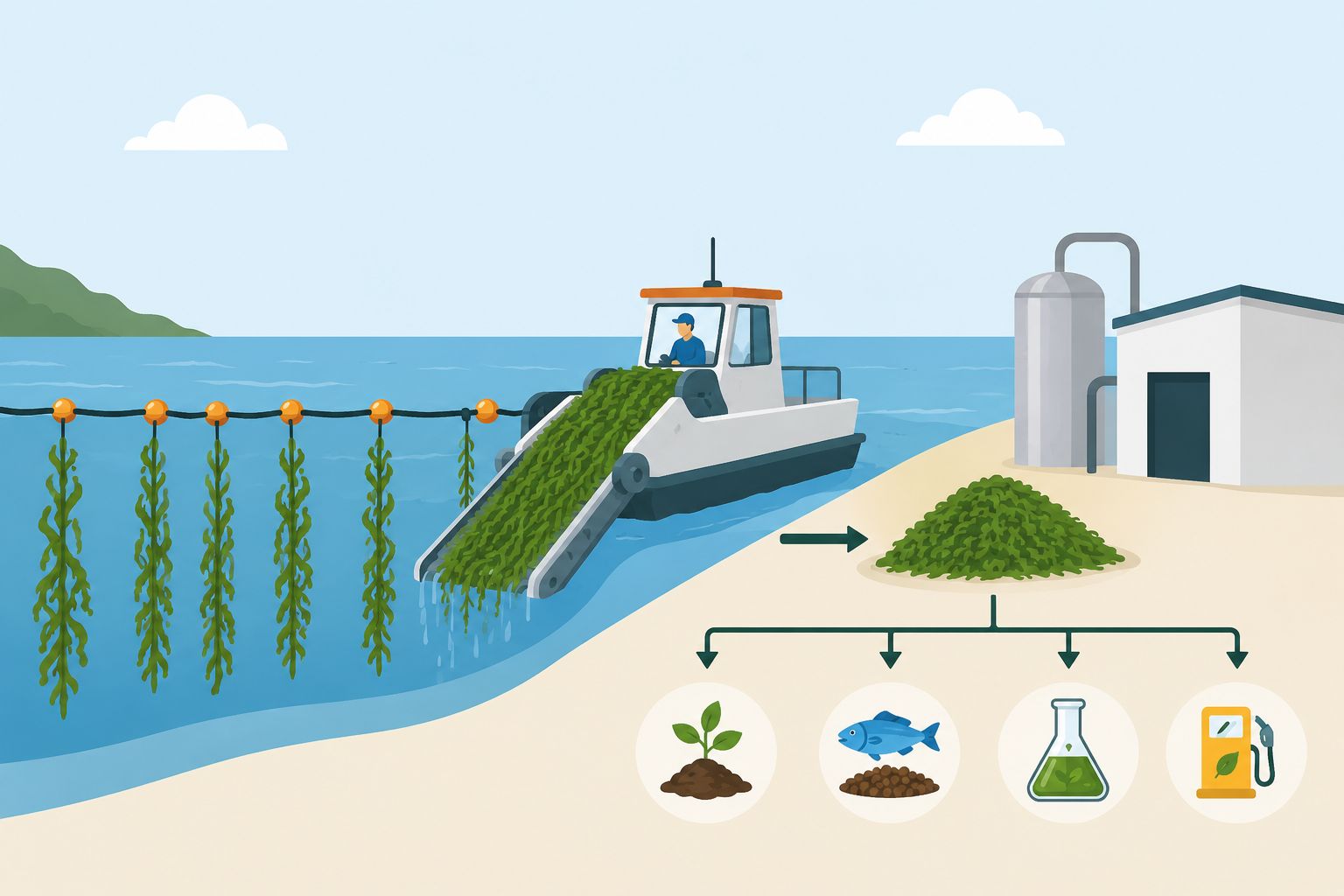
One of the company’s best-known systems is called the SeaCombine. According to the company and coverage by Chemical & Engineering News, the machine is designed to simultaneously harvest mature seaweed and reseed new growth. Sea6 says this allows multiple cultivation cycles annually while reducing labor intensity. C&EN reported that the company claims it can harvest up to six seaweed crops per year using the system.
The company primarily works with tropical red seaweed species. After harvesting, the biomass is processed through Sea6’s biorefinery systems. Rather than selling raw seaweed alone, the company converts the material into several categories of products. Its agricultural division produces biostimulants and crop-input products intended to improve nutrient uptake, plant growth, and resistance to stress. Sea6 also works on aquaculture feed ingredients, food ingredients, and renewable chemical applications.
One of the more closely watched areas is biofuel. Sea6 has been developing processes to convert seaweed biomass into biocrude using hydrothermal liquefaction, a process that converts wet biomass into oil-like material under high heat and pressure. The company says this approach avoids the need to dry seaweed before processing, which is often one of the major cost barriers in algae-based fuels.
The company has also spoken publicly about partnerships related to energy applications. Sea6 announced an MoU with HPCL around seaweed-to-fuel innovation.
The company operates in India and Indonesia. Reports indicate that funding has been used to expand farming infrastructure, increase processing capacity, and scale agricultural product manufacturing.
Still, the broader seaweed industry has been gaining attention globally because seaweed grows rapidly and does not require freshwater, arable land, or synthetic fertilizers. Governments and investors are increasingly examining marine biomass as a possible input for food systems, biomaterials, methane-reducing livestock feed, and low-carbon industrial products.
Sea6 is not alone in this market. US-based Blue Ocean Barns focuses on seaweed feed additives designed to reduce methane emissions from cattle. CarbonWave works on seaweed-derived biomaterials and emulsifiers. Several companies in Europe and Asia are also developing offshore seaweed cultivation systems and biorefineries.
What differentiates Sea6 is its emphasis on tropical seaweed farming combined with mechanization. Much of the global seaweed industry still depends on manual cultivation. Sea6’s core proposition is that ocean farming can become industrialized in the same way agriculture on land became mechanized over time.
- Our Correspondent