India’s healthcare system has one persistent problem that patients and doctors both understand: medical records are everywhere and nowhere at the same time.
Prescriptions are stored in WhatsApp chats, lab reports sit in PDFs, hospital discharge summaries are lost in paper files, and every new doctor starts with the same question—“Do you have your old reports?” Eka.Care was built to solve that fragmentation.
Based in Bengaluru, Eka.Care is a connected health platform that helps patients store and manage their health records, while giving doctors and hospitals digital tools for prescriptions, electronic medical records (EMR), follow-ups, and care coordination. Its larger goal is to become the infrastructure layer connecting India’s digital health system.
Instead of being only a telemedicine app or only a doctor software tool, Eka.Care tries to connect both sides: the patient’s health profile and the provider’s clinical workflow.
That practical use case—making healthcare records usable rather than scattered—has made it one of the more important companies in India’s digital public health stack.
Founders
Eka.Care was founded in 2020 by Vikalp Sahni and Deepak Tuli. Both founders were previously associated with Goibibo, where they helped build large-scale consumer technology systems. After leaving travel technology, they moved into healthcare with a very different problem: India lacked a standard digital layer for personal health records.
The company also aligned early with the government’s Ayushman Bharat Digital Mission (ABDM), which created a national framework for digital health IDs and interoperable medical records.
That timing mattered. Eka.Care was not building a standalone health app—it was building around India’s emerging public digital health infrastructure.
What the product actually does
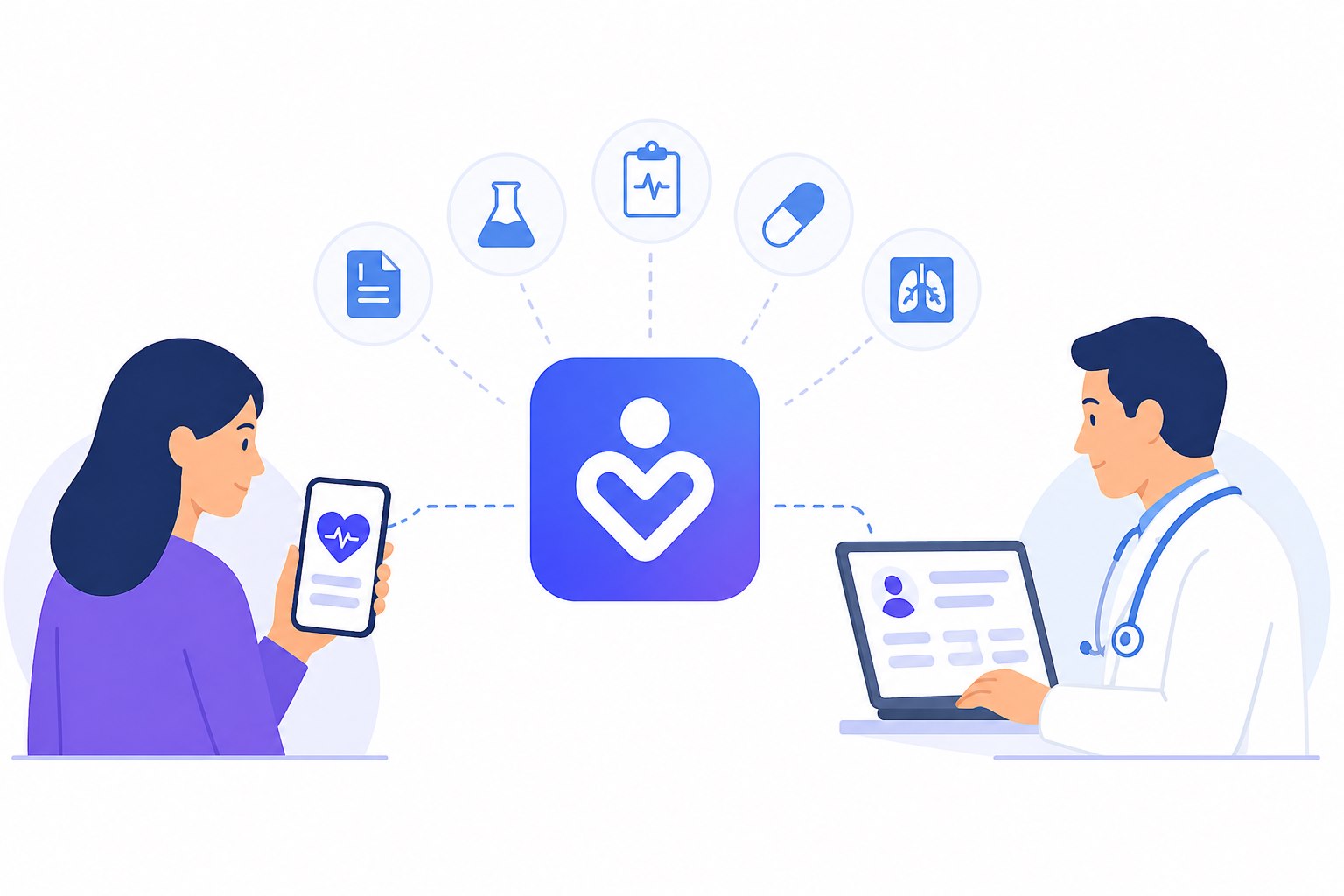
Eka.Care’s main product is a digital health profile for patients and an operating system for doctors. For patients, the app stores prescriptions, lab reports, vaccination records, discharge summaries, and medication history in one place. It also supports ABHA (Ayushman Bharat Health Account) creation, giving users a government-recognized digital health ID connected to the ABDM network.
The company says it has created more than 20 million ABHA IDs and manages more than 140 million medical records on the platform.
For doctors and clinics, Eka offers EMR and practice management tools.
These include: digital prescriptions, patient records, appointment scheduling, follow-up reminders, WhatsApp-based patient communication and billing and OPD workflow support apart from AI-assisted documentation and smart clinical suggestions
The goal is simple: reduce the amount of fragmented manual work doctors handle every day.
Instead of writing paper prescriptions and separately managing patient history, the system keeps the consultation, records, and follow-up connected.
How it works
A patient visits a clinic using Eka’s doctor platform. The doctor creates an e-prescription, updates diagnosis details, and stores the consultation digitally inside the EMR. That record is linked to the patient’s health profile and can be shared securely through ABDM consent flows. Later, if the patient visits another doctor or hospital, records can be retrieved instead of recreated from memory.
The company also offers a Medical Records Analyser, which converts uploaded reports into a structured dashboard for faster understanding, and AI-powered clinical decision support during consultations. This matters because healthcare in India is often not limited by treatment availability—it is limited by poor continuity of care. If history is missing, treatment restarts from zero.
Deployment
Eka.Care says it has onboarded: 33,000+ clinics and hospitals, 90,000+ doctors.
Funding
Eka.Care raised $4.5 million in seed funding in 2021 from investors including 3one4 Capital, Eximius Ventures, and Speciale Invest [Company press archive].
In July 2022, it raised a $15 million Series A led by Hummingbird Ventures, with participation from 3one4Capital, Mirae Asset, Verlinvest, Aditya Birla Ventures, and angel investors including Binny Bansal and Rohit MA of Cloudnine Hospitals.
Global context
Globally, countries are moving toward interoperable personal health records, but most systems remain fragmented. The U.S. has electronic records but poor interoperability across providers. Many developing countries still rely heavily on paper systems.
India’s opportunity is different: because the digital public infrastructure is being built now, platforms like Eka.Care can be designed around interoperability from the start. That makes the company less comparable to a telemedicine app and more comparable to a health infrastructure layer.
The tech-for-good angle
The strongest social impact case for Eka.Care is continuity of care.
A patient with diabetes, heart disease, pregnancy history, or chronic illness should not have to rebuild medical history at every visit. Digital records reduce repeated tests, improve diagnosis speed, and make treatment safer. Doctors also benefit because administrative work falls and follow-up care improves. This is not flashy healthcare AI.
- Our correspondent