Most AI startups focus on offices, hospitals, or city logistics. Innogle works in a very different environment: the ocean.
Based in Chennai, Innogle builds AI-powered systems for fishermen, aquaculture operators, coastal security teams, and marine researchers. Its products are designed for practical problems at sea—finding profitable fishing zones, monitoring fish farms, tracking worker safety, detecting underwater threats, and collecting real-time ocean data.
The company describes itself as an “oceanography deep-tech” firm using AI, robotics, and the Internet of Underwater Things (IoUT) to improve ocean operations. Instead of treating the sea as a blank space, Innogle treats it as a data environment that can be measured, monitored, and managed.
That makes it one of the few Indian startups building specifically for the blue economy rather than adapting general technology for maritime use.
Founders
Innogle Technologies Private Limited was founded in 2019 in Chennai, Tamil Nadu. The company positions itself as “India’s first oceanography deep-tech company,” focused on fisheries, coast guards, and researchers rather than general enterprise software.
Its early work centered on helping fishing communities with safer navigation and better catch prediction. From there, it expanded into aquaculture monitoring, underwater sensing, coastal surveillance, and ocean worker safety.
The logic was practical: fishing and marine operations are still heavily dependent on fragmented manual decisions. Better real-time information can directly affect income and safety.
What the product actually does
Innogle does not sell one single product. It builds a group of connected systems for ocean operations. Its best-known platform is KadalCompass.
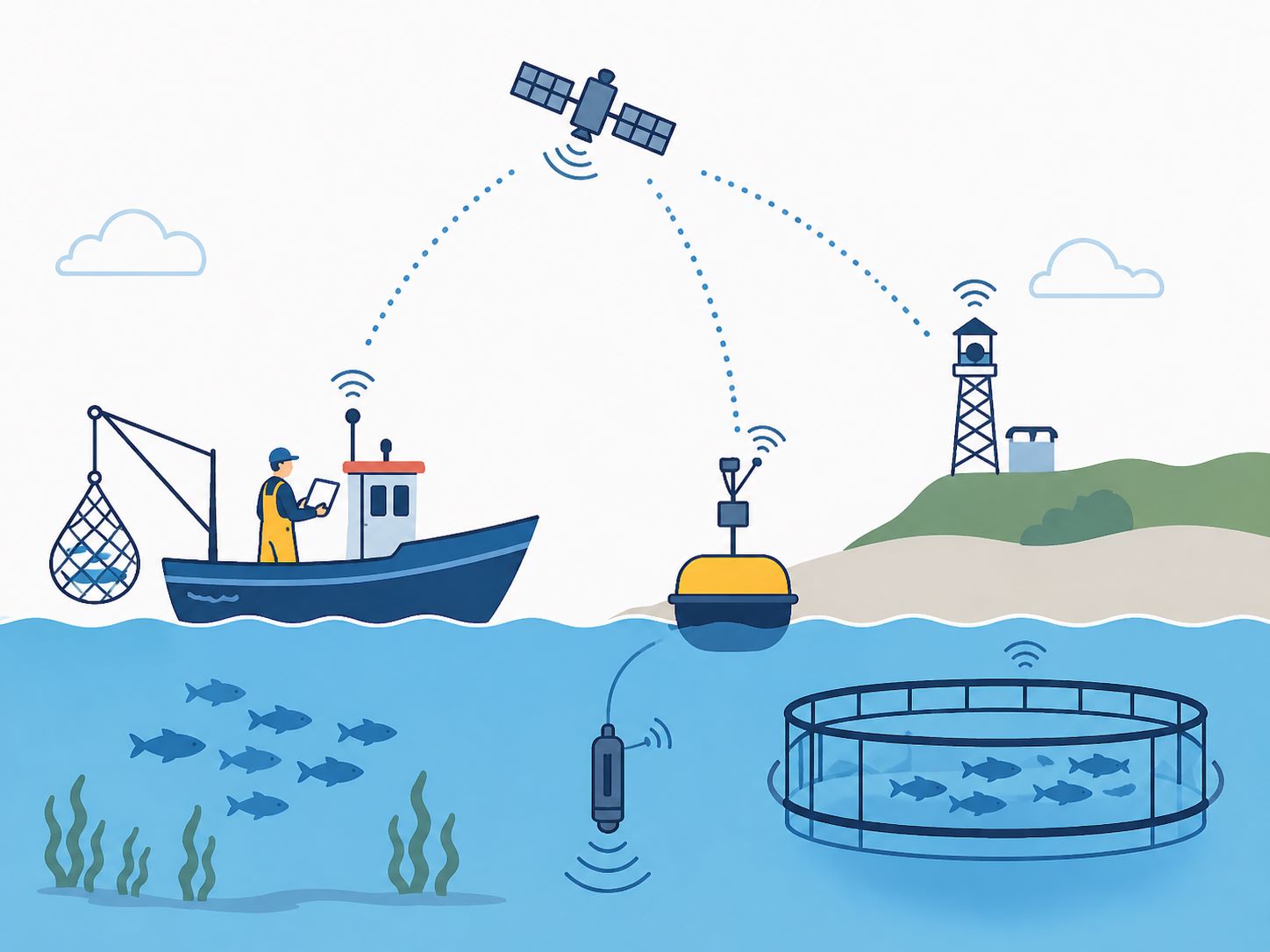
KadalCompass is an AI-enabled smart display device installed on fishing boats. It uses AI, 5G connectivity, and IoUT systems to provide real-time fishing guidance, vessel safety tracking, and ocean condition insights.
In simple terms, it helps fishermen answer three questions: Where should I fish? Is it safe to continue? How do I stay connected and visible at sea?
The system combines underwater sensing, location awareness, and predictive analytics to guide vessel movement and improve decision-making.
The second major area is aquaculture. Its CageCompass platform helps cage-based fish farms monitor water quality, fish behavior, disease risks, and harvesting conditions. Sensors placed underwater collect data such as dissolved oxygen, pH, salinity, turbidity, temperature, and ammonia. This data is transmitted over 4G and 5G networks and analyzed through AI models.
Instead of relying only on manual inspection, operators can monitor conditions continuously and intervene earlier. Its Swancee and Saagarnova systems extend this into larger water bodies and coastal monitoring.
Swancee is a floating IoUT device for lakes, reservoirs, and aquaculture zones. Saagarnova is a larger ocean buoy platform for maritime security and ocean data mining, designed for underwater object detection, deep-port monitoring, and coastal surveillance.
There is also Rakshava, a life-safety wearable for ocean workers, and autonomous search-and-rescue systems for emergencies at sea.
How the system works
The company’s core technical idea is Hydro AI plus IoUT. IoUT means Internet of Underwater Things—connected underwater devices that collect and transmit data from below the surface. These devices use sensors, cameras, embedded communication systems, and floating or fixed nodes to create a live underwater monitoring network. Hydro AI is the intelligence layer that interprets this data.
It can monitor water quality, predict environmental changes, identify fish behavior, detect underwater movement, and flag anomalies such as oil spills, security intrusions, or sudden ecosystem changes.
This is important because most marine industries still work with delayed or incomplete information. Innogle is trying to turn ocean operations into a real-time monitored system.
The company has also been included in government and policy discussions around Indian AI and deep-tech startups. In February 2026, the Prime Minister’s roundtable with CEOs of AI and deep-tech companies included Innogle among the invited firms, alongside larger national startups.
Competition
Innogle sits at the intersection of fisheries technology, marine robotics, and coastal security.
In India, companies like SatSure work on remote sensing and geospatial intelligence, though not specifically underwater operations.
Marine-specific competitors are fewer. Startups in fisheries intelligence, aquaculture IoT, and port surveillance often work on only one layer—fleet management, fish farm monitoring, or coastal defense. Innogle is trying to combine all of these into one ocean intelligence stack.
Globally, companies in this category include Saildrone in the U.S. for autonomous ocean monitoring, Ocean Infinity for marine robotics, and XpertSea for aquaculture intelligence. What makes Innogle different is its focus on Indian coastal operations and small fishing economies rather than only high-budget naval systems.
The tech-for-good angle
The strongest social impact case for Innogle is straightforward: safer fishing and better livelihoods.
Fishing communities often work with incomplete weather data, weak connectivity, and high physical risk. A wrong route decision can mean fuel loss, lost income, or life-threatening danger.
If KadalCompass improves route selection and safety tracking, that has immediate financial and human value.
In aquaculture, better water monitoring means fewer disease outbreaks and lower stock loss. That directly affects farmer income and food security.
Coastal security systems also help with illegal fishing detection, environmental monitoring, and disaster response.
This is not “AI for convenience.” It is operational technology for people whose income depends on the sea. That makes Innogle unusual in India’s startup landscape.
Most AI companies work on software for screens. Innogle is building systems for boats, fish farms, ports, and underwater infrastructure—places where data has traditionally been hardest to collect, but where the consequences of missing it are often the highest.
- Our correspondent