Waabi’s inclusion in the 2026 Forbes AI 50 placed it among the world’s most promising private AI companies, alongside names like OpenAI, Anthropic, and Perplexity.
Waabi was founded to solve a very practical problem: how to move goods safely and reliably when trucking systems are under pressure from driver shortages, fatigue-related accidents, and rising logistics costs.
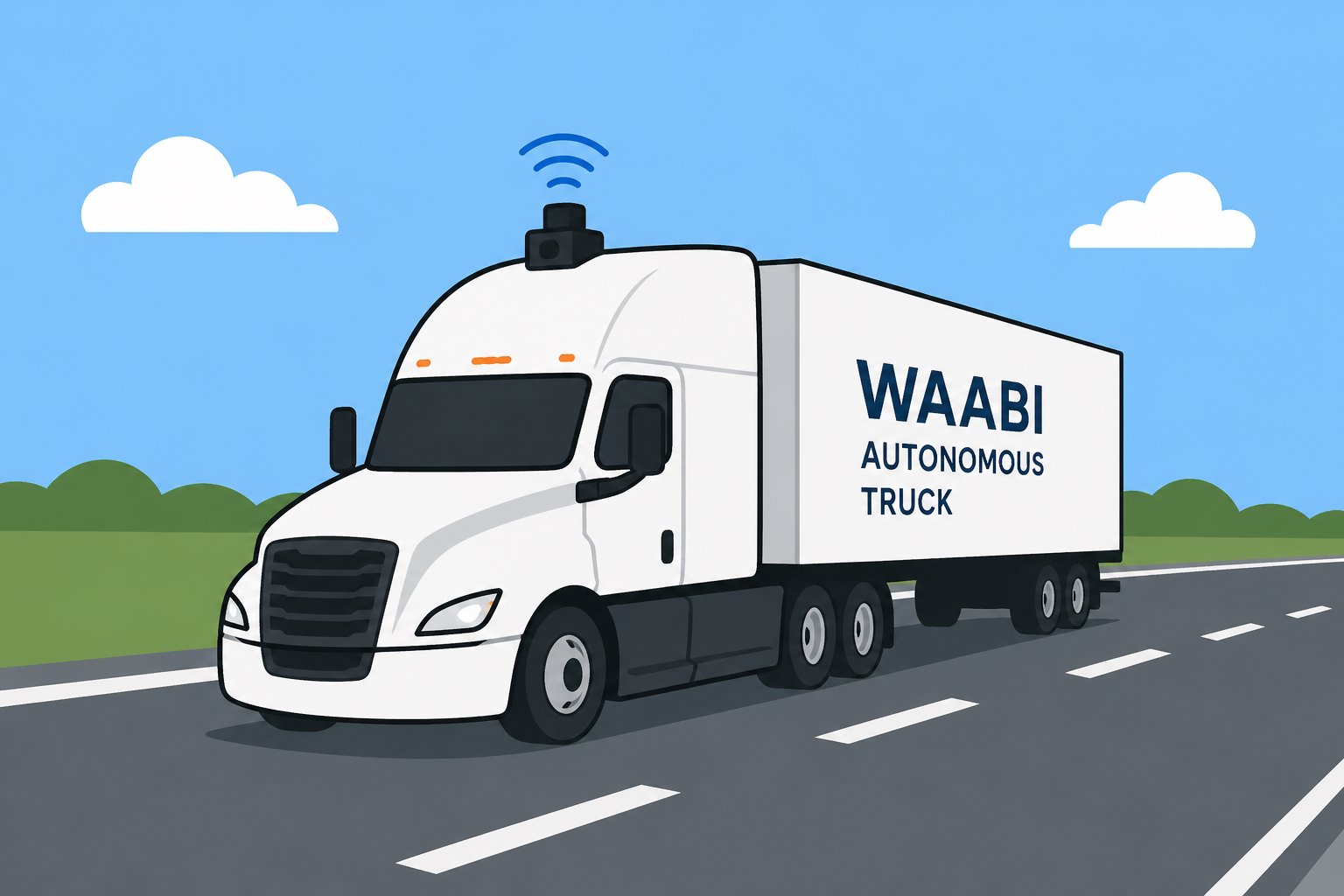
Instead of starting with self-driving taxis in dense city traffic, the company chose long-haul freight trucks moving on highways. Its core product is the Waabi Driver, an AI system designed to operate heavy trucks without a human driver behind the wheel.
That focus matters. Freight is one of the clearest places where autonomy can create public value. Trucks move food, medicines, industrial supplies, and e-commerce shipments. If they can drive safely for longer hours without fatigue, supply chains become more reliable and roads can become safer.
In early 2026, Waabi became one of the most highly funded autonomous driving startups in North America after raising $1 billion and expanding into robotaxis through a partnership with Uber.
For India, where freight costs remain high and road logistics carry nearly 70% of domestic cargo movement, this category is especially important.
Founders
Waabi was founded in 2021 by Raquel Urtasun. She is one of the best-known researchers in autonomous driving. Before Waabi, she was Chief Scientist and Head of R&D at Uber’s Advanced Technologies Group, the company’s self-driving division. She is also a professor of computer science at the University of Toronto and a co-founder of the Vector Institute.
Urtasun has repeatedly argued that older autonomous vehicle companies relied too heavily on expensive real-world testing and too slowly reached commercial deployment. Waabi was built around a different idea: train and validate self-driving systems first in simulation, then deploy them in the real world.
The company launched with an $83.5 million Series A in 2021, led by Khosla Ventures and backed by investors including Uber and Aurora. At the time, it was described as one of the largest Series A rounds for a Canadian startup in the sector.
That was unusually large for a new company and reflected investor confidence in Urtasun’s technical credibility.
What the product actually does
The main product is the Waabi Driver. This is not a truck. It is the full autonomous driving system—the software, sensors, and onboard computing that acts as the driver. Its first target is Class 8 long-haul freight trucks.
The system uses cameras, lidar, radar, and AI models to understand the road, predict how nearby vehicles may behave, and decide how the truck should move. It handles braking, lane changes, merging, obstacle avoidance, and highway navigation without constant human input.
A major part of the system is Waabi World, the company’s simulation platform.
Instead of depending mainly on millions of real-world road miles, Waabi trains and tests its system inside detailed virtual environments. These simulations create situations that are difficult or dangerous to reproduce in real life—sudden lane closures, extreme weather, aggressive cut-ins, and unexpected road behavior.
The company also uses “mixed reality testing,” where a real truck on a closed track reacts to virtual traffic situations generated by the simulator. This helps the company test dangerous edge cases without creating real-world risk .
This matters because proving safety is the hardest part of autonomous trucking. Waabi’s claim is that simulation allows faster and better validation than traditional road testing alone.
Expansion
In January 2026, Waabi announced its largest funding round and expanded beyond trucking. The company raised $1 billion in financing: as part of the deal, Uber plans to deploy at least 25,000 robotaxis powered by Waabi technology on its platform.
This is important because it shows Waabi is trying to build a general AI driving system, not just a trucking product. The company says the same AI “brain” can operate trucks, taxis, drones, and eventually other machines. That is a much bigger ambition than autonomous freight alone.
The India perspective
India is not yet deploying fully driverless long-haul trucks like Waabi’s target market in North America. But the problems Waabi is solving are very real in India.
India’s logistics costs are estimated at around 13–14% of GDP, significantly higher than many developed markets. Long-haul trucking faces chronic driver shortages, fatigue, unpredictable delivery times, and major safety issues.
Heavy truck accidents are also severe because of vehicle size and highway conditions. But India’s road environment is much harder for full autonomy than U.S. highways.
There are mixed traffic conditions, two-wheelers, pedestrians, animals, poor lane discipline, road quality variation, and inconsistent mapping. That makes immediate “driverless truck” deployment difficult.
Because of this, Indian companies are focusing first on ADAS and assisted autonomy rather than fully driverless freight. The Automotive Research Association of India (ARAI) said in 2026 that Indian autonomous vehicle development focuses more on protecting pedestrians, cyclists, and two-wheeler riders because they represent the majority of road fatalities. ARAI also opened a dedicated ADAS testing facility and said ADAS will become mandatory in new commercial vehicles like buses and trucks by 2027.
This means India’s path will likely be “assisted trucking first, autonomy later.”
Global context
Waabi competes with companies like Aurora Innovation, Kodiak Robotics, Gatik, and the former TuSimple.
Reuters reported in 2026 that Gatik had secured $600 million in contracted revenue and deployed fully driverless trucks for commercial operations, serving major retailers like Walmart and Kroger .
That shows the category is moving from pilots to real operations.
Waabi’s main differentiation is its simulation-first approach. Instead of leading with “miles driven,” it leads with validation quality and generalizable AI.
Why it matters
The strongest tech-for-good argument for Waabi is road safety and supply-chain reliability.
Long-haul trucking depends heavily on human drivers working difficult schedules. Fatigue-related accidents are a major issue worldwide.
Autonomous systems can reduce fatigue, improve delivery consistency, and keep trucks moving longer without unsafe work conditions.
For India, the short-term lesson is not “replace drivers tomorrow.”
It is how to use AI to make freight safer, more predictable, and less wasteful.
Waabi represents the most advanced version of that idea. India’s version may look different—but the problem it solves is exactly the same.
- Our correspondent