Every season, Indian farmers make dozens of calls they cannot fully see coming — when to irrigate, when to spray, whether a pest outbreak is building, whether the crop is stressed. Most of these decisions are made on instinct, experience, or a field visit.
Satyukt Analytics, a Bengaluru-based agri-tech company, is trying to change that by putting satellite-derived farm intelligence directly on a farmer’s phone.
The company has been running since July 2018, and its platform, Sat2Farm, has covered over 125,000 acres of farmland across 70-plus crops in nine countries, according to the FAO’s Science, Technology and Innovation portal.
Origins
The name Satyukt was derived by combining the first names of its two co-founders — Dr. Sat Kumar Tomer and Dr. Yukti Gill.
Dr. Sat Kumar Tomer, the firm’s CEO, holds a Master’s and PhD from the Indian Institute of Science (IISc), Bangalore, and completed a post-doctoral tenure at CESBIO (Centre d’Études Spatiales de la Biosphère) in Toulouse, France. Before founding Satyukt, he worked as a Research Associate at the Centre National d’Études Spatiales in France from 2012 to 2015, then joined IISc as a Research Associate in 2015. His entire research career was built around one question: how satellite remote sensing data could be made practically useful at the level of individual farms.
Dr. Yukti Gill, who serves as Managing Director, completed her Masters and PhD in Organizational Behaviour from Banaras Hindu University. While Dr. Sat brought the technical depth, Dr. Yukti brought the domain of human systems — how to structure a team, how to reach communities, how to get a product actually used.
After spending 15 years in academia, Dr. Sat assembled a team of researchers and professionals to build the Sat2Farm mobile application, with the goal of improving agricultural livelihoods through affordable, actionable insights. The company was formally incorporated in July 2018.
Product
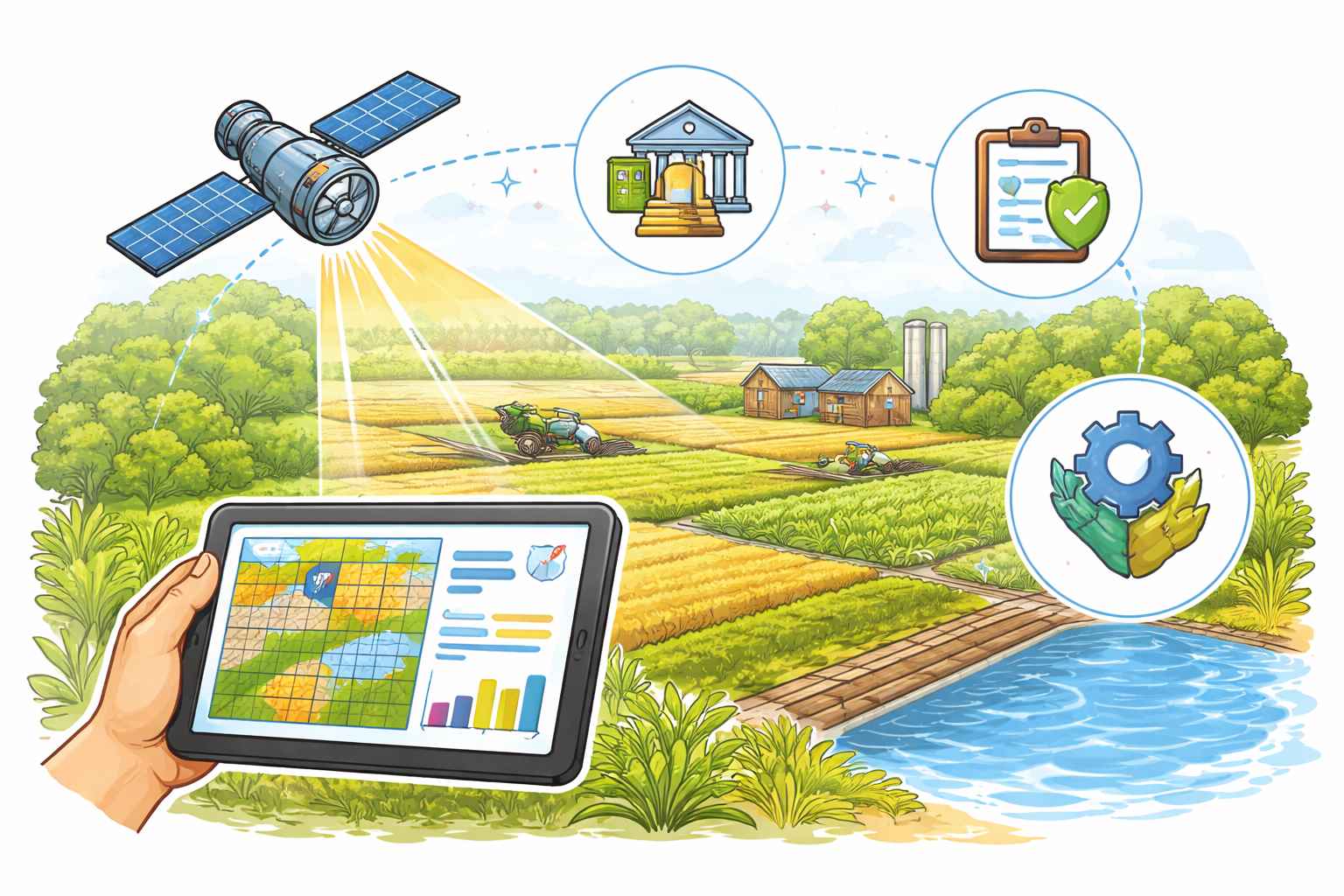
Sat2Farm works like this: a farmer walks their farm boundary, tags it within the app, and the system begins pulling satellite data specific to that plot. No sensors, no drones, no on-field equipment needed.
Using the app, a farmer can map land area within minutes in locally used units like Bigha or Gunta, get satellite-based soil moisture readings, receive a 15-day weather forecast, detect early pest or disease warnings based on temperature and humidity parameters, and identify crop nutrient deficiencies without a lab soil test.
The last two points deserve explanation. Most remote sensing platforms use optical satellite data — images captured by cameras in space. These are useless in cloudy weather. Satyukt processes microwave data, which works in all weather conditions, enabling it to deliver space-based products year-round. This is particularly relevant in India, where monsoon cloud cover can last for months. The company claims to be the only Indian firm with this capability.
The pest and disease forecasting system does not use images of insects — it uses indirect signals. Based on factors such as relative humidity, temperature, and other agronomic parameters, the system generates warnings of likely pest or disease outbreaks and suggests suitable control measures. Farmers can also photograph affected plant parts using the app’s camera feature and receive identification and treatment advice.
Satyukt uses open-source satellite data from NASA and ESA. The company has built in-house algorithms that combine multi-satellite data to reduce dependence on any single satellite and capture farm-level variability more accurately.
Beyond Sat2Farm, the company has built three other products. Sat2Credit produces risk and credit scores for agri-lending, allowing banks to assess the creditworthiness and risk profile of individual farms without physical visits.
Sat4Agri is a B2B tool for fertilizer and pesticide companies to identify which regions are facing pest pressure or nutrient stress, allowing them to target their sales and advisory. Sat4Risk is designed for crop insurance companies to assess and monitor agricultural risk in near real-time.
The platform is available on Android and iOS, as well as through a web interface. Advisories are available in vernacular languages and audio formats, which matters considerably for smallholder adoption in rural India.
Funding
In October 2020, Satyukt raised approximately USD 500,000 in seed funding from Social Alpha and NABVENTURES, a venture growth equity fund and subsidiary of NABARD (National Bank for Agriculture and Rural Development).
In June 2023, Satyukt raised Rs 10 crore in a pre-Series A round led by NABVENTURES, with the transaction supported by Equity 360. According to the company, this capital was intended to expand its satellite network, enhance analytics infrastructure, refine its algorithms, and introduce new products including Sat4Agri and Sat4Risk.
In total, Satyukt has raised $1.72 million across four funding rounds from five investors. Other investors listed include Software Technology Park of India and Pusa Krishi. The company also received a BIRAC Biotechnology Ignition Grant of Rs 48 lakh in its early years, and was selected as part of the India Agritech Incubation Network, a joint initiative of the Bill and Melinda Gates Foundation and Tata Trusts, powered by Social Alpha.
Deployment
Satyukt signed MoUs with field partners for pilots covering Karnataka, Maharashtra, Uttar Pradesh, Telangana, and West Bengal. The company reached farmers in eastern Uttar Pradesh through the network of Social Alpha and PANI, a social development organisation, and signed an MoU with the Telangana government for a pilot project.
A farmer in Ramanagara, Karnataka who has been using Sat2Farm since January 2022 described using satellite soil moisture data to identify a malfunctioning drip irrigation filter on his farm — without visiting it. These use cases — remote farm monitoring and early anomaly detection — are where the platform shows its clearest practical value.
Internationally, Satyukt has established a foothold in India, Guyana, and selected African countries, with ambitions to extend its service area to one million acres. According to the company its platform is being used by smallholder farmers across 50-plus countries.
The company reports that farmers using Sat2Farm have seen 10-25% monetary savings over a season, and the platform claims up to 40% water savings through optimized irrigation.
Competition
In India, the most direct comparable is SatSure Analytics, which also uses satellite and earth observation data for agriculture, insurance, and finance. Cropin Technology Solutions, also Bengaluru-based, operates a cloud platform for agricultural data and has a larger enterprise footprint. Internationally, CropX (Israel) focuses on soil sensors and farm management software; Planet Labs provides raw high-resolution satellite imagery used by a range of agri-analytics players; and EOS Data Analytics offers crop monitoring through satellite imagery.
Where Satyukt claims differentiation is in its microwave and SAR (Synthetic Aperture Radar) data processing, which it says allows for all-weather, year-round crop monitoring — unlike optical satellite platforms which go dark under cloud cover. It also holds a patent for a method of estimating soil nitrogen content using satellite remote sensing. No public data is available to independently benchmark Satyukt’s accuracy against these competitors.
Global context
The global precision agriculture market was valued at USD 8.34 billion in 2024 and is projected to reach USD 29.22 billion by 2033, growing at a CAGR of 14.95%. Within that, the satellite data services for agriculture segment was valued at USD 6.88 billion in 2026 and is projected to reach USD 11.8 billion by 2030, growing at a CAGR of 14.4% .
The structural case for satellite-based agri-intelligence in India is well-established. More than three-quarters of Indian farmers hold less than two hectares of land. IoT sensors and drone-based solutions cost far more than most smallholders can afford. Open-source satellite data from NASA and ESA provides a path to delivering farm-scale insights at much lower per-acre cost — which is the model Satyukt has been building on since 2018.
What it has built so far — a satellite-native, all-weather, multilingual farm advisory platform with credible academic roots and a growing product suite — is a substantive foundation.
- Our correspondent