Cautio was founded in 2023 in Bengaluru by Ankit Acharya and Pranjal Nadhani.
The starting point was not hardware, but a repeated operational problem in fleet businesses. Logistics companies, cab operators, and transport fleets were already using GPS systems to track vehicles. But when accidents or disputes happened, there was little visibility into what actually occurred inside the vehicle or on the road.
Basic dashcams existed, but they functioned as passive recorders. Footage was reviewed after incidents, often too late to prevent anything. The founders focused on converting this passive layer into an active system that could intervene during the journey.
The early product direction was shaped around Indian road conditions. Mixed traffic, unpredictable driving patterns, and long-haul fatigue created a different set of challenges compared to more structured road environments. The company chose to build specifically for these conditions rather than adapting global models.
Founders
Ankit Acharya and Pranjal Nadhani brought backgrounds in engineering and product development, with experience in building scalable systems. Their approach was to tightly integrate hardware and software rather than treat them as separate layers.
The team also worked closely with fleet operators during initial deployments to understand actual driver behavior and operational constraints.
Funding
Cautio raised around Rs 11 crore in seed funding in 2024 from a mix of early-stage investors and mobility-focused backers. The funding has been used to refine hardware design, improve AI models, and scale deployments across fleets.
Product
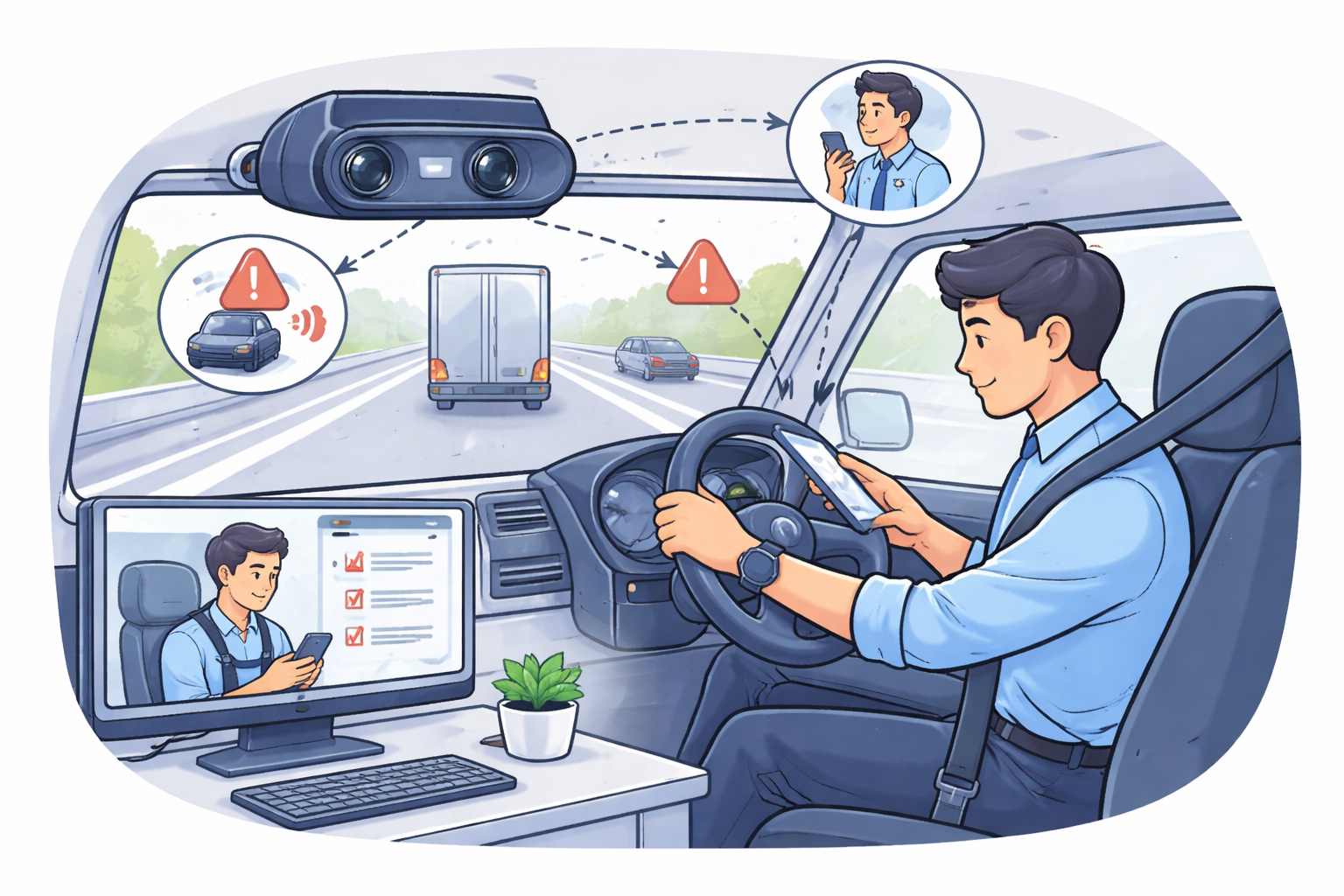
Cautio builds AI-powered dashcams designed for commercial fleets. These are not just cameras; they are embedded systems that monitor both the road and the driver in real time.
Each unit includes:
- A front-facing camera that captures road conditions
- A driver-facing camera that monitors behavior
- An onboard processor that runs AI models
The system continuously analyzes video to detect risk patterns. These include driver fatigue, distraction, mobile phone usage, harsh braking, and unsafe following distances.
When a risk is detected, the system generates immediate alerts. These alerts are delivered in two ways. The driver receives an in-cabin warning, usually audio-based. At the same time, the fleet manager receives a notification through a dashboard.
How does it work?
The dashcam operates as a closed-loop system inside the vehicle.
Video from both cameras is processed locally using onboard AI models. This is critical because decisions need to be made in real time without relying on network connectivity.
For example, if the system detects that a driver’s eyes are closing repeatedly, it classifies this as fatigue. Within seconds, it triggers an alert inside the vehicle. This immediate feedback is what differentiates it from traditional dashcams.
At the same time, key events are uploaded to the cloud. Fleet managers can review incidents, track driver scores, and analyze patterns across vehicles.
Over time, the system builds a behavioral profile of drivers. This allows fleet operators to identify high-risk patterns, such as frequent harsh braking or repeated distraction.
Deployment
Cautio’s systems are deployed across logistics fleets, commercial transport operators, and mobility companies. In long-haul trucking, the system is primarily used to detect fatigue and maintain safe driving behavior over extended journeys. In urban fleets such as cabs and delivery vehicles, the focus shifts to distraction and traffic-related risks.
Deployment involves installing the dashcam unit in each vehicle and connecting it to the fleet’s management system. Initial calibration is required to account for camera angles and vehicle type.
The company has reported adoption across multiple fleet operators, with deployments scaling into thousands of vehicles. The focus has been on enterprise customers rather than individual drivers.
Performance
Fleet operators evaluate these systems based on reduction in incidents and improvement in driver behavior. Early feedback indicates that real-time alerts lead to immediate behavioral correction. Drivers tend to adjust habits such as phone usage or lane discipline when alerted consistently.
Fleet managers benefit from visibility. Instead of relying on driver reports or post-incident analysis, they can monitor events as they happen and track trends over time.
There are operational challenges. Indian driving conditions can trigger false positives, such as sudden braking in dense traffic. The system requires continuous tuning using local data to improve accuracy.
Differentiation
Cautio’s differentiation comes from three areas.
First, it is built specifically for Indian road conditions. This affects how models are trained and how alerts are calibrated. Second, it combines onboard processing with cloud analytics. Real-time decisions happen inside the vehicle, while long-term analysis is handled centrally. Third, it focuses on fleets rather than individual consumers. This allows it to integrate deeply into fleet workflows, including driver scoring, compliance tracking, and reporting.
Competition
Cautio operates in a competitive global category of AI-powered fleet safety systems. Companies like Netradyne and Samsara offer similar systems with advanced analytics and large-scale deployments. In India, players like LocoNav and Roadcast provide fleet tracking solutions, sometimes integrating video-based monitoring. Cautio differentiates itself by focusing specifically on AI-driven video intelligence rather than broader telematics.
Global context
The shift from GPS-based tracking to video-based monitoring is a broader global trend. Earlier fleet systems tracked speed and location. Modern systems add context by analyzing video, allowing detection of driver behavior and road conditions. In markets like the US, AI dashcams are often linked to insurance and compliance systems. Safer driving can reduce premiums and liability.
In emerging markets, adoption is driven by safety concerns and falling hardware costs. Systems that can operate reliably in complex environments are gaining traction.
– Our correspondent