Pune-based social enterprise Farmers for Forests, commonly called F4F, is working on a problem that sits at the intersection of agriculture, climate change, and rural livelihoods: how to make tree-based farming financially viable for small farmers.
The organization was founded in 2019 and focuses on helping farmers transition degraded or low-productivity farmland into biodiverse agroforestry systems.
Instead of treating forests and agriculture as separate categories, F4F works on mixed farming models where native trees, crops, and ecological restoration are integrated into the same landscape.
According to the organization, the goal is to improve soil quality, increase farm resilience, restore biodiversity, and create long-term income streams for rural communities.
The group operates as a hybrid social enterprise rather than a conventional NGO. Its model combines philanthropy, carbon finance, ecological restoration, and rural development programs. It has a multidisciplinary team including technologists, field ecologists, drone operators, and carbon-market specialists.
At the center of the organisation’s work is agroforestry. In practical terms, this means farmers plant trees alongside agricultural crops instead of maintaining monoculture farmland. The trees are usually native species selected for long-term ecological suitability rather than short-cycle commercial plantations. F4F says its programs focus on biodiverse, multi-layer agroforests rather than single-species plantations.
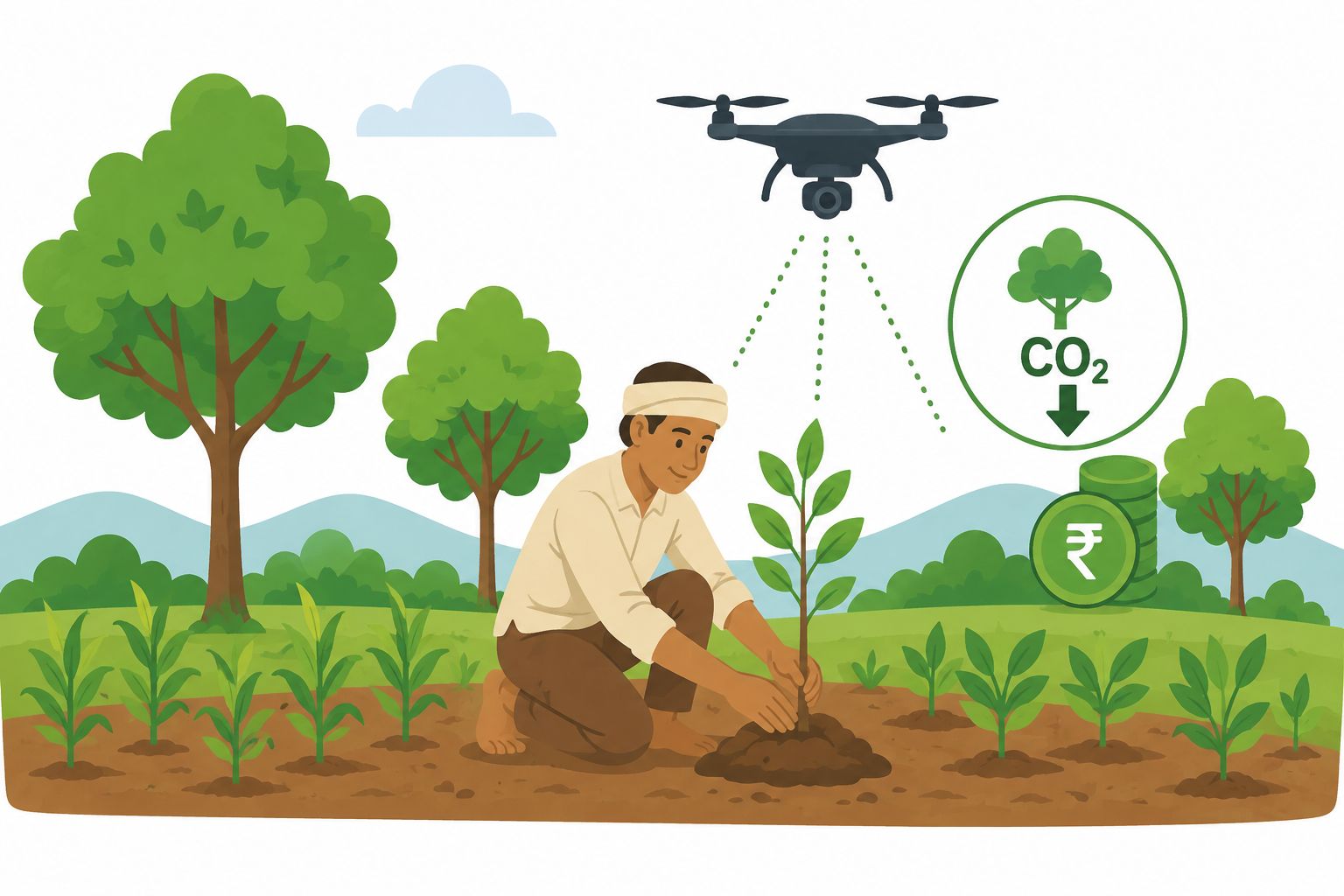
The economic challenge with agroforestry is timing. Farmers often need immediate income, while trees may take years before generating financial returns. F4F’s model tries to solve this by creating payments tied to ecological restoration and carbon sequestration. Farmers receive financial incentives not only for planting trees but also for maintaining them over time.
This is where the company’s technology layer becomes important.
F4F uses drones, satellite imagery, GPS mapping, and AI-based monitoring systems to track tree growth and ecological restoration projects. The technology stack is designed to verify tree survival, monitor carbon sequestration, and create transparent environmental records that can support carbon credit financing.
AI and remote sensing tools are used to monitor agroforestry plots across dispersed rural regions. This reduces dependence on entirely manual field audits, which are expensive and difficult to scale.
F4F stated that its AI-enabled agroforestry monitoring systems are intended to help track tree health, improve survival rates, and build reliable carbon accounting systems for smallholder farmers. The organiation says that there is evidence of 3x to 5x increases in farmer incomes through agroforestry transitions.
The use of satellite and drone monitoring is significant because carbon-credit projects often struggle with verification. Investors and buyers usually want evidence that trees actually survive and continue storing carbon over time. Traditional verification systems can become extremely expensive when projects involve thousands of small farms spread across large rural geographies.
F4F is attempting to automate part of this process using geospatial monitoring and AI-based analytics. According to Mulago Foundation, which selected the organization as part of its portfolio, drones and AI-powered analytics are used to monitor tree growth and verify carbon sequestration linked to farmer payments.
The organization is also experimenting with results-based payment systems. Instead of paying only for plantation drives, the model rewards long-term survival and maintenance of trees. This is important because many afforestation programs fail after initial planting due to poor maintenance and low survival rates.
Farmers for Forests currently works across multiple environmental categories including agroforestry, forest restoration, urban biodiversity, and human-elephant conflict prevention. The latter involves ecological interventions designed to reduce conflict between wildlife and farming communities in regions where elephant movement overlaps with agricultural land.
Globally, F4F operates within a broader category of technology-enabled agroforestry and ecosystem restoration platforms. International organizations such as Trees for the Future work on similar models combining tree-based farming with farmer training and ecological restoration. Carbon-credit linked forest restoration platforms are also expanding across Africa, Latin America, and Southeast Asia.
What makes F4F somewhat different is its focus on combining biodiversity restoration with technology-heavy verification systems targeted at Indian smallholder agriculture. Many traditional reforestation programs rely heavily on manual surveys and centralized implementation. F4F is attempting to build digitally trackable agroforestry systems that can eventually connect rural farmers to climate-finance markets.
From a tech-for-good perspective, the organization is trying to solve two problems at the same time. Climate-focused restoration projects often fail because local communities do not receive sustained economic value from protecting ecosystems.
At the same time, small farmers facing erratic rainfall, declining soil quality, and rising climate stress often lack access to long-term income alternatives. F4F’s approach uses technology not as the end product but as infrastructure for trust, verification, and payments.
Drones, AI systems, satellite monitoring, and carbon accounting tools are being used to make ecological restoration measurable enough to attract financing, while directing part of that value back to rural farming communities. The larger idea is to make biodiversity restoration economically sustainable rather than dependent only on grants or short-term plantation drives.
- Our correspondent