Dozee Health was founded in Bengaluru in 2015 after its founders observed a recurring problem inside Indian hospitals.
Outside intensive care units, most patients were still being monitored manually. Nurses checked vitals every few hours, recorded readings by hand, and alerted doctors if something looked abnormal. In crowded hospitals, especially during night shifts, critical deterioration could go unnoticed between checks.
The founders believed this was not simply a staffing problem. They saw it as an infrastructure problem. Continuous monitoring systems existed inside ICUs, but they were expensive, wired, and difficult to scale across general wards. Their idea was to create a simpler system that could continuously monitor patients without attaching machines or wearable devices directly to the body.
The company was founded by Mudit Dandwate and Gaurav Parchani. Both founders are engineers with backgrounds in embedded systems, sensing technologies, and healthcare hardware development and they wanted to build systems that could automate patient monitoring while reducing pressure on hospital staff.
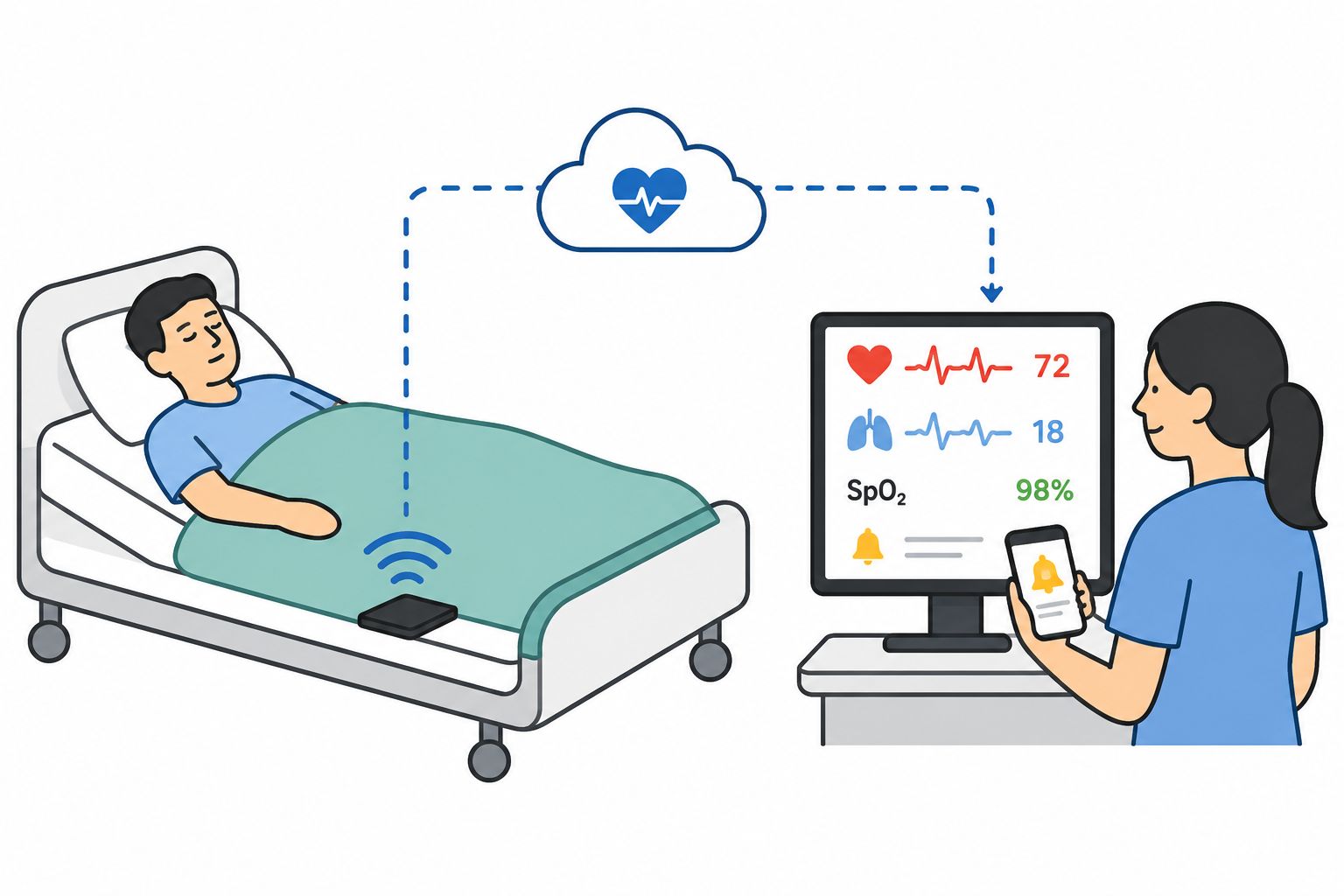
The company’s core product is a contactless Remote Patient Monitoring system, often referred to as RPM. Instead of wires or wearable bands, Dozee uses a thin sensor sheet placed underneath a mattress. The sensor captures tiny vibrations generated by the human body through heartbeats, breathing cycles, and body movement. The system works using a technology called ballistocardiography, which measures these micro-vibrations without touching the patient directly.
Once the sensor captures these signals, the data is sent to cloud-based software where AI algorithms convert the raw movement data into measurable health parameters. The system continuously tracks heart rate, respiratory rate, oxygen saturation trends, blood pressure patterns, stress levels, and sleep quality. Doctors and nurses can access this information through hospital dashboards and mobile applications.
The company’s larger focus is not just monitoring but early warning detection. Dozee developed what it calls an Early Warning System, or EWS, which continuously analyses patient data and alerts medical teams if signs of deterioration appear. Instead of waiting for scheduled manual checks, nurses receive alerts when vital signs move outside expected ranges. The company says this allows hospitals to intervene earlier during emergencies.
Dozee became especially visible during the COVID-19 pandemic when hospitals needed ways to monitor large numbers of patients simultaneously. Many hospitals lacked enough ICU beds or continuous monitoring infrastructure. Dozee’s system allowed ordinary ward beds to function more like monitored care beds without requiring full ICU equipment installations.
Several major hospital networks publicly partnered with the company. Apollo Hospitals became one of Dozee’s largest deployment partners. The company also partnered with public healthcare systems. In 2023, British International Investment announced support for Dozee’s “MillionICU” initiative, which aimed to convert ordinary hospital beds into step-down ICU beds using remote monitoring systems.
The startup has raised multiple rounds of funding as remote patient monitoring became a major healthcare technology category globally.
The company has also expanded beyond hospitals into home healthcare and elder monitoring. Its consumer-facing products monitor sleep quality, respiration, stress, and heart activity through under-mattress sensors.
Globally, Dozee operates in the larger Remote Patient Monitoring market, which has expanded rapidly due to hospital staff shortages, aging populations, and growing demand for continuous care systems. Companies worldwide are trying to reduce dependence on periodic manual monitoring by introducing connected sensors and AI-based early warning systems.
One of the better-known international companies in this category was EarlySense, an Israeli startup that also developed under-mattress contactless monitoring systems for hospitals. Large healthcare equipment firms such as Philips, GE HealthCare, and Medtronic have also expanded into connected monitoring and hospital analytics systems. However, most global systems still rely heavily on wired bedside monitors or wearable devices.
Dozee’s differentiation comes from combining contactless sensing hardware with cloud-based analytics and hospital workflow integration. Instead of requiring patients to wear sensors continuously, the company attempts to make the hospital bed itself part of the monitoring infrastructure.
The company’s long-term challenge will be maintaining clinical reliability while scaling across different healthcare environments. Hospital monitoring systems operate inside high-risk environments where false alarms, integration failures, and inconsistent staff adoption can create operational problems. Scaling across public hospitals, private hospital chains, and international markets also requires navigating complex regulatory and clinical validation standards.
Even with those challenges, Dozee represents a larger shift happening inside hospital infrastructure. Instead of limiting continuous monitoring to intensive care units, companies like Dozee are attempting to make continuous monitoring available across ordinary wards using AI systems, cloud software, and low-friction sensing hardware integrated directly into the bed itself.
- Our correspondent