In 2023, when Rahul Maroli and Manit Kathuria started building Tap Health from Gurgaon, the Indian healthtech landscape was already crowded. There were telemedicine platforms, diagnostic apps, and even a handful of digital therapeutics companies. But the two founders noticed something most others missed.
The real problem in chronic care wasn’t the doctor visit. It was the 89 days between visits.
Most diabetes management happens outside the clinic, in the small decisions patients make every day. What to eat. Whether to check blood sugar.
Remembering to take medication. Traditional healthcare is built for episodic intervention, not continuous support. And existing digital solutions either relied on expensive human coaches, making them unaffordable for most Indians, or offered generic advice that didn’t adapt to individual behavior.
Maroli, previously Business Head at ZEE5, and Kathuria, a three-time founder with a background in product design, approached this differently . Instead of asking how to digitize existing care models, they asked whether AI could replace the human coach entirely, not as a chatbot feature but as the fundamental architecture of the product.
The company started with a simpler version, an AI health assistant called Vaid that helped users check symptoms. Launched in 2023, that free app reached over 200,000 users with zero marketing spend, purely through word of mouth . More importantly, it allowed the team to refine their natural language processing for Indian languages and colloquialisms, a foundational investment that would matter later.
By late 2024, Tap Health had raised money across two funding rounds, with investors including SRV Controls and angel backers . The company also secured a spot in the I-HEAL @ ISB 3.0 accelerator program, run by the Indian School of Business in partnership with CitiusTech, which provided mentorship, hospital access, and investor connections . For a two-person team at the time, these were critical validations.
Product
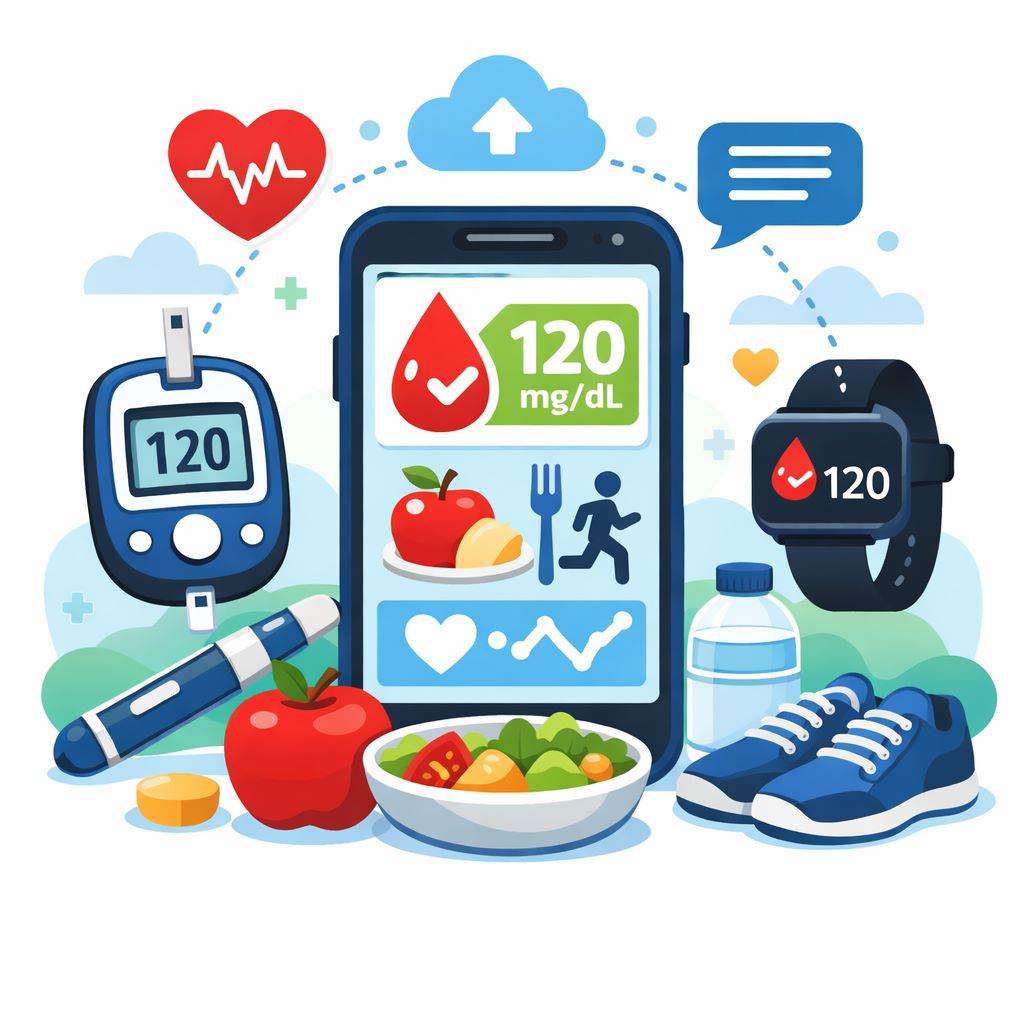
Tap Health operates a fully autonomous digital therapeutic for chronic conditions, starting with Type 2 diabetes. A patient downloads the app, provides basic health information, and the AI system, now evolved into Vaid 2.0, takes over. It coordinates multiple specialized AI agents, a diet recommendation engine that understands Indian cuisine variations every 100 kilometers, an exercise generator that creates personalized video routines, a nudge intelligence system built on behavioral science frameworks, and an insight engine that analyzes every user interaction .
The system works across multiple channels, including app, WhatsApp, and iMessage, and can integrate with devices and labs. It adapts in real time. If a user eats a heavy meal, the AI adjusts recommendations for subsequent meals or activity levels to maintain balance without imposing rigid restrictions. The entire program costs approximately ₹200 per month, less than 10 percent of what human-led digital therapeutics charge, and less than the average diabetic patient’s annual medication budget of ₹12,000 to ₹17,000 .
In December 2025, Tap Health won the ATTD Asia Clinical Innovation Award at the Advanced Technologies and Treatments for Diabetes conference in Singapore.
The award, presented in partnership with Eli Lilly and Company, recognized the company’s on-device small language model that works in low or no internet areas, its real-time pattern detection for glucose fluctuations, and its clinically validated algorithms to reduce glycaemic variability .
Dr. Amit Gupta, a diabetologist who serves as Tap Health’s Chief AI Advisor, accepted the award. Early evidence from the platform indicates improvements in glucose monitoring frequency, healthy behavior engagement, and patient confidence, though specific clinical outcome data has not yet been published .
The company has also been selected for the Lilly Solution Accelerator Program, powered by T-Hub and Eli Lilly, which provides pilot opportunities and go-to-market support.
Context
Tap Health operates in a category often called autonomous or AI-native chronic care. Globally, this sits within the broader digital therapeutics market, but with a critical distinction. Traditional DTx companies like Omada Health, Virta Health, and Livongo (now part of Teladoc) typically combine software with human coaching. Tap Health and a few others are attempting to remove the human entirely, using AI to handle personalization, motivation, and intervention.
More direct competitors include companies like K Health, which raised $439 million for its AI-driven clinician access platform, Ada Health at $167 million, and Ubie at $125 million . However, most of these focus on symptom checking or triage rather than ongoing chronic disease management.
The global context for this category is shifting rapidly. By 2050, an estimated 853 million people will live with diabetes worldwide, up from 589 million today.
Traditional healthcare systems cannot scale to manage this population with one-on-one human support. At the same time, large language models and small language models have made it technically feasible to build AI systems that can conduct personalized, context-aware conversations at scale. Regulators are also catching up, with the US FDA clearing several AI-based diagnostic tools and countries like India developing frameworks for digital therapeutics.
What remains unproven is whether fully autonomous AI can achieve clinical outcomes equivalent to human-led programs. Tap Health claims its AI achieves over 93 percent accuracy on symptom analysis, tested against doctors, but long-term glycemic control data is not yet available . The company also faces the challenge of distribution.
For now, Tap Health is building what might be the most practical answer to a brutal math problem. India has roughly 300 million pre-diabetic and diabetic individuals. Traditional care cannot reach them. Human coaches are too expensive. Something has to give. The company’s bet is that AI, designed specifically for how Indians actually speak, eat, and live, can fill that gap.
- Our correspondent