In most school systems, identifying children with learning differences is still a slow and uneven process.
A child who struggles in class may go unnoticed for years, or be flagged only when the gap becomes too large to ignore. Even when identified, support depends heavily on access to specialists like psychologists, therapists, and trained educators—who are often in short supply.
Cognitii was started to address this exact operational gap. The company is building a system that helps schools identify, assess, and support children with developmental and learning differences in a more structured and scalable way.
Origin
The company was founded in 2024 by Jhillika Trisal, Falguni Shrivastava, and Souvik Ghosh. The founding team brought together experience across education, technology, and product design, along with direct exposure to the challenges families face in navigating special education.
Instead of building a standalone diagnostic tool or a therapy product, they chose to focus on the infrastructure layer—how schools can systematically handle identification and intervention.
Product
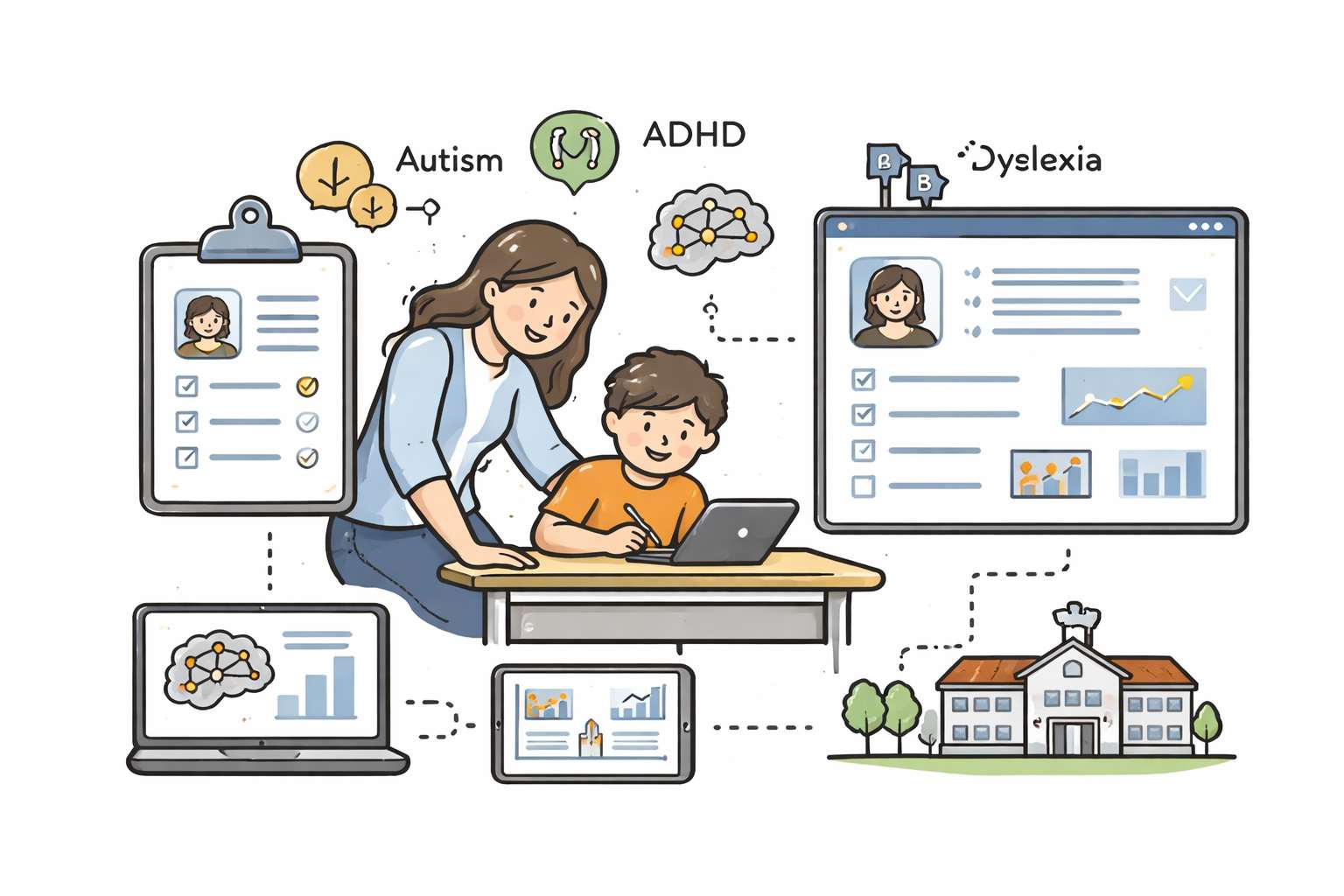
At the core of Cognitii’s product is a platform that combines screening, profiling, and intervention planning into a single workflow. Schools use the system to run structured assessments for students, particularly in early grades where signs of learning differences begin to emerge.
The process starts with short, structured tasks designed to capture how a child processes information. These are not traditional tests. They are closer to guided activities that measure things like attention, memory, response time, and pattern recognition. Some tasks may involve simple problem-solving, while others observe how a child responds to instructions or sequences.
As students interact with these tasks, the system captures multiple signals—not just whether an answer is correct, but how the student arrived at it. For example, how long did they take to respond? Did they hesitate? Did they follow a pattern or deviate from it? These signals are important because learning differences often show up in behaviour and process, not just outcomes.
This data is then processed to generate a structured profile of the child. Instead of producing a binary label, the system maps strengths and challenges across different cognitive and behavioural dimensions. A child might show strong visual reasoning but weaker attention control, or good comprehension but slower processing speed.
Based on this profile, Cognitii generates an Individualized Education Plan. In practice, this is a set of actionable recommendations for teachers. It may include specific classroom strategies, types of exercises, pacing adjustments, and support mechanisms tailored to the child’s needs.
What makes this useful in a school setting is that it translates specialist knowledge into something teachers can apply directly. In many cases, teachers are expected to support diverse learning needs without formal training in special education. Cognitii’s system acts as a guide, helping them adapt their teaching without requiring deep expertise in diagnostics.
The platform also includes tracking tools. As interventions are applied, the system monitors progress over time. Teachers can update observations, run follow-up assessments, and see whether specific strategies are working. This creates a feedback loop that is often missing in traditional setups, where interventions are applied but not systematically evaluated.
Deployment
Cognitii is typically deployed at the school or network level. Schools onboard their students, run baseline screenings, and then use the platform as part of their ongoing academic process. In some cases, it can also be used in partnership with NGOs or government programs focused on inclusive education.
Early deployments have focused on demonstrating that screening and intervention can be done at scale without relying entirely on external specialists. Schools are able to cover larger student populations, identify needs earlier, and maintain records in a structured format. This is particularly relevant in systems where access to psychologists and therapists is limited.
Global context
Cognitii operates in a space that sits between edtech, healthtech, and public service delivery. There are global players working on parts of this problem, but few offer an integrated system designed for school-level deployment.
For example, Cognitii focuses on evaluating student responses and providing feedback, primarily in higher education contexts. PresenceLearning connects schools with remote therapists and specialists, addressing the supply side of special education. Lexplore uses eye-tracking to identify reading difficulties.
How is it different
Cognitii’s approach is different in that it focuses on building a continuous system—from early screening to classroom intervention—rather than solving a single point problem. It is designed to work within existing school structures, rather than requiring entirely new processes.
Globally, there is increasing attention on early identification of learning differences. Research shows that interventions are more effective when applied early, but most systems lack the tools to do this consistently. In many countries, screening is either not done at scale or depends on referrals, which delays action.
Technology is starting to change this by making it possible to run structured assessments across large populations. Advances in data processing and behavioural analysis allow systems to pick up patterns that would be difficult to track manually. At the same time, there is growing emphasis on inclusive education, which requires schools to accommodate a wider range of learning needs within the same classroom.
This creates a clear demand for tools that are both scalable and practical. Schools do not just need diagnosis; they need systems that fit into daily teaching workflows. This is where Cognitii is positioning itself.
Challenges
The company’s challenge will be to maintain reliability while scaling across different contexts. Learning behaviour can vary widely based on language, culture, and classroom environment. Models need to be calibrated carefully to avoid bias and ensure that recommendations are appropriate.
Another factor is integration with public systems. In countries like India, where government schools serve large populations, any solution needs to work within existing administrative and resource constraints. This includes considerations around cost, training, and data governance.
Cognitii’s early focus on building a structured, end-to-end workflow gives it a clear direction. Instead of treating special education as a specialist add-on, it treats it as part of the core schooling process.
- Our correspondent