In most cities, wastewater is treated as the end of the line. Water comes into homes and buildings, gets used, passes through a sewage treatment plant (STP), and then is discharged—often into lakes, drains, or rivers.
Boson Whitewater starts with a different view. It treats wastewater not as an endpoint, but as a second chance.
The company is built on a simple idea: cities already have water—they are just not using it twice.
The origin
Boson Whitewater was founded in 2011 in Bengaluru by Vikas Brahmavar and Gowthaman Desingh.
The founding insight came from observing how urban water systems actually function. Most apartment complexes, IT parks, and commercial buildings already have sewage treatment plants. These plants clean wastewater to a level suitable for basic reuse like gardening or flushing.
But a large portion of this treated water still goes unused and is discharged.
The founders focused on this gap. If the water is already partially treated, can it be further processed to make it usable again—at a much higher quality?
This was not a theoretical problem. In cities like Bengaluru, where water scarcity is acute, large volumes of treated water were being wasted every day. Boson’s idea was to capture that waste and convert it into a reliable supply.
What Boson Whitewater does
At its core, Boson Whitewater is a decentralized water utility.
It installs systems on top of existing sewage treatment plants and upgrades the quality of water to a level that can be reused for industrial, commercial, and even potable purposes.
The system works in multiple stages. First, it takes already treated wastewater from an STP. This water is typically safe for limited uses but still contains contaminants. Then it passes through an 11-stage purification process.
These stages include filtration to remove particles, chemical treatment to reduce organic content, membrane systems to remove dissolved impurities, and ultraviolet disinfection to eliminate bacteria and viruses.
The result is high-quality water that can be used for cooling systems, industrial processes, and in some cases, drinking. What makes this system different is not just the treatment process, but how it is deployed.
Boson installs and operates the system itself. The customer—an apartment or commercial complex—does not need to invest upfront. Instead, they pay for the water they use. This is often referred to as a “water-as-a-service” model.
How the model works
To understand the system, it helps to look at a typical building. An apartment complex generates wastewater every day. Its STP treats this water, but only a fraction is reused internally. The rest is discharged. Boson installs its system at the site and takes this excess water.
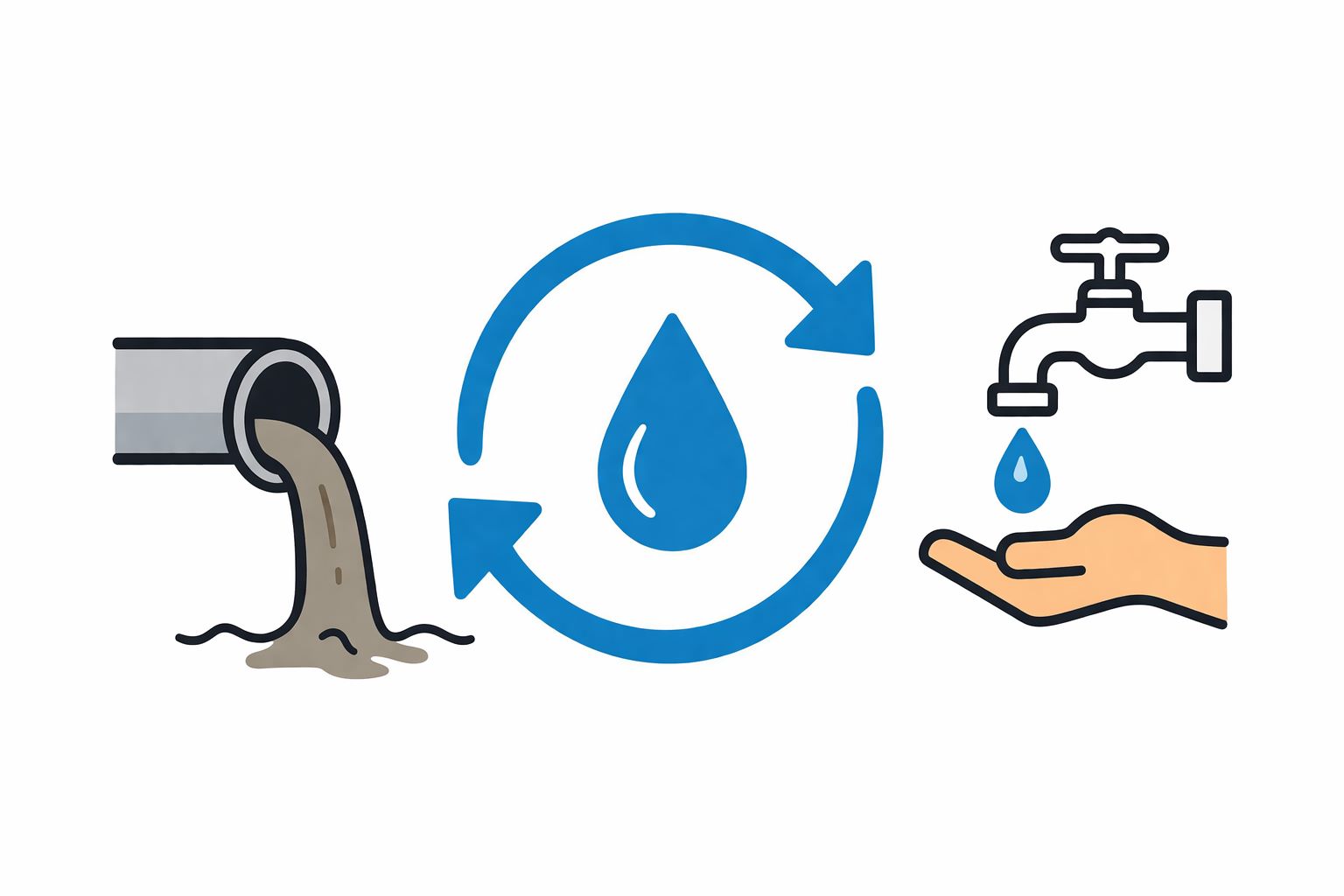
It processes the water and either: supplies it back to the building for higher-value use or transports it to nearby industries. This creates a loop:
wastewater → treated water → reused water
Instead of relying on tanker water or groundwater, the building becomes partly self-sufficient.
Scale, funding, and growth
Boson Whitewater has raised over $1.5 million in funding across multiple rounds, with investors including Indian Angel Network and Zerodha’s Rainmatter.
The company has grown steadily by focusing on deployments rather than rapid expansion. It works with apartment complexes, IT parks, malls, and industries across Bengaluru and is expanding to other cities. In operational terms, the impact is measurable.
The company has systems that collectively recycle hundreds of thousands of litres of water per day, with some projects alone saving around 3 lakh litres daily.
Across installations, it has demonstrated the ability to convert large volumes of wastewater into usable water—sometimes exceeding 800,000 litres per day.
Pilots and real-world deployments
Boson’s model has been tested through multiple pilots and partnerships. One example is its collaboration with the Bengaluru water authority (BWSSB), where it supplies around 70,000 litres of recycled water daily to industries.
In residential deployments, the company works with apartment complexes to convert excess STP water into reusable supply, helping them reduce dependence on tanker water. Some deployments also aim to achieve zero liquid discharge, meaning no treated wastewater leaves the premises unused.
The model is also being extended through tanker networks, where recycled water is supplied to nearby industries for applications like cooling.
What makes the approach unique
Boson Whitewater’s differentiation lies in how it combines technology, economics, and deployment. First, it focuses on decentralised infrastructure. Instead of building large central plants, it works at the level of individual buildings.
Second, it uses a service-based model. Customers do not need capital investment, which removes a major barrier to adoption.
Third, it creates a circular system. Water is reused within the same urban ecosystem instead of being discharged.
Fourth, it integrates IoT monitoring. The system continuously tracks water quality and performance, allowing real-time adjustments and transparency. Finally, it targets existing infrastructure. It does not require new pipelines or major changes in behaviour.
Market feedback and challenges
The value proposition is clear for customers.
Water costs in cities can be high, especially when dependent on tanker supply. Boson’s system often reduces costs by 40–50% compared to tanker water.
However, adoption is not without challenges. One of the biggest barriers is perception. There is a psychological resistance to using recycled water, especially for drinking. Boson addresses this through testing, certification, and transparency, but behaviour change takes time.
Another challenge is variability. The quality of input water can vary across locations, requiring systems to adapt.
The global context
Boson operates in a broader space of water recycling and reuse. Globally, cities like Singapore have successfully implemented large-scale wastewater recycling systems such as NEWater, which supply high-quality recycled water for multiple uses. The global water recycling market is growing rapidly, driven by increasing scarcity and urbanisation.
However, most systems are centralised and require large infrastructure investments. Boson’s approach is different—it decentralises the process and brings it closer to the point of use.
- Our correspondent