Mental health support has a structural problem. The need is continuous, but access is not.
People experience stress, anxiety, or low mood in real time—during work, late at night, or in moments of isolation. But traditional support systems are built around scheduled sessions, availability of therapists, and physical or digital appointments. Wysa is built to operate in the gap between these two realities.
The origin
Wysa was founded in 2015 by Jo Aggarwal and Ramakant Vempati, with the first version launched in 2016.
The starting point was not to build a chatbot, but to solve a practical constraint. Mental health systems do not scale easily. Each therapist can only handle a limited number of patients, and access remains uneven across geographies and income levels.
The founders focused on a narrower question: what can be offered immediately, without waiting, and at low cost? This led to the idea of a conversational interface that could guide users through structured mental health techniques.
What Wysa does
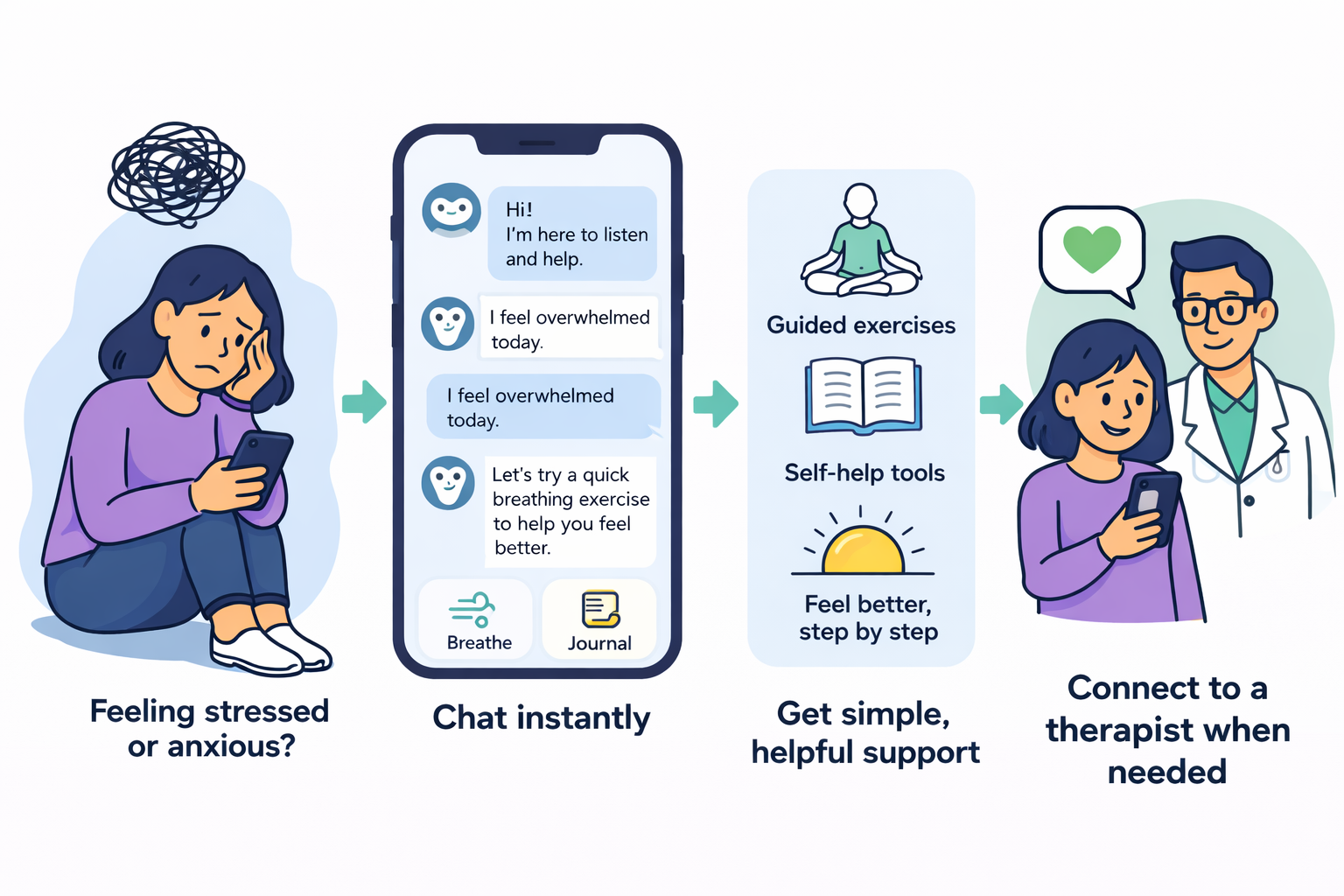
Wysa is an AI-based mental health support application delivered through a chat interface. A user opens the app and starts typing. The system responds and guides the conversation based on what the user is expressing.
The responses are not random. They are built using established therapeutic methods such as cognitive behavioural therapy and mindfulness-based techniques. If a user reports anxiety, the system may guide them through breathing exercises or grounding techniques. If a user describes negative thoughts, it may help reframe those thoughts into more structured patterns.
If a user is unable to sleep, it may suggest step-by-step routines to improve sleep behaviour.
The interaction is structured as a sequence of small, actionable steps rather than long explanations. The platform also includes a library of self-help tools—covering stress, sleep, focus, and emotional regulation—that users can access directly.
How the system works
Wysa combines conversational AI with pre-designed therapeutic flows. When a user inputs text, the system identifies intent and emotional signals. Based on this, it selects a response path that aligns with a specific technique.
For example, if the system detects stress, it may initiate a short guided exercise. If the user continues the conversation, the system adjusts the flow.
This is not open-ended AI improvisation. The responses are constrained within clinically designed structures. In addition to AI support, Wysa offers access to human therapists. Users can move from self-guided interaction to scheduled sessions when needed.
So the system works in layers:
instant chat-based support
structured self-help tools
optional human intervention
What changes for the user
Without tools like Wysa, most people handle stress informally. They may distract themselves, ignore the issue, or wait until it becomes more serious. With Wysa, the interaction happens immediately. A user can open the app and begin a structured process within seconds. Instead of unstructured thinking, they are guided through specific steps.
This changes two things. First, it reduces delay. Support is available at the moment of need. Second, it creates repeatable behaviour. Users can return to the same tools multiple times, building familiarity with techniques.
Over time, this leads to more consistent self-management rather than one-time intervention.
Scale, adoption, and usage
Wysa has reached millions of users globally, with usage across more than 90 countries. The platform has handled hundreds of millions of conversations, which gives it a large dataset on how users interact with mental health tools.
It is used in multiple contexts. Individuals use it directly as a self-help tool.
Employers integrate it into workplace mental health programs. Healthcare systems use it as a first layer of support before clinical intervention.
This multi-channel adoption is key to its scale.
Funding and growth
Wysa has raised over $30 million in funding across multiple rounds. Its investors include a mix of venture funds and healthcare-focused investors, reflecting both commercial and clinical interest in the model. The company has expanded its presence in markets like the US, UK, and India, and has built partnerships with healthcare providers and insurers.
Unlike purely consumer apps, a significant part of Wysa’s growth comes from institutional adoption—where organisations deploy it for employees or patients.
Performance and real-world outcomes
The effectiveness of Wysa is measured through engagement and behavioural indicators. Users tend to return to the platform repeatedly, which indicates that the interaction is useful in practice. Some studies and internal reports suggest improvements in self-reported anxiety and stress levels when users engage consistently.
From a system perspective, Wysa reduces the load on human therapists by handling lower-intensity cases. Instead of every user needing a therapist immediately, some issues can be managed through guided self-help. This makes the overall system more efficient.
What makes the approach different
Wysa’s differentiation comes from how it is designed and deployed. It is always available, which removes scheduling constraints. It is anonymous, which reduces hesitation in sharing personal thoughts. It is structured, which makes interactions actionable rather than open-ended. It combines AI with human support, rather than positioning itself as a replacement. It is designed for repeated use, not one-time sessions. These factors make it usable in everyday situations, not just clinical settings.
The global context
Wysa operates in the broader category of digital mental health. Globally, demand for mental health services far exceeds supply. This gap is especially visible in emerging markets, but also exists in developed healthcare systems. AI-based tools are being used to extend the reach of mental health support.
Similar platforms exist internationally, but most follow a similar pattern: combining conversational interfaces with structured therapy techniques.
What differentiates players is usability, clinical validation, and integration with healthcare systems.
- Our correspondent