There is a pattern in healthcare that repeats across countries. Diseases are often detected late—not because tools do not exist, but because they are difficult to access, expensive, or uncomfortable.
Breast cancer is one of the clearest examples of this. Early detection dramatically improves survival rates. Yet, screening rates remain low, especially in emerging markets. Traditional methods like mammography require infrastructure, trained personnel, and can be uncomfortable or unsuitable for younger women.
NIRAMAI Health Analytix starts with this gap. It does not try to improve existing machines. It tries to change how screening itself is done.
The origin:
NIRAMAI was founded in 2016 by Geetha Manjunath and Nidhi Mathur in Bengaluru. The idea came from a combination of deep technical expertise and a practical healthcare problem. Manjunath had spent decades in research roles at places like Hewlett-Packard Labs and Xerox, working on artificial intelligence and data analytics.
The founders realised that breast cancer detection relied heavily on imaging techniques that were not easily scalable in low-resource settings. They asked a different question: can cancer be detected without touching the body, without radiation, and without expensive infrastructure?
This led to the creation of NIRAMAI—short for Non-Invasive Risk Assessment with Machine Intelligence.
What NIRAMAI built
At the core of NIRAMAI’s offering is a technology called Thermalytix. To understand it, it helps to simplify the idea. The human body emits heat. When abnormal cells grow—like cancer cells—they often create subtle changes in temperature patterns due to increased blood flow and metabolic activity.
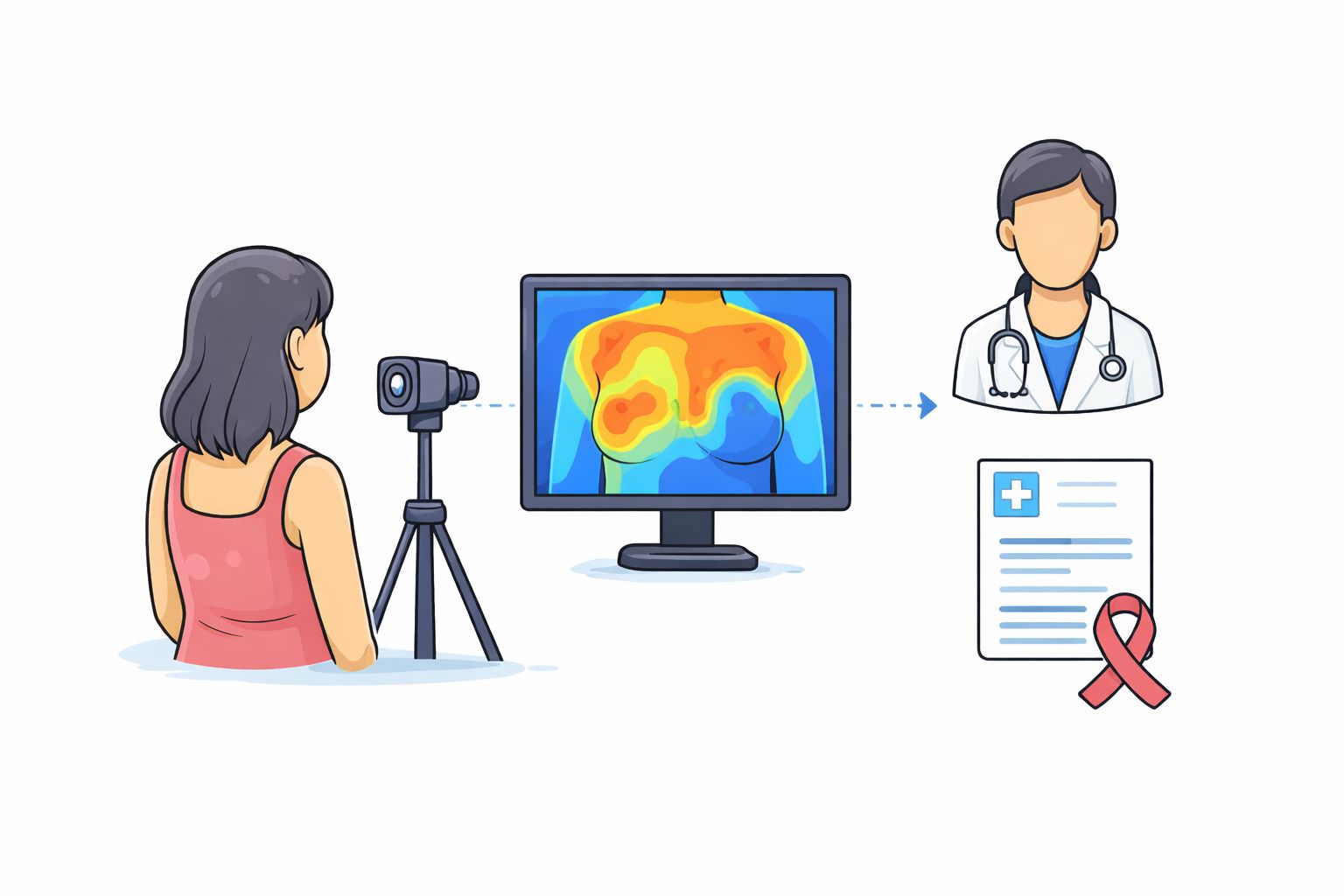
NIRAMAI captures these temperature patterns using a high-resolution thermal camera.
But capturing the image is only the first step. The system then uses artificial intelligence to analyse these thermal images. It studies hundreds of thousands of temperature points and identifies patterns that may indicate abnormalities. The output is a risk score and a report that helps doctors decide whether further investigation is needed.
What makes this different is how the process feels for the patient:
there is no radiation. there is no physical contact. there is no compression (unlike mammography). This makes the test easier to adopt, especially in large screening camps and rural settings.
How the system works
The workflow is designed for simplicity. A woman sits in front of a thermal camera. Images are captured in a controlled environment. These images are uploaded to the cloud, where AI models analyse them. Within minutes, a report is generated.
This report can be used in two ways: as a triage tool in screening camps and
as a diagnostic support tool in hospitals.
NIRAMAI has built multiple versions of the system: a portable unit for camps and a compact device for clinics and a more detailed setup for hospitals. This flexibility allows it to operate across very different environments.
What changes after deployment
Before systems like NIRAMAI, screening often depends on access to specialised equipment and trained radiologists. After deployment, screening becomes more accessible. Large groups of women can be screened quickly in community settings. Early risk signals can be identified without waiting for symptoms.
This changes the timing of detection. Instead of detecting cancer after a lump appears, the system aims to detect abnormalities years earlier. That shift—from late detection to early risk identification—is where the impact lies.
Funding and growth
NIRAMAI has raised funding across multiple rounds since its founding. It began with a seed round backed by investors like pi Ventures, Ankur Capital, Axilor Ventures, and Binny Bansal. In 2019, it raised around $6 million in a Series A round led by Dream Incubator, with participation from BEENEXT and others.
Overall funding estimates vary depending on sources, ranging from around $6 million to over $14 million including grants and institutional backing.
The company has also received support from global organisations like the Bill & Melinda Gates Foundation and CDC UK for research and pilots. This mix of venture and institutional funding reflects both commercial and public health interest.
Pilots, deployments, and performance
NIRAMAI has conducted clinical trials and deployments across hospitals and screening programs. Early deployments included installations in over 20 hospitals and diagnostic centres across multiple Indian cities.
The system has been used to screen thousands of women, with strong validation results presented in international forums. In terms of performance, AI models used by NIRAMAI have achieved accuracy levels around 90% in identifying abnormalities.
The company has also expanded into adjacent use cases, such as its FeverTest solution during COVID-19, which used thermal imaging and AI to screen for symptoms in public spaces. Another important milestone is regulatory validation. NIRAMAI has received US FDA clearance and European CE certification for its products, enabling global expansion.
What makes the approach unique
Several elements differentiate NIRAMAI from traditional screening systems.
First, it is non-invasive and non-contact. This removes a major barrier for many women. Second, it is radiation-free, making it safer for repeated screening. Third, it is portable. Unlike large imaging machines, it can be deployed in camps, clinics, and remote locations. Fourth, it uses AI-driven analysis rather than manual interpretation alone, reducing dependence on specialist radiologists. Fifth, it is designed for early detection, not just diagnosis. These factors combine to make screening more accessible and scalable.
The global landscape
NIRAMAI operates in the broader field of AI-based medical diagnostics. Globally, there are companies working on imaging-based diagnostics using AI—especially in radiology and pathology. However, many of these solutions still depend on traditional imaging methods.
NIRAMAI’s approach—using thermal imaging combined with AI—is relatively distinct. It is particularly relevant in regions where access to advanced imaging infrastructure is limited.
-Our correspondent